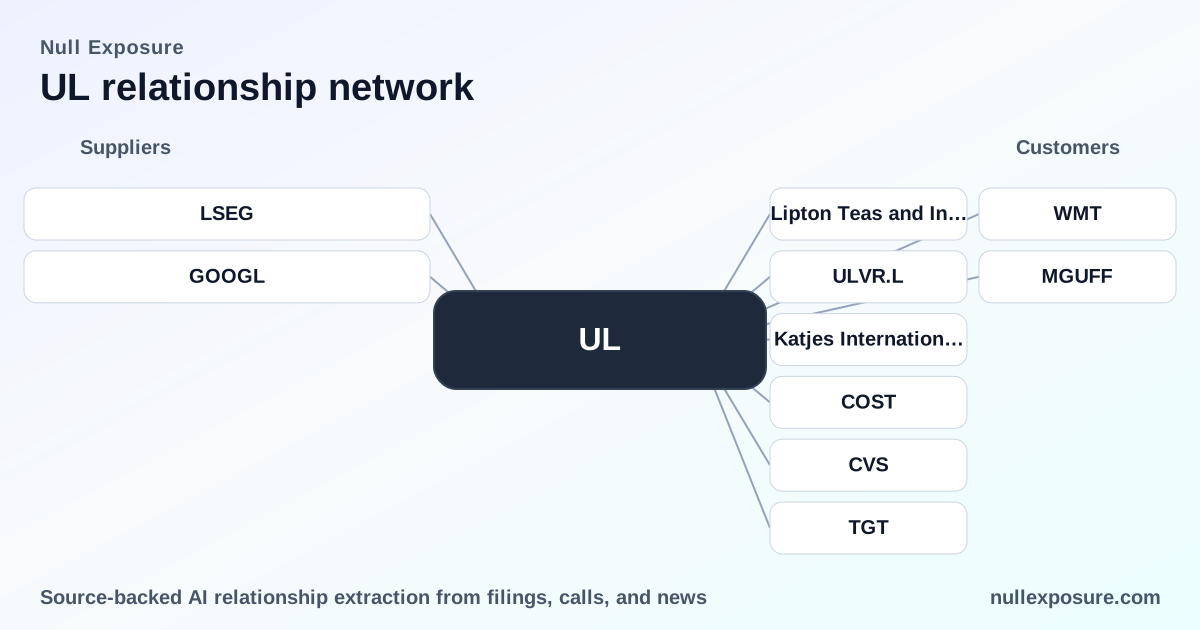
Unilever (UL) — Customer Relationships and Commercial Signals that Matter to Investors
Unilever monetizes a global portfolio of household and personal-care brands by manufacturing, marketing, and distributing branded goods across retail and direct channels; the company converts scale and brand equity into steady revenue (Revenue TTM: $50.5B) and healthy operating margins (~20%). Investors should treat Unilever as a consumer staples platform that derives cash from retail distribution agreements, transitional service fees tied to carve-outs, and periodic portfolio reshaping through divestitures and acquisitions. For researchers and operators tracking commercial counterparties, the relationship map below delivers the concrete partner and customer signals pulled from recent market coverage. Learn more about signal-driven corporate intelligence at https://nullexposure.com/.
How Unilever’s commercial model drives predictability — and where risk concentrates
Unilever’s operating model is distribution- and retail-dependent: branded revenues are realized when major grocers, club retailers, e-commerce marketplaces, and regional licensees place orders and stock shelves. This produces a contracting posture characterized by volume-based, long-standing vendor agreements with large retailers, supplemented by short- to medium-term transitional service agreements (TSAs) when brands are sold or spun out. The business shows low counterparty concentration at the customer level (Unilever sells into hundreds of retail partners), but high brand concentration at the product level — a small set of global brands deliver a disproportionate share of margin. Portfolio transactions (sales of brands, acquisitions of niche players) create recurring but bounded service revenues (TSAs) and occasional lump-sum proceeds that change cash-flow profiles and require integration or separation execution.
Constraints data in the records returned no explicit contractual constraints or binding operational caveats. Treat this absence as a company-level signal: no discrete, named counterparty constraints were captured in the reviewed sources, so investor focus should remain on observable commercial actions (divestments, TSA cash flows, retailer placements) rather than on documented supplier-side limitations.
What the coverage actually shows — relationship-by-relationship review
Below are the individual counterparties and commercial mentions surfaced in recent coverage, with plain-English summaries and source citations for each entry.
-
FLUX
Flux reported that it “recently received UL EE listing across our entire material handling portfolio of products,” signaling Unilever’s listing decision for a Flux product family in Unilever’s material handling operations. This is recorded in an earnings-call transcript cited by InsiderMonkey (March 2026). Source: InsiderMonkey earnings-call transcript (Mar 9, 2026). -
Lipton Teas and Infusions (formerly Ekaterra)
Unilever Nigeria recorded N842 million in 2025 receipts from a Transitional Service Agreement with Lipton Teas and Infusions, up from N194 million in 2024, indicating continued TSA revenue streams after brand divestment. Source: BusinessDay Nigeria report on Unilever Nigeria (Mar 2026). -
McCormick & Co. (MKC / MKC-V references)
Multiple outlets reported that Unilever is in discussions with McCormick over a potential sale of its foods division — a strategic transaction that would materially reshape Unilever’s exposure to packaged foods and related retail relationships. Source: Bloomberg coverage cited by DrugstoreNews and Yahoo Finance (May 2026). -
ULVR.L (Unilever Indonesia / SariWangi mention)
Coverage noted Unilever Indonesia agreed to sell its SariWangi tea business for roughly 1.5 trillion rupiah (~$89M) to an affiliate of the Djarum Group. This confirms ongoing regional brand exits and localized portfolio rationalization. Source: TS2.tech summary referencing the Indonesian sale (Mar 2026). -
Savoria Kreasi Rasa
The buyer in the SariWangi transaction, Savoria Kreasi Rasa (Djarum affiliate), is documented as the acquirer of Unilever Indonesia’s SariWangi brand; the deal highlights how local strategic buyers are taking on formerly global Unilever labels. Source: TS2.tech report on the SariWangi sale (Mar 2026). -
Katjes International
Unilever announced the sale of Graze to Katjes International (placement into the Candy Kittens group in the UK) as part of portfolio reshaping; financial terms were undisclosed, demonstrating selective carve-outs of non-core snacking brands. Source: TS2.tech / Dec 1, 2025 transaction announcement summarized in coverage (Dec 2025–Mar 2026 summaries). -
Walmart
Unilever products continue to be carried by major mass retailers; Walmart is explicitly named among mainstream U.S. retailers distributing recently-acquired Grüns supplements, illustrating the company’s persistent access to national retail channels. Source: Just-Food coverage on the Grüns acquisition (May 2026). -
Amazon
Online marketplace Amazon is listed as a U.S. channel for Grüns supplements following Unilever’s acquisition of the brand, underscoring the company’s omnichannel distribution strategy. Source: Just-Food article on Grüns (May 2026). -
Costco
Costco is similarly cited as a national retail channel for recently acquired supplement brands, reinforcing Unilever’s placement in club retail formats. Source: Just-Food (May 2026). -
Target (TGT)
Target appears across coverage as a primary U.S. retail partner carrying Unilever brands, used by analysts to underscore the physical visibility of Unilever’s shelf presence for U.S. investors. Source: Ad-hoc-news investor note (Mar 2026). -
CVS
CVS is included in retailer lists that demonstrate Unilever’s penetration into pharmacy and health-and-beauty retail channels. Source: Ad-hoc-news investor commentary (Mar 2026). -
Kraft Heinz (KHC)
Reports indicate Unilever held dialogues with Kraft Heinz over potential merger combinations of portions of their food businesses, though such talks reportedly ended; this highlights strategic bidder interest in Unilever’s food assets. Source: Yahoo Finance reporting on corporate discussions (May 2026). -
Boxed.com
Boxed.com partnered with Unilever on a Giving Tuesday program to deliver everyday essentials to women’s shelters, indicating use of online club retailers for CSR-led distribution initiatives. Source: DrugstoreNews coverage (May 2026). -
Magnum (MGUFF / MGUFF references)
During earnings call coverage, analysts questioned the magnitude of TSA receipts from Magnum, signaling that Unilever expects transitional service fee flows from recently spun or sold entities such as Magnum. Source: InsiderMonkey Q4 2025 earnings-call transcript (Mar 2026).
Investment implications and operational risks for investors and operators
- Revenue diversification is real but not unlimited. Unilever’s exposure to mass retail and e-commerce creates stable shelf presence, while brand sales and TSAs create episodic service revenue and reduce ongoing operational complexity.
- Portfolio reshaping is a strategic lever. The McCormick discussions and multiple brand disposals show management is actively pruning or reconfiguring the foods portfolio; M&A outcomes will materially affect future revenue composition.
- Retail execution remains critical. Continued placement in Walmart, Target, Costco, Amazon and CVS supports volume predictability, but these relationships are operationally critical for point-of-sale distribution and margin capture.
- TSA receipts are an earnings cadence to monitor. Public references to TSA receipts from Lipton and Magnum indicate a modest but visible revenue stream in periods of transition; investors should track disclosure on TSA timing and quantum.
For a focused feed of commercial signals and relationship mapping that supports due diligence and counterparty monitoring, visit https://nullexposure.com/.
Bottom line
Unilever combines global brand scale with active portfolio management; investors should weight the stability of retail distribution against the near-term earnings variability introduced by divestments and TSA flows. The relationships documented in public coverage demonstrate both the company’s deep retail access and an ongoing program of brand rationalization that will determine the next phase of revenue mix and margin profile.