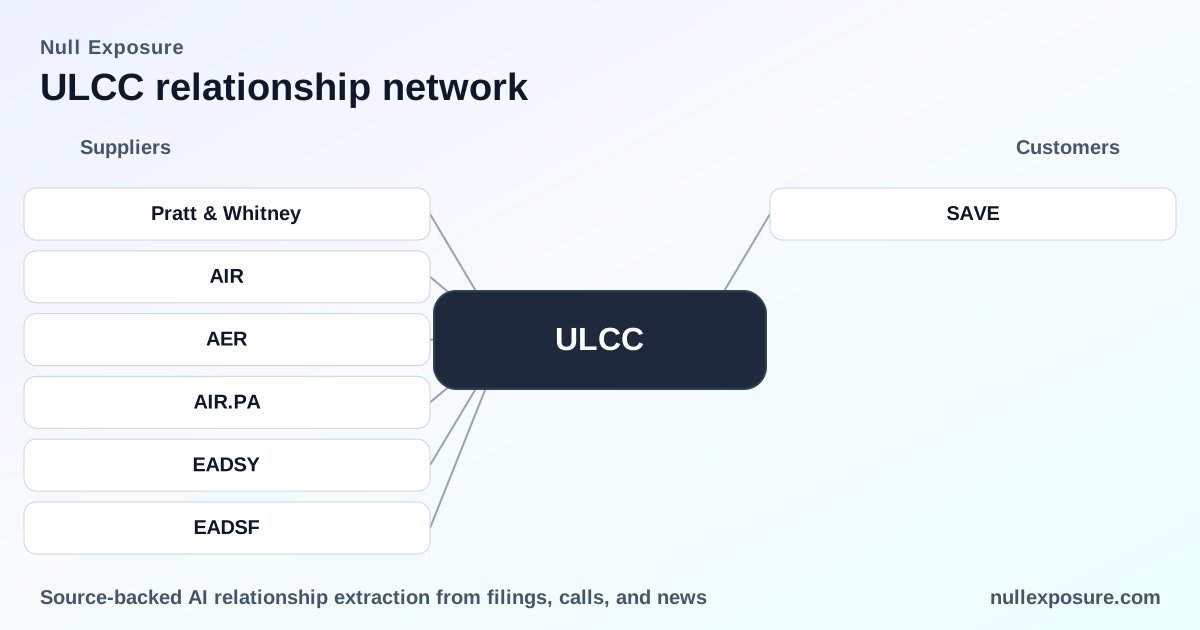
Frontier Group Holdings (ULCC): Customer Relationships and Competitive Positioning
Frontier is a low-fare passenger carrier that monetizes air travel through direct ticket sales, ancillary fees, and targeted route deployment across North America and near-international markets. The company operates as a single business unit focused on leisure traffic, sells a large majority of tickets through direct channels, and seeks growth by backfilling capacity vacated by peers while expanding selectively into adjacent geographies. For a structured view of counterparties and customer signals, see https://nullexposure.com/.
Investment thesis up front
Frontier’s economics rely on scale in short- and medium-haul markets, aggressive unit-cost management, and ancillary revenue capture. With revenue of roughly $3.72 billion TTM and negative EBITDA in the most recent reporting period, the firm is in a recovery and growth posture where route selection and competitor exits directly influence load factors and pricing power. Customer concentration is retail leisure travelers served primarily in North America, and the company’s distribution posture (≈72% direct sales) both preserves margin and increases sensitivity to brand and digital platform performance.
How Frontier actually sells and makes money
Frontier’s revenue mix and sales channels explain both resilience and vulnerability. The company:
- Sells primarily to individual leisure travelers, with management describing the business as focused on low-fare passenger transport to that segment; this is the company’s core customer base.
- Relies on direct distribution, with approximately 71.6–71.7% of tickets sold via flyfrontier.com, its mobile app and contact centers—this is the primary booking funnel and margin engine.
- Operates chiefly in North America, with domestic revenue comprising the large majority of operating income and Latin America representing a modest portion.
These operating characteristics create a contracting posture where Frontier is a direct seller to consumers, concentrated geographically, and structurally dependent on digital channels and leisure demand.
What management is saying about competitors and route opportunity
On the 2025 Q4 earnings call (March 7, 2026), management discussed capacity opportunity resulting from competitor exits and regional repositioning. That commentary signals an active network strategy: backfilling vacated routes and selectively entering geographies where leisure demand and unit economics align. According to the call, management specifically referenced opportunities created by Spirit Airlines’ network changes as part of this effort.
Every customer/competitor relationship cited on the record
Spirit Airlines — opportunistic network expansion
Management asked whether Frontier’s growth is “simply going to be backfilling the space vacated by Spirit,” indicating an explicit strategic opportunity to take routes or frequencies left open after Spirit’s network adjustments. This is a direct competitor dynamic and a source of near-term route growth if Frontier can secure slots and obtain favorable unit economics. (Source: Frontier 2025 Q4 earnings call, March 7, 2026.)
SAVE — same actor referenced in conversation
The transcript also references SAVE (Spirit’s public ticker) in identical language about backfilling space vacated by Spirit, reinforcing that management is anchoring near-term expansion planning to competitor capacity exits attributed to Spirit/SAVE. The double mention underscores the strategic relevance of this competitor’s network moves to Frontier’s route planning. (Source: Frontier 2025 Q4 earnings call, March 7, 2026.)
Operating constraints and what they imply for customer relationships
Frontier’s corporate disclosures and the constraint signals on customer relationships highlight structural drivers and risks:
-
Counterparty type: individual. Frontier’s primary customer is the retail leisure traveler, making its revenue profile highly sensitive to consumer sentiment, seasonality, and discretionary travel trends. This concentration reduces negotiation leverage with buyers but increases the value of brand, pricing agility, and ancillary product design. (Company disclosure on customer mix.)
-
Geography: North America-centric. Operating revenues by region show the U.S. as the dominant market (Domestic ~$3,565m vs. Latin America ~$210m for fiscal 2024), so Frontier’s demand and regulatory exposure are heavily U.S.-focused. Network disruptions or domestic demand shocks disproportionately affect performance. (Company filing: Year ended December 31, 2024.)
-
Relationship role: seller. Frontier is primarily a seller of air travel through direct channels—its website, app and contact centers accounted for roughly 71.6–71.7% of ticket sales in 2023–2024—so distribution control is a competitive advantage but also a single point of operational dependency. Any digital-channel interruption or reputational hit translates directly to sales and margin effects. (Company disclosure of sales channels.)
-
Segment: core product focus. The business is managed as a single unit offering low-fare passenger service to leisure travelers; ancillary products are additive but the airline’s economics hinge on core seat sales and route optimization. This single-segment management simplifies operations but concentrates downside risk if leisure travel weakens. (Company management description.)
Taken together, these constraints describe a business that is operationally simple but strategically sensitive: route wins created by competitors are high-impact, and Frontier’s direct-sell model amplifies both upside (higher ancillaries, better margin capture) and downside (customer acquisition and retention risk).
Key investment implications and risk factors
- Upside from competitor exits is tangible and actionable. Management’s explicit focus on backfilling routes from Spirit/SAVE creates near-term capacity growth options that can lift load factors and revenue if executed economically. (Earnings call commentary, March 7, 2026.)
- Margin recovery requires execution on ancillary sales and unit costs. Revenue above $3.72B TTM with negative EBITDA demonstrates the path to profitability is dependent on steady yield management and cost discipline.
- Concentration in North America and retail leisure creates cyclical exposure. Domestic demand swings, slot constraints, or adverse regulatory actions in key hubs carry outsized effects.
- Direct distribution is a strategic asset and a single point of failure. With ~72% of tickets sold directly, UX, pricing engines and digital reliability are critical operational control points.
Bottom line and where to look next
Frontier’s strategy is clear: operate low-cost routes for leisure traffic, capture ancillary revenue via direct channels, and opportunistically pick up capacity vacated by rivals such as Spirit. For investors and operators assessing customer relationships, the important signals are Frontier’s geographic concentration, reliance on individuals as customers, and the company’s explicit route-play response to competitor moves.
For a consolidated view of counterparties and to track how these relationships evolve in future filings and calls, visit https://nullexposure.com/.
Bold takeaway: Frontier’s immediate revenue leverage will come from tactical route additions sourced from competitor capacity exits, but sustained margin restoration requires continued direct-channel strength and disciplined unit-cost execution.