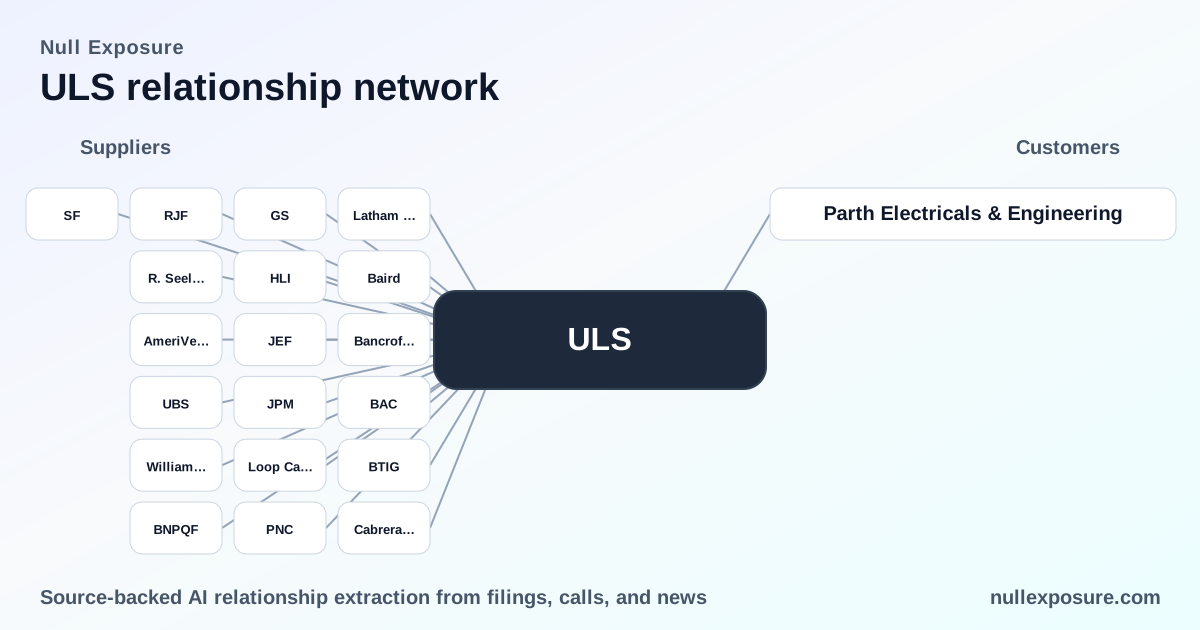
UL Solutions (ULS): Customer Relationships Drive Recurring, High-Margin Safety Services
Thesis — UL Solutions monetizes a dual revenue stream: third‑party testing, inspection and certification (TIC) services that generate recurring, inspection-driven cash flows, and software/licensing subscriptions and advisory that scale gross margins and embed customers long term. The business combines measurable, transaction-based fees from certifications with subscription/licensing stickiness, producing predictable revenue and above‑average profitability for the TIC sector.
Learn more about how we surface counterparty and contract signals at https://nullexposure.com/
Why customers matter for the investment case
UL Solutions is not a simple vendor: it is a regulatory gatekeeper. Certification status directly affects customers’ ability to sell products, and software tools help manage compliance and supply‑chain transparency. That mix creates meaningful recurring revenue, limited customer churn for certified products, and a portfolio exposed to global manufacturing trends. At the same time, the company’s exposure to regions such as APAC — particularly China — creates geographic concentration risk that investors must price into multiples and growth assumptions.
What the relationship signals collectively indicate about operating model
- Contracting posture — recurring and license-based: The firm explicitly sells SaaS and license-based software alongside inspection and certification services, indicating a hybrid model of recurring subscription revenue plus per‑inspection fees that are often contractually recurrent.
- Concentration and geography — global but APAC‑heavy: Revenue is global with significant exposure to North America, APAC and EMEA; historical commentary highlights meaningful revenue from China, so regional cycles in APAC materially affect growth.
- Criticality and switching costs — high: The services are often critical to customers’ ability to place products on market, implying high customer dependence and durable cash flow from certification renewals and mandatory inspections.
- Maturity and segmentation — diversified across services and software: UL operates both a large services business (TIC) and a growing Software & Advisory segment, providing both defensive cash flow and higher‑margin software growth optionality.
- Counterparty mix — limited government revenue but higher compliance burden if present: Government contracts exist but are a limited portion of revenue; such contracts can increase compliance costs when present.
These signals justify a valuation premium relative to commodity testing names but require vigilance on regional demand cyclicality and the competitive landscape for robot/smart‑device certifications.
Customer relationships investigated
UL Solutions’ public footprint in the news reveals a small set of named counterparties reflecting certification and divestiture activity. Below are concise, plain‑English summaries of each relationship disclosed in the public record.
Peak Rock Capital — buyer of UL’s Employee Health & Safety software business
UL sold its Employee Health and Safety software business to Peak Rock Capital, indicating selective portfolio pruning and a focus on core TIC and S&A offerings; the divestiture suggests management is optimizing capital allocation toward higher strategic priorities. A SahmCapital commentary noted the sale during FY2026 reporting and related valuation discussion in April 2026. (SahmCapital, April 2026)
Simbe — first public‑facing robot safety certification (Tally)
UL granted its first safety certification for Simbe’s Tally autonomous shelf‑scanning robot under the UL 3300 standard, demonstrating UL’s role in certifying emergent robotics platforms for public environments and reinforcing its market position in robotics safety. This milestone was reported by Investing.com and referenced in multiple May 2026 news pieces. (Investing.com, May 2026; Finviz, May 2026)
Parth Electricals & Engineering — UL approval for a U.S. dispatch
Parth Electricals & Engineering received UL approval for a $1.2 million dispatch to the U.S., illustrating UL’s routine commercial certification work that enables international shipments to meet U.S. safety standards and directly supports revenues for product certification services. MarketScreener covered this regulatory approval in March 2026. (MarketScreener, March 2026)
NWPX (North American product brand) — UL 508A certification for park products
NWPX Infrastructure achieved UL 508A certification for several park products, signifying UL’s technical testing and electrical safety verification role for industrial control panels and related equipment; such certifications typically require verification of component selection, conductor sizing, short‑circuit ratings and labeling. Coverage appeared in November 2025 across sector news outlets. (Quantisnow, November 2025; SahmCapital republication, November 2025)
How these relationships map to business risk and value creation
Each named relationship illustrates a different revenue vector:
- Portfolio optimization and M&A: The sale to Peak Rock shows UL is actively reshaping its software holdings to sharpen focus; that can free capital for core lab expansion or software investment.
- Adjacency growth in robotics and new mobility: The Simbe certification is a signaling event — UL is establishing precedents in certifying autonomous, public‑facing robots, which positions it to capture growth as robotics move into retail and public environments.
- Transactional certification economics: Accounts like Parth and NWPX reflect the staple TIC revenue model — one‑off or recurring product approvals that underpin steady, inspection‑driven cash flows.
Investors should treat these customer mentions as representative micro‑signals: they confirm UL’s active role across traditional industrial controls, new mobility robotics, and transactional certification markets rather than altering the firm’s overall revenue mix overnight.
Key takeaways for investors and operators
- Revenue durability is high because certification and mandatory inspections create repeatable demand and stickiness for customers who rely on UL marks to access markets.
- Software/licensing expands margin optionality, offering predictable, subscriptionlike revenue that complements the homogenously priced TIC business.
- Geographic concentration matters: APAC exposure, especially China, is a growth lever but also a cyclicality and geopolitical risk that should be reflected in scenario analysis.
- Strategic focus is active: divestitures and new certification milestones show management is executing a portfolio strategy that prioritizes core TIC and high‑value S&A growth.
If you want structured counterparty intelligence and contract signals that feed valuation and risk models, explore full coverage at https://nullexposure.com/
Final read — investment implications
UL Solutions combines defensive, regulation‑driven revenue with selective software scaling to deliver a resilient growth profile. The named customer relationships validate UL’s position across legacy industrial certifications and emerging robotics safety. For investors, the question is allocation versus cyclicality: pay up for durable cash flows and strategic software optionality, but discount for APAC concentration and execution risk in converting certification leadership into faster S&A growth.
For deeper diligence and a systematic view of counterparties across your portfolio, visit https://nullexposure.com/