Ulta Beauty (ULTA): Customer Relationships, Operating Constraints, and Investment Implications
Ulta Beauty operates the largest specialty beauty retail platform in the United States, monetizing through retail merchandise sales, e‑commerce, and in‑store salon services, reinforced by a 44.6 million‑member loyalty program that drives repeat purchasing and customer data capture. The company recognizes revenue at the point of sale or on shipment/pickup for e‑commerce, positioning Ulta as a high‑frequency transactional retailer with significant recurring customer engagement and strong domestic revenue concentration. For a concise, enterprise‑grade map of customer links and implications, visit https://nullexposure.com/.
Recent reported customer relationships you should track
Below are all customer relationship mentions surfaced in public reporting for FY2026. Each entry is summarized in plain English with the original reporting cited.
NIQ — data‑sharing collaboration
Ulta will share transactional sales data with NIQ to support NIQ’s Full View™ of the beauty channel, improving omnichannel measurement across prestige and mass beauty and wellness. This is positioned as a strategic data‑sharing agreement announced in a BizWire press release on April 30, 2026 (NIQ / Ulta press release: https://markets.financialcontent.com/stocks/article/bizwire-2026-4-30-niq-and-ulta-beauty-announce-strategic-data-sharing-collaboration).
Target — analyst commentary on partnership loss risk (May 2026)
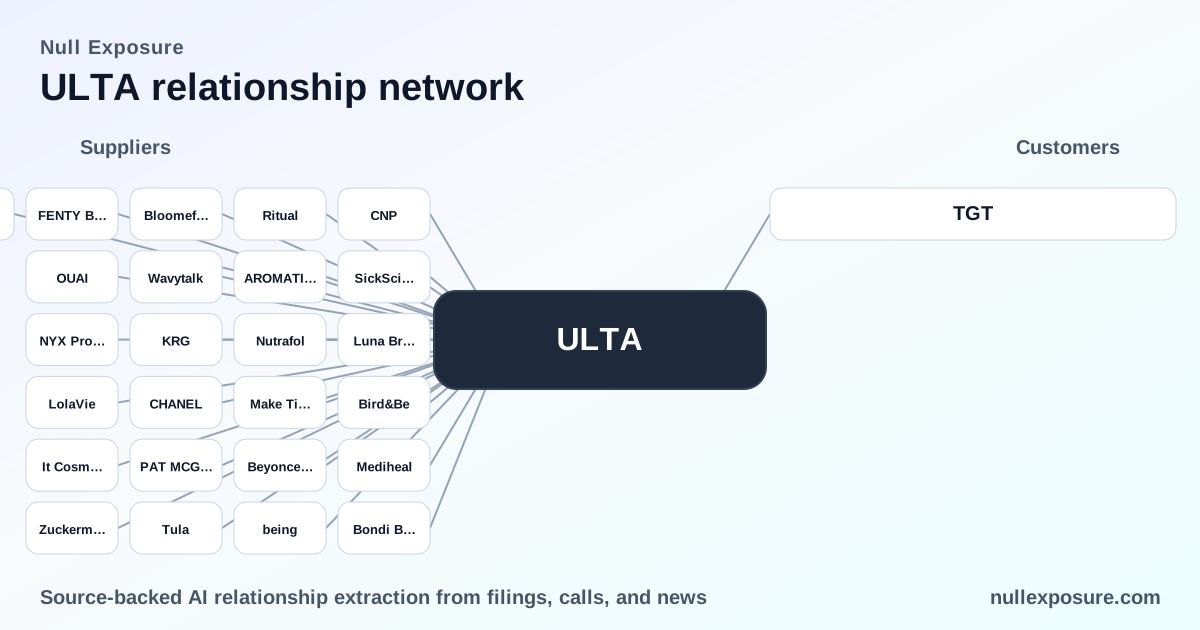
Analysts highlighted the potential loss of Ulta’s partnership with Target as a material competitive and revenue risk while also noting international expansion as a growth avenue; commentary was published May 4, 2026 on Simply Wall St assessing Ulta’s outlook (Simply Wall St analysis: https://simplywall.st/stocks/us/retail/nasdaq-ulta/ulta-beauty/news/is-it-too-late-to-consider-ulta-beauty-ulta-after-a-51-one-y).
Target — valuation update noting partnership exposure (March 2026)
An earlier Simply Wall St piece reiterated the same risk: analysts updated fair‑value estimates while explicitly calling out rising costs, intense competition, and potential Target partnership loss as downside drivers (Simply Wall St valuation note, March 10, 2026: https://simplywall.st/stocks/us/retail/nasdaq-ulta/ulta-beauty/news/is-it-too-late-to-consider-ulta-beauty-ulta-after-its-84-one/amp).
TGT (duplicate reporting) — same Target risk captured under ticker symbol
The same March 10, 2026 analysis is also indexed under the TGT tag, again flagging Target partnership exposure among key analyst concerns (Simply Wall St, March 10, 2026: https://simplywall.st/stocks/us/retail/nasdaq-ulta/ulta-beauty/news/is-it-too-late-to-consider-ulta-beauty-ulta-after-its-84-one/amp).
How these relationships map to Ulta’s operating model and business constraints
The public information and company disclosures establish a clear picture of Ulta’s relationship economics and operating posture:
- Contracting posture — transactional/spot sales. Revenue recognition at point of sale and on e‑commerce shipment indicates predominantly spot transactions with customers rather than long‑term contractual revenue streams. This elevates sensitivity to foot traffic, conversion rates, and same‑store sales trends.
- Counterparty type — individuals (consumers). Ulta sells primarily to individual beauty consumers, not large corporate customers, making the business consumer‑behavior dependent, driven by brand mix, promotions, loyalty incentives, and service frequency.
- Geography — concentrated in North America (U.S.). The company generates the vast majority of net sales and long‑lived assets in the United States, creating geographic concentration risk but also deep domestic market scale and operating leverage.
- Roles — seller and service provider. Ulta’s core offering is retail merchandise (approximately 29,000 products across ~600 brands) combined with in‑store salon and beauty services, creating a hybrid retail‑services margin profile that blends merchandise gross margins with service revenue per visit.
- Relationship stage — active, loyalty‑driven. With more than 95% of sales coming from 44.6 million active Rewards members, Ulta’s customer relationships are highly active and data‑rich, giving the company direct marketing leverage and a recurring revenue signal.
- Segments — core product and services. Financials separate merchandise and salon services; both are material to sales and require distinct operational management (inventory and supplier relations for products; labor and scheduling for services).
These company‑level constraints imply an operating model that is transactional but loyalty‑amplified, dependent on in‑store experience and brand assortment, and vulnerable to shifts in consumer traffic or changes in large distribution partnerships.
What investors should take from the relationship set
- Data partnerships like NIQ strengthen measurement and brand economics. The NIQ collaboration improves Ulta’s visibility into omnichannel performance, which supports better assortment, pricing, and vendor negotiation. (NIQ press release, April 30, 2026: https://markets.financialcontent.com/stocks/article/bizwire-2026-4-30-niq-and-ulta-beauty-announce-strategic-data-sharing-collaboration)
- Loss or weakening of national distribution partners is a meaningful downside risk. Multiple analyst notes flagged Target as a potential partnership loss that would increase competitive pressure and revenue volatility (Simply Wall St, March–May 2026: https://simplywall.st/stocks/us/retail/nasdaq-ulta/ulta-beauty/news/is-it-too-late-to-consider-ulta-beauty-ulta-after-its-84-one/amp; https://simplywall.st/stocks/us/retail/nasdaq-ulta/ulta-beauty/news/is-it-too-late-to-consider-ulta-beauty-ulta-after-a-51-one-y).
- Domestic concentration amplifies macro exposure. Strong U.S. concentration means macro weakness, inflation in operating costs, or changes in discretionary spending will directly pressure Ulta’s top line and margins; this theme underpins several analyst concerns cited in March–May 2026 commentary.
- Loyalty membership is a strategic moat but requires activation. The large Rewards base delivers high share of wallet; continued monetization depends on product assortment, in‑store experience, and digital conversion.
- Operational complexity is multi‑dimensional. Managing inventory across 29,000 SKUs and coordinating salon labor across thousands of salons creates execution risk distinct from pure goods retail.
If you want a consolidated, machine‑grade customer relationship map and risk scoring, explore the enterprise view at https://nullexposure.com/ — it provides the same relationship coverage with normalized signals for portfolio monitoring.
Investment conclusion — what to watch next
For investors and operators evaluating Ulta’s customer relationships, prioritize monitoring three levers over the next 12 months:
- Partnership status and distribution changes (Target commentary is already a visible analyst risk).
- Loyalty engagement and spend per active Rewards member, which drives recurring revenue and margin stability.
- Execution on omnichannel measurement and assortment optimization enabled by data partnerships such as the NIQ collaboration.
Ulta’s business combines resilient consumer engagement and attractive unit economics with concentrated geographic exposure and spot transactional revenue; the investment case rests on execution — preserving distribution channels, monetizing the Rewards base, and maintaining product/service quality amid rising costs. For detailed relationship matrices and ongoing monitoring, visit https://nullexposure.com/.