ULTI’s Customer Footprint: Enterprise payroll as a recurring, high‑stakes revenue stream
ULTI is a workforce‑management and payroll software provider that monetizes through recurring enterprise contracts for payroll, HR and timekeeping services. The company captures long‑duration revenue with significant switching costs by embedding payroll and benefits processing into clients’ day‑to‑day operations, and it derives pricing power from the mission‑critical nature of those services. For investors evaluating ULTI’s customer relationships, the core thesis is simple: customer concentration and operational criticality drive durable revenue, but also create acute operational and litigation risk if service continuity is disrupted.
Discover more coverage and customer intelligence at https://nullexposure.com/.
Why customers are the business: contracting posture, concentration and criticality
ULTI sells into large enterprises and public institutions under multi‑year agreements that are contractually sticky and operationally critical. Payroll and benefits processing are not optional line items; they are central to workforce continuity. That contracting posture produces dependable recurring revenue and high customer lifetime value, but it also means any outage or security failure produces immediate economic and reputational damage for both client and vendor. From a portfolio perspective, the company’s business model favors a small number of large customers over broad transactional volume, increasing both headline revenue visibility and concentration risk. Finally, ULTI’s offering sits on mature operational processes—clients expect incremental feature delivery, compliance updates, and high reliability rather than speculative product hype.
Customer roster, relationship notes and sources
Below are every customer relationship found in public reporting for ULTI in the assembled results, with a concise plain‑English takeaway and the original source.
-
Clemson University — Clemson is listed among U.S. clients that relied on the company’s payroll/time systems, demonstrating ULTI’s penetration into higher‑education institutions where payroll continuity is essential. Source: MarketRealist article on the Kronos ransomware incident (May 2026), https://marketrealist.com/p/kronos-ransomware-attack/.
-
Jaguar Land Rover — Jaguar Land Rover is cited as a U.K. corporate customer, indicating the company’s footprint in automotive manufacturing where global payroll complexity and multi‑jurisdiction compliance matter. Source: MarketRealist (May 2026), https://marketrealist.com/p/kronos-ransomware-attack/.
-
Sainsbury’s (SBRY) — The Sainsbury’s supermarket chain is named as a U.K. customer, illustrating retail exposure and the operational scale required to service large point‑of‑sale and hourly workforces. Source: MarketRealist (May 2026), https://marketrealist.com/p/kronos-ransomware-attack/.
-
Santa Clara County — Santa Clara County appears as a U.S. public‑sector client, signifying ULTI’s role in government payroll and the associated expectations for data protection and continuity. Source: MarketRealist (May 2026), https://marketrealist.com/p/kronos-ransomware-attack/.
-
Winthrop University Hospital — Winthrop University Hospital is listed among healthcare clients, which underscores the vendor’s presence in health systems where payroll outages can have downstream effects on staffing and patient care. Source: MarketRealist (May 2026), https://marketrealist.com/p/kronos-ransomware-attack/.
-
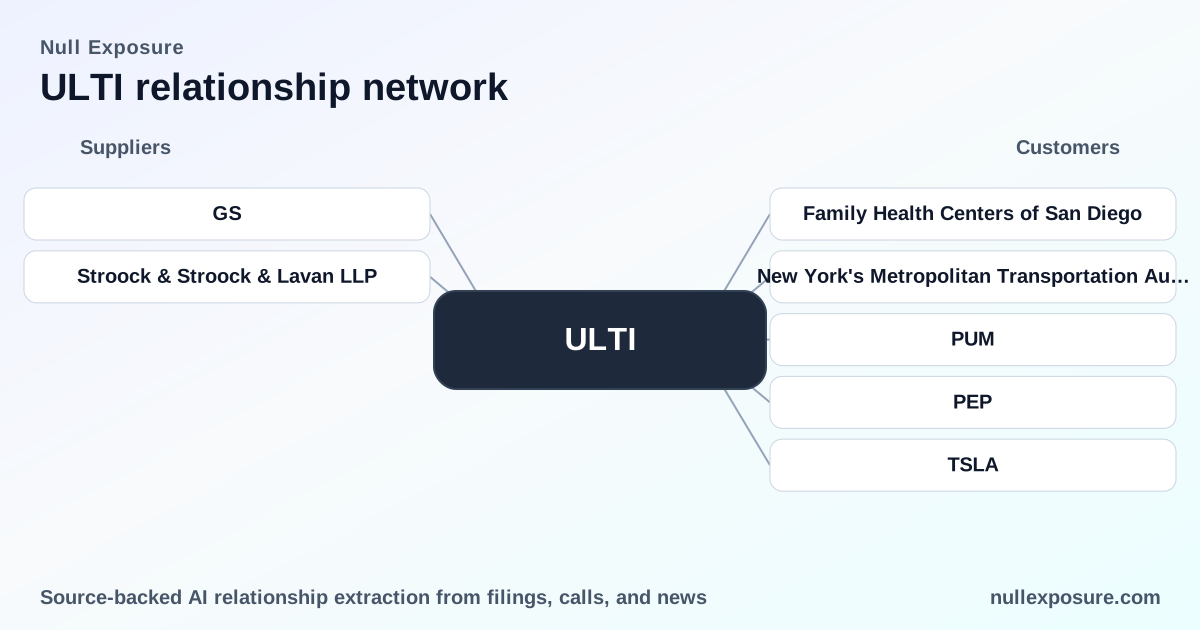
Family Health Centers of San Diego — A lawsuit filed in federal court referenced Family Health Centers of San Diego experiencing delayed paychecks for roughly 1,800 employees after the service disruption, highlighting direct operational and employee relations consequences for customers. Source: TechTarget reporting on the Kronos breach lawsuit (March 2026), https://www.techtarget.com/searchsecurity/news/252515029/Lawsuit-claims-Kronos-breach-exposed-data-for-millions.
-
New York’s Metropolitan Transportation Authority — The MTA was definitively notified that its information was stolen, a disclosure that illustrates the national‑scale data sensitivity of public‑transport clients. Source: TechTarget (March 2026), https://www.techtarget.com/searchsecurity/news/252515029/Lawsuit-claims-Kronos-breach-exposed-data-for-millions.
-
Puma (PUM) / Puma — Puma is named among organizations told their information was stolen, showing that global apparel brands with complex supply chains are part of the installed base. Source: TechTarget (March 2026), https://www.techtarget.com/searchsecurity/news/252515029/Lawsuit-claims-Kronos-breach-exposed-data-for-millions.
-
Adobe Systems Incorporated (ADBE) — Adobe is listed in a historical customer roster that highlights ULTI’s long track record serving large enterprise software and technology companies. Source: Yahoo press release coverage referencing Ultimate Software customers (February 2013), https://www.yahoo.com/2013-02-20-ultimate-software-earns-14th-consecutive-certifica.html.
-
Texas Roadhouse (TXRH) — Texas Roadhouse appears as a named customer, reflecting retail and restaurant sector penetration where hourly payroll and tip allocation increase processing complexity. Source: Yahoo (February 2013), https://www.yahoo.com/2013-02-20-ultimate-software-earns-14th-consecutive-certifica.html.
-
The New York Yankees Baseball Team — The Yankees are cited among long‑standing customers, providing a consumer‑facing example of specialty payroll needs in sports and entertainment. Source: Yahoo (February 2013), https://www.yahoo.com/2013-02-20-ultimate-software-earns-14th-consecutive-certifica.html.
-
Culligan International — Culligan International is included on ULTI’s historical client list, showing industrial and distribution customer types that use enterprise HR/payroll services. Source: Yahoo (February 2013), https://www.yahoo.com/2013-02-20-ultimate-software-earns-14th-consecutive-certifica.html.
-
Major League Baseball — MLB is a named client, underscoring the vendor’s reach into complex, multi‑entity payroll environments with seasonal and variable compensation. Source: Yahoo (February 2013), https://www.yahoo.com/2013-02-20-ultimate-software-earns-14th-consecutive-certifica.html.
-
Pep Boys (PBY) — Pep Boys is listed as a customer in historical disclosures, representative of the automotive aftermarket and retail sectors. Source: Yahoo (February 2013), https://www.yahoo.com/2013-02-20-ultimate-software-earns-14th-consecutive-certifica.html.
-
Tesla (TSLA) / TSLA — Tesla employees were part of litigation referenced in reporting about payroll outages, indicating exposure to high‑profile technology manufacturers affected by service interruptions. Source: TechTarget (March 2026), https://www.techtarget.com/searchsecurity/news/252515029/Lawsuit-claims-Kronos-breach-exposed-data-for-millions.
-
PepsiCo (PEP) / PEP — PepsiCo is mentioned in lawsuits alleging misuse of employee information and phishing following the breach, pointing to consumer goods customers with large global workforces. Source: TechTarget (March 2026), https://www.techtarget.com/searchsecurity/news/252515029/Lawsuit-claims-Kronos-breach-exposed-data-for-millions.
What these relationships collectively tell investors
-
High operational criticality: ULTI’s customers include large public agencies, healthcare providers, retailers and global brands—sectors where payroll disruptions immediately translate into labor, legal and reputational costs. The relationship set validates payroll as a core mission for clients.
-
Concentration with scale: The roster shows a bias toward large, well‑known enterprises rather than a diffuse SMB base; that generates predictable ARR but concentrates downside risk when incidents occur.
-
Litigation and regulatory exposure: Multiple entries reference litigation and data‑theft notifications; customers can and will pursue legal remedies after outages, increasing contingent liabilities and reputational risk.
-
Mature commercial model: Historical customers from 2013 alongside 2026 breach reporting signal a long‑standing installed base with predictable renewal dynamics, but legacy footprints also raise modernization and migration cost issues.
Investment takeaways and actionables
-
Bull case: Stable recurring revenue from high‑stickiness contracts, diversified across private and public sectors, supports valuation premia when uptime and security metrics are demonstrable.
-
Risk case: Concentration among large clients and the obvious sensitivity of payroll data mean that security incidents and service outages are not hypothetical—they are central risk factors that affect earnings and can trigger litigation and client churn.
-
Next steps for due diligence: Request contract tenure, revenue concentration by top‑10 clients, SLA credit exposure, and a detailed incident‑response history. Institutional investors should triangulate those answers against the customer list above.
For a deeper signal set and to benchmark ULTI’s customer exposure against peers, visit https://nullexposure.com/.
Bold conclusion: ULTI’s customer base underpins durable recurring revenue but also anchors significant operational and litigation risk—investors must price both the revenue visibility and the asymmetric downside from service failures.