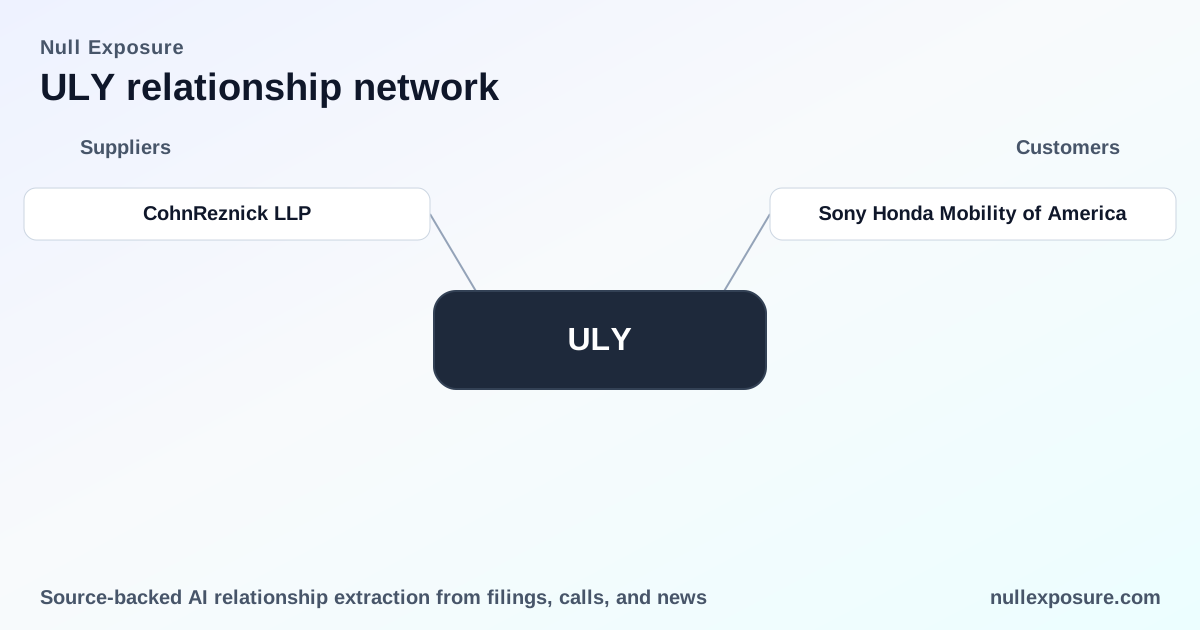
ULY Customer Relationships: What the Sony Honda Mobility Win Reveals About Scale and Risk
ULY operates a connected mobility assistance platform that matches vehicle owners with roadside-service providers and then invoices corporate partners through a mix of per-incident fees, SaaS/subscription charges and occasional term licenses. The company monetizes by contracting with OEMs, insurers and mobility brands to deliver nationwide roadside assistance and by capturing recurring platform revenue plus variable service margins on each event. For investors, the business combines highly repeatable, usage-driven cash flows with concentration-sensitive counterparty exposure. Learn more at https://nullexposure.com/.
Why the Sony Honda Mobility relationship matters in plain terms
ULY announced a commercial arrangement to provide nationwide coverage for Sony Honda Mobility of America’s Aphelio owners. This ties an emerging EV OEM to ULY’s national network and gives the company access to a brand-new installed base that will generate both recurring platform revenue and per-incident services as owners require assistance. According to ULY’s 2025 Q3 earnings call, the company referenced an October 7 press release announcing the partnership with Sony Honda Mobility of America, positioning ULY as the provider of coverage across all 50 states and D.C.
Key takeaway: the Sony Honda Mobility deal is a customer-win that strengthens ULY’s OEM roster and potentially increases per-incident volumes while reinforcing product-market fit with EV manufacturers.
How ULY structures contracts and captures revenue
ULY’s operating model combines several monetization levers:
- Multi-year customer contracts are the default commercial posture, with typical initial terms of three to five years and common automatic renewals for 12‑month periods. This underpins revenue visibility for enterprise partners.
- Subscription/SaaS revenue is recognized ratably over service terms (typically one year) for membership programs and cloud platform access, delivering a recurring base to complement event-driven fees.
- Usage-based pricing captures service economics on a per-event basis (per tow, per jump-start, etc.), aligning ULY’s revenue with actual roadside activity.
- Term licensing is occasional but available for customers that prefer access to the software platform under a licensing arrangement.
These contract characteristics are disclosed across the company’s filings covering 2024–2025, and they explain why ULY’s revenue profile blends predictable subscription flows with variable per-incident margins. The mix creates scale optionality as OEMs and insurers grow their fleets, but it also ties financial performance directly to underlying roadside volumes and partner retention.
Concentration, criticality and what that implies for investors
ULY’s customer concentration is a material factor. As of December 31, 2024, 49 active Customer Partners existed in North America, with the top three partners representing 56% of 2024 revenue and two or three customers accounting for 49% and 64% of revenue in 2024 and 2023, respectively. The company also disclosed an example where a Customer Partner representing roughly 25% of revenue in 2023 did not renew when a contract expired on January 31, 2024.
Investor implication: concentration drives both upside and downside — a small number of large OEM or insurer clients can accelerate topline growth quickly, but contract non-renewals or pricing pressure from any of those clients represent a near-term earnings risk.
Operational posture: platform provider and service manager
ULY functions both as a software provider and a service integrator. The platform routes consumer distress calls, manages the full service lifecycle, negotiates rates with subcontractors and delivers final disposition. The company describes its role as enabling customers to outsource “all or portions” of their roadside programs and typically executes non‑exclusive multi-year agreements.
From a go-to-market perspective, the company often brings new clients onboard through pilot programs, followed by multi-year contracts once the client validates performance. Renewals typically proceed through a request-for-proposal process, reinforcing a vendor-selection environment that requires consistent operational execution.
Where ULY operates and why geography matters
ULY’s revenues are concentrated in North America (United States and Canada) and the company has explicitly disclosed that it generates substantially all of its revenue from RAS (roadside assistance services) initiated through its platform in those markets. That regional concentration simplifies operational scale—one network and regulatory environment—but also concentrates macroeconomic and OEM-cycle exposure geographically.
All customer relationships disclosed in public records
- Sony Honda Mobility of America — ULY confirmed a contract to provide nationwide roadside coverage for Sony Honda Mobility’s Aphelio owners, enabling coverage across all 50 states and D.C.; this was disclosed in ULY’s 2025 Q3 earnings call and referenced an October 7 press release. (ULY 2025 Q3 earnings call)
This list reflects every customer relationship explicitly cited in the available results.
Constraints and company-level signals that shape the business model
Several corporate disclosures establish the operating constraints that define how ULY wins and retains customers:
- Contract tenors and renewal mechanics: Multi-year contracts (commonly three years, sometimes auto-renewing) create revenue visibility and typical negotiation cadence.
- Revenue mix: A meaningful share of revenue is subscription-based and recognized ratably, with substantial incremental revenue recognized on a per-incident basis tied to usage.
- Commercial role: ULY operates as both a seller of software and a service provider that manages execution through subcontractor networks.
- Customer maturity: New partners typically start with pilots and transition into multi-year agreements; existing agreements often follow formal RFP renewal processes.
- Geographic concentration: Substantially all revenue derives from the United States and Canada, concentrating market and regulatory exposure.
- Material customer concentration: Top customers materially influence results; historical non-renewals have produced sizable revenue movement.
These constraints come directly from company disclosures covering 2024–2025 and should be treated as structural features of the business rather than relationship-specific exceptions.
Bottom line for investors: growth levers vs. concentration risk
- Growth levers: OEM partnerships (such as Sony Honda Mobility) accelerate volume and provide a recurring base of SaaS and per-incident revenue; pilot-to-contract conversion gives a scalable customer-acquisition path.
- Risks: High revenue concentration and North American geographic focus create asymmetric downside if one or two large partners alter their procurement posture; variable service volumes also translate to earnings variability.
- Operational focus: Execution at scale—sustaining network reliability, contractor cost control and RFP-winning economics—determines margin expansion.
For a concise investor briefing and deeper customer analytics, visit https://nullexposure.com/.
Bold signal summary: ULY’s economics hinge on converting pilots into multi-year contracts, expanding per-incident volume from OEMs like Sony Honda Mobility, and managing concentration risk among a small set of large partners.