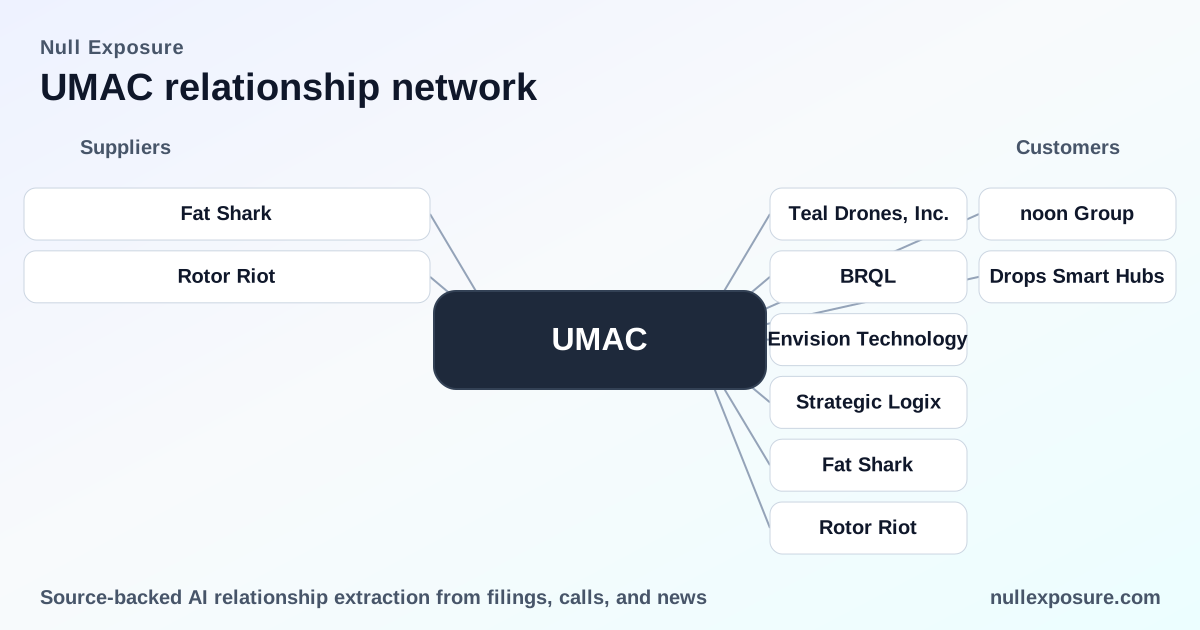
Unusual Machines (UMAC): customer map and what it means for investors
Unusual Machines sells NDAA-compliant drone motors, flight controllers, ESCs and finished FPV products through a hybrid channel mix of B2B component supply and curated retail (Rotor Riot / Fat Shark). The company monetizes by manufacturing proprietary components for commercial and defense-focused drone OEMs, retailing FPV hardware through owned ecommerce, and winning spot or program-based orders that convert to revenue at shipment. Revenue drivers are product sales (hardware) and program supply agreements to drone manufacturers and integrators; margin leverage depends on onshoring and higher-volume order flow.
For a quick deep-dive into UMAC’s customer-facing activity and contracts, see more at https://nullexposure.com/.
Key operating signals investors should care about
Unusual Machines’ customer footprint shows a blend of spot commercial orders, expanding enterprise engagements, and growing ties into U.S. defense channels. From the disclosed evidence we can read several firm-level characteristics:
- Contracting posture: largely spot and shipment-based recognition. The company recognizes sales when products ship and price is fixed, which implies revenue volatility linked to order timing rather than long-term recurring contracts.
- Customer mix: retail consumers, distributors and large enterprise OEMs. Evidence supports revenue from individual consumers and retail distributors plus a deliberate push into enterprise drone manufacturers.
- Government access: emerging, not dominant. Being on a federal purchasing framework enables orders from U.S. agencies, which increases addressable demand for NDAA-compliant components.
- Concentration and spend profile: program orders are typically mid-sized. The only disclosed contract values sit in the low-mid six-figure band (see Teal Drones/Red Cat excerpt), while other reported orders (Powerus) are larger (multi-million).
- Segment focus: hardware-first, services ancillary. The business is reported as a single reportable segment focused on FPV/hardware, while some service revenue exists via subcontracting and program support.
- Relationship maturity: active and expanding. Public disclosures show active supplier agreements and commercial rollouts in 2025–2026 that coincided with onshoring production and capacity expansion.
These signals shape valuation sensitivity to order cadence, onshoring execution, and the company’s ability to convert program wins into repeatable revenue.
Relationship roll‑call: who UMAC is selling to and supplying
Below are every counterpart referenced in UMAC’s customer results, with a concise investor‑oriented summary and a source note for each.
Teal Drones, Inc.
Unusual Machines acted as a subcontractor to Teal Drones (a Red Cat subsidiary) under a November 2024 purchase order and recognized $155,000 of related-party revenue in 2024, with the total related contract worth $250,000. This is an active, spot-sourced program that demonstrates the company’s role as a component/service supplier on prime contracts. (UMAC Form 10‑K, FY2024)
BrooQLy, Inc. (dba Dynamic Aerospace Systems / DAS) — listed as BRQL
UMAC entered a strategic supplier agreement to provide NDAA‑compliant flight controllers, ESCs, motors and subsystems for DAS’s Breacher counter‑UAS, Sentinel ISR platform and commercial programs, establishing immediate production use. This supplier arrangement positions UMAC as a named component source for both defense and commercial product lines. (Press release, March 10, 2026)
Red Cat Holdings (RCAT)
UMAC secured motor orders tied to Red Cat or its affiliates, a commercial OEM channel that drove market attention when the orders were announced. The RCAT orders illustrate UMAC’s pathway to OEM scale via motor supply agreements. (Market news / StockTwits coverage, March 10, 2026)
Envision Technology
UMAC publicly congratulated Envision Technology—one of its customers—after Envision was selected for the Army’s PBAS Tranche 1.1, indicating Envision’s procurement pipelines include UMAC components. This signals downstream capture of defense program suppliers. (Press release, March 10, 2026)
Strategic Logix
Strategic Logix was similarly named among customers selected for the Army PBAS tranche, reflecting UMAC’s component placement with integrators competing for attritable systems contracts. (Press release, March 10, 2026)
Rotor Riot
UMAC retails small acrobatic FPV drones and equipment through the Rotor Riot ecommerce store, representing the company’s direct‑to‑consumer retail channel and brand presence in FPV hobbyist markets. Retail sales through Rotor Riot diversify revenue beyond OEM components. (Company communications / press releases, 2026)
Powerus Global (Powerus)
UMAC reported a $5M+ order from Powerus for counter‑UAS systems, representing one of the larger single customer purchase announcements and showcasing the company’s ability to secure multi‑million program orders. This is a notable step up from mid‑six‑figure purchase levels. (Press release / Globe and Mail coverage, May 2026)
Fat Shark
UMAC began U.S. production of motors in November 2025 and commenced Fat Shark headset production in January 2026, adding second and third shifts to motor production during 2026; Fat Shark represents a branded product partnership and vertical manufacturing expansion. This underscores the company’s onshoring strategy translating into higher throughput for both component and finished goods. (TradingView and investor commentary, March–May 2026)
Lantronix (LTRX)
Lantronix and Unusual Machines partnered to integrate Lantronix edge AI compute modules with UMAC flight components—enabling autonomous navigation and mission execution for demanding defense and commercial use cases. This partnership increases product stickiness through integrated compute + flight subsystems. (GlobeNewswire / press releases, March–April 2026)
noon Group
As part of the BrooQLy/DAS agreement, UMAC components are designated for commercial deployments with the UAE’s noon Group, indicating international commercial channels for UMAC‑supplied platforms. This shows early non‑U.S. commercial adoption through OEM partners. (Press release, March 10, 2026)
Drops Smart Hubs
UMAC components are slated for use in Drops Smart Hubs’ Greece deployments via DAS commercial programs, extending UMAC’s customer reach into logistics/last‑mile drone applications. (Press release, March 10, 2026)
KOPN
An earnings call transcript referenced Unusual Machines as a manufacturer selling drones and components under brands like Fat Shark, illustrating market recognition of UMAC’s branded and OEM product lines within industry commentary. (Earnings call excerpt, 2025Q3)
How constraints shape the commercial thesis
- Spot revenue recognition makes quarterly top‑line lumpy; investors should model revenue as order‑driven rather than subscription-like recurring income. (Company revenue recognition policy cited in filings)
- Customer types span individuals to large enterprise and government, meaning demand is diversified across retail, OEM, and public sector channels—reducing single‑channel exposure but increasing execution complexity.
- Geography is primarily North America, anchored by the Orlando facility and Rotor Riot operations, so scaling international revenue depends on OEM partner exports rather than immediate branch presence.
- Role diversity (seller, distributor, service provider) indicates UMAC operates both as a product manufacturer and a supplier on prime contracts, which raises the importance of supply chain and prime‑contract relationships for revenue sustainability.
- Spend band signal: disclosed program values in the $100k–$1M range for specific contracts, with at least one multi‑million order reported (Powerus), implying a mix of small program wins and emerging larger program wins.
Note: the specific Teal Drones/Red Cat contract values and subcontractor role are explicitly disclosed in the Form 10‑K and therefore attributed to that relationship; other constraints above reflect company‑level signals derived from the body of disclosures.
Bottom line for investors
UMAC’s customer base is a deliberate mix of retail monetization and B2B/defense supply—this mix both diversifies channels and creates execution risk tied to program conversion and production scale. Key value drivers over the next 12–24 months include converting supplier agreements (BrooQLy, Powerus, Lantronix) into repeatable revenue, realizing unit‑cost benefits from onshoring, and expanding higher‑value program wins. For continued tracking of UMAC’s customer momentum and supplier agreements, visit https://nullexposure.com/ for updates and source summaries.