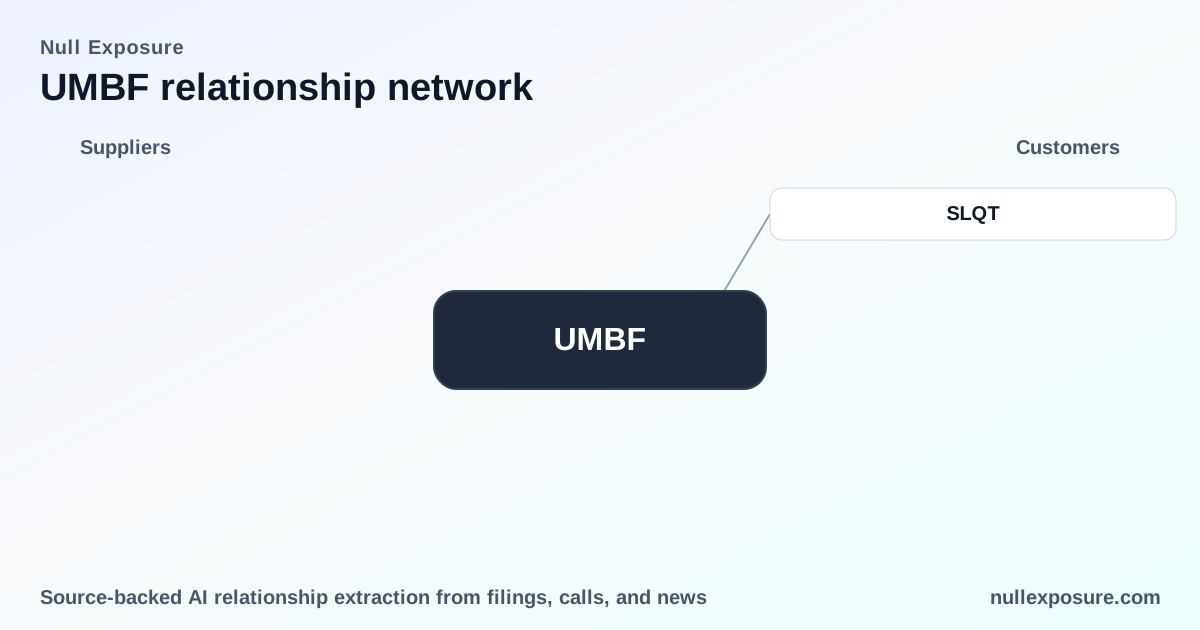
UMB Financial (UMBF): Fee‑based trust and commercial banking relationships that underpin a diversified funding and service franchise
UMB Financial operates as a regional bank holding company that monetizes through deposit gathering, commercial lending, treasury services, asset servicing and trustee/agency fees—a mix of recurring fee revenue and interest margin. Its corporate trust, escrow and agent roles alongside commercial credit facilities create low‑volatility, contractually anchored revenue while treasury and card services produce transaction‑driven income. For a concise view of customer linkages and contract posture, see more at https://nullexposure.com/.
How UMB’s customer book translates into revenue and risk
UMB’s business model blends long‑duration institutional relationships (trustee, indenture agent, exchange agent, term loans) with transactional products (interchange, FX, cash management). That hybrid gives the company steady fee income from fiduciary roles and deposit‑funded lending power, while transaction volumes introduce usage variability. UMB’s contracting posture is therefore mixed—predominantly long‑term and fee‑based for trustee and commercial lending roles, with material usage‑based elements for card interchange and FX services.
Geographic concentration centers in the Midwest and Southwest, which supports a deep regional commercial book, even though UMB provides global asset servicing for institutional clients. Counterparty mix spans large enterprise, mid‑market, small business, government and individual customers, reducing single‑segment concentration but raising operational demands across product lines. Active trustee and agent roles across multiple borrowers increase reputational and operational criticality and place importance on custody and compliance controls.
Learn more about analyzed relationship flows at https://nullexposure.com/.
Observed counterparty relationships (public records and press)
Below are every customer relationship found in public sources during FY2026; each entry includes a plain‑English take and the cited public reference.
SelectQuote (SLQT)
UMB Bank provided an enhanced $90 million revolving credit facility as part of a $415 million refinancing package alongside a $325 million term loan led by Pathlight Capital. This positions UMB as a financing partner supporting SelectQuote’s liquidity and operations. Source: InsuranceNewsNet / Business Wire reporting on the refinancing (March 10, 2026).
JetBlue (JBLU)
JetBlue entered a framework agreement with affiliates of SKY Leasing and UMB Bank for up to $500 million in new debt financing, indicating UMB’s participation in aircraft/airline financing and large corporate lending frameworks. Source: StockTwits news summary referencing the financing framework (May 3, 2026).
Orion Group Holdings (ORN)
Orion reported outstanding borrowings of $53 million under a UMB credit facility and separately disclosed a five‑year $120 million credit agreement with UMB Bank to fund acquisitions and improve liquidity. This confirms UMB’s role as a term lender for mid‑market corporate clients. Source: Orion earnings call transcript and TradingView coverage (March–May 2026).
Arbor Realty Trust (ABR)
Arbor issued debt under an indenture with UMB Bank, N.A. acting as trustee, confirming UMB’s recurring role as indenture trustee for structured real‑estate credit instruments. Source: Investing.com / press coverage on Arbor’s issuance (May 2, 2026).
Arbor Realty Trust preferred series (ABR‑P‑F)
Separate notices around Arbor’s preferred series likewise indicate UMB acting in a fiduciary/administrative capacity for the issuance, a repeat of trustee responsibilities across Arbor’s capital structure. Source: Investing.com Portuguese coverage and local filings (May 2, 2026).
Univest Financial (UVSP)
UMB Bank is acting as the exchange agent for Univest Financial’s exchange offer, illustrating UMB’s engagement in securities processing and corporate trust services for financial institutions. Source: Investing.com reporting on Univest’s exchange offer extension (February–May 2026).
Pro‑Dex, Inc. (PDEX)
Pro‑Dex executed a second amended and restated credit and security agreement naming UMB Bank as lender for a term loan of approximately $5.2 million, reflecting UMB’s involvement in smaller‑ticket commercial lending and asset‑backed facilities. Source: EDGAR filing / Br. Advfn coverage of the credit agreement (February 9, 2026).
CNX Resources (CNX)
CNX’s $500 million senior notes offering listed UMB Bank as trustee, underscoring UMB’s placement in corporate debt administration for energy sector issuers. Source: TradingView coverage of the notes offering (May 2, 2026).
Peapack‑Gladstone Financial (PGC)
Peapack‑Gladstone notified UMB Bank, as trustee, of intent to redeem subordinated notes, confirming the bank’s trustee role for bank capital instruments and its involvement in subordinated debt redemptions. Source: Investing.com SEC filing summary on the redemption notice (May 3, 2026).
Shore Bancshares (SHBI)
Shore Bancshares extended an exchange offer and listed UMB Bank, N.A. as exchange agent with a named corporate trust officer contact, demonstrating UMB’s routine role handling exchange offer documentation for community bank issuers. Source: PR Newswire and Yahoo Finance release of the exchange offer docs (March 10, 2026).
HBT Financial (HBT)
HBT signed a subordinated note purchase agreement and indenture listing UMB Bank as trustee, indicating UMB’s function in facilitating subordinated bank debt issuances and related registration mechanics. Source: TradingView reporting on the subordinated notes and indenture (May 3, 2026).
Operational constraints and what they imply for investors
UMB’s public disclosures surface several firm‑level operating characteristics that inform underwriting and valuation.
- Contract mix: UMB combines usage‑based revenue streams (card interchange processed per transaction) with long‑term contractual fees (trust and custody agreements) and occasional spot FX execution; this mix reduces revenue cyclicality but retains sensitivity to transaction volumes.
- Counterparty diversification: Public language identifies a full spectrum of client types—large enterprise, mid‑market, small business, government and individuals—which lowers concentration risk but increases product complexity and operational footprint.
- Geographic posture: The bank is regionally concentrated in the Midwest and Southwest while offering global asset servicing, creating a stable regional deposit base complemented by institutional fee growth.
- Role and criticality: Frequent appearances as trustee, indenture agent and exchange agent position UMB as a critical service provider for capital markets and bank issuers; those roles are fee‑for‑service and contractually durable.
- Relationship maturity: Public filings point to multi‑year credit agreements and ongoing trustee mandates, reflecting mature, active relationships rather than spot interactions.
Key takeaway: UMB’s customer book is structured to deliver recurring, fee‑oriented revenue through fiduciary and commercial lending roles while retaining transactional upside from card and treasury services—an attractive profile for investors focused on durable, low‑volatility bank franchises.
Final read: what investors should watch
Monitor the trajectory of fee income from trustee/agent roles and changes in transaction volumes (card interchange, FX), alongside credit performance on term loans originated to mid‑market borrowers. Any material shift in regional deposit trends or loss of major trustee mandates would be a primary risk to the franchise.
For an integrated compilation of UMB’s customer‑level signals and further relationship mapping, visit https://nullexposure.com/.