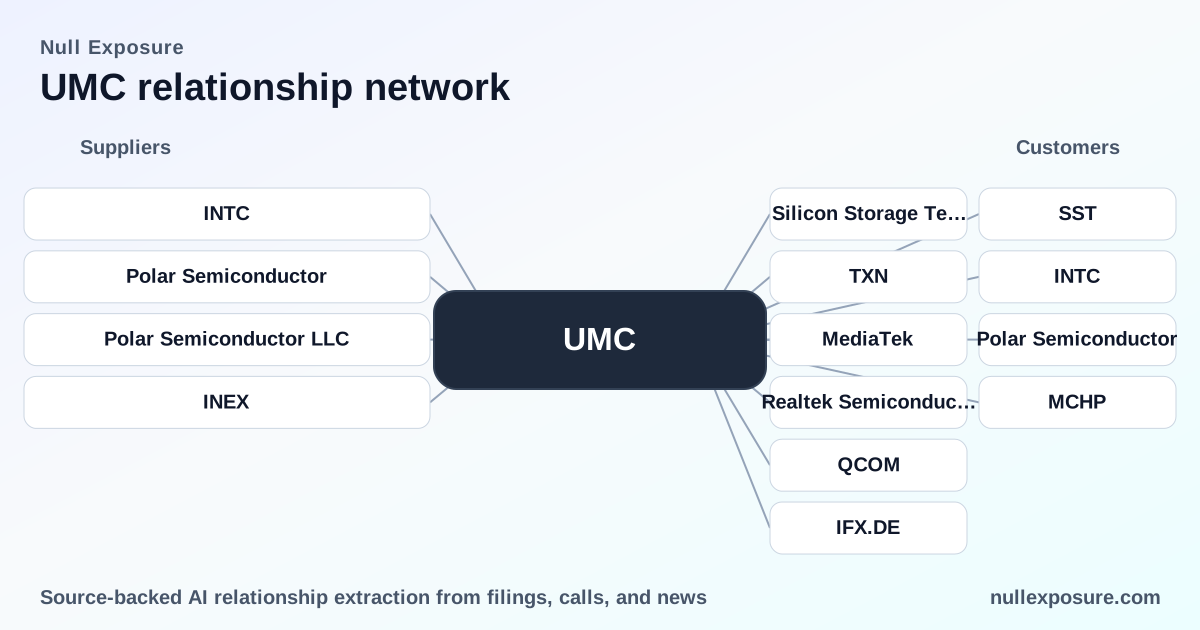
United Microelectronics (UMC): Customer Map and Commercial Implications
United Microelectronics operates as a pure-play wafer foundry, monetizing by fabricating semiconductor wafers for a diversified roster of fabless companies and integrated device manufacturers across mature process nodes. UMC earns revenue through long- and short-term wafer contracts, technology qualification programs (notably 28nm and 12nm platforms), and customer design support that converts into recurring production volumes; the business generates material cash flow and returns to shareholders via dividends while holding steady operating margins. For a compact review of coverage and analytics, see Null Exposure’s platform on UMC. https://nullexposure.com/
Why the customer roster matters to investors
UMC’s risk-reward profile is a function of customer concentration, product criticality, and node specialization. The company focuses on mature process technologies where competitive differentials come from process reliability, yields, and specialized IP such as embedded non-volatile memory (eNVM). That positioning creates stable cash generation but links growth to pockets of demand (automotive, microcontrollers, communications) and to the success of strategic partnerships.
Key customer relationships and what they mean for production
Silicon Storage Technology (SST)
UMC completed qualification and launched production of SST’s embedded SuperFlash Gen 4 on its 28HPC+ platform, delivering an automotive-grade eNVM solution and cost efficiencies versus alternative HKMG offerings. This is a direct manufacturing partnership that validates UMC’s 28nm execution for automotive applications (Microchip press release, March 2026).
Source: Microchip/IR press release, March 2026.
Microchip Technology (MCHP)
Microchip (MCHP) is the parent of SST and figures into the same supply chain win; industry coverage referenced the SST/UMC completion as bolstering Microchip’s embedded memory capabilities and positioning UMC as a production partner for automotive-grade microcontroller memory (TradingView / Zacks coverage, March 2026).
Source: TradingView/Zacks report, March 2026.
MediaTek
MediaTek is cited among UMC’s major customers in coverage of the foundry’s client mix; UMC services MediaTek on mature nodes that support communications and consumer SoCs (LinkedIn Pulse industry note, March 2026).
Source: LinkedIn Pulse industry summary, March 2026.
Infineon Technologies
Infineon appears on the roster of global clients that leverage UMC’s mature-node foundry capacity—reflecting UMC’s positioning in power and automotive semiconductor supply chains (LinkedIn Pulse industry summary, March 2026).
Source: LinkedIn Pulse industry summary, March 2026.
Qualcomm
Qualcomm is named as a client in multiple industry rundowns, which underscores UMC’s exposure to high-volume communications and connectivity chips produced on mature nodes (LinkedIn Pulse industry summary, March 2026).
Source: LinkedIn Pulse industry summary, March 2026.
Texas Instruments
Texas Instruments is a recurring customer cited in market coverage; TI’s long lifecycle analog and mixed-signal products align with UMC’s foundry specialization and capacity footprint (LinkedIn Pulse and other market commentary, March–May 2026).
Source: LinkedIn Pulse industry summary; InsiderMonkey coverage, May 2026.
Realtek Semiconductor Corp.
Realtek is among the diversified client base using UMC’s mature processes for connectivity and multimedia silicon, reinforcing the company’s revenue exposure to consumer and industrial IC demand (LinkedIn Pulse industry summary, March 2026).
Source: LinkedIn Pulse industry summary, March 2026.
Broadcom
Market commentary lists Broadcom among UMC’s manufacturing partners, indicating UMC participates in parts of Brocade/ASIC and connectivity supply chains where Broadcom sources mature-node capacity (InsiderMonkey report, May 2026).
Source: InsiderMonkey coverage, May 2026.
Intel
UMC disclosed collaborative programs with Intel—most prominently a 12nm collaboration—and the company is pursuing expanded U.S. footprint through such partnerships, signaling UMC’s willingness to pursue co-development and capacity agreements beyond its traditional client base (earnings-call and coverage, March 2026).
Source: UMC earnings call transcript coverage / InsiderMonkey, March 2026.
Polar Semiconductor
UMC announced a memorandum of understanding tied to expansion in the U.S. market that references Polar Semiconductor, an example of UMC’s strategy to secure localized partnerships and augment Western capacity and customer relationships (earnings-call coverage, March 2026).
Source: UMC earnings-call transcript coverage / InsiderMonkey, March 2026.
--
What the relationship map implies for operating constraints and business characteristics
With no explicit contractual excerpts provided, the customer map and financial profile signal several company-level operating characteristics:
- Contracting posture — multi-client foundry model with qualification-led revenue. UMC converts design wins and process qualifications (e.g., SST’s ESF4 on 28HPC+) into production revenue; contracts typically include long qualification cycles and recurring wafer orders once unit ramps occur.
- Concentration — diversified across large OEMs but exposed to a small set of high-volume customers. Public commentary lists major firms across communications, automotive, and analog markets, which reduces single-customer dependency but concentrates exposure in a handful of large accounts.
- Criticality — strategic where embedded or automotive-grade IP is required. The SST/ESF4 automotive-grade program demonstrates UMC’s role in safety- and reliability-critical supply chains, increasing switching costs for customers once production is qualified.
- Maturity — emphasis on mature nodes with predictable cost curves. UMC’s focus on 28nm and 12nm collaborations positions it for steady demand from established product lines rather than bleeding-edge GPU/CPU logic nodes.
- Financial signal — steady profitability and shareholder returns. UMC reports TTM revenue of roughly $240.7B and gross profit of about $71.3B, with operating margins near 18.5% and a dividend yield around 3.7%, supporting an investor thesis of cash-generative, dividend-paying foundry exposure.
Investment takeaways and near-term watchpoints
- Positive: The SST/UMC qualification and release to production for automotive-grade eNVM is a concrete revenue realization event that proves process credibility and opens higher-margin automotive content.
- Watchpoints: Monitor customer mix concentration and the pace of design wins across 6nm/12nm/28nm initiatives; U.S. partnership activity (Intel, Polar) is strategically meaningful but execution-dependent.
- Valuation context: UMC trades with a trailing P/E in the low 20s and forward P/E nearer to the high teens, reflecting the market’s view of stable earnings backed by robust cash flows and dividends.
For a focused, data-driven dashboard on UMC’s customer exposures and contract milestones, visit Null Exposure’s company page. https://nullexposure.com/
Overall, UMC’s customer relationships validate its operational thesis: a mature-node foundry that converts qualification success into durable production revenue, with particular upside where automotive-grade and embedded memory expertise produce stickier demand.