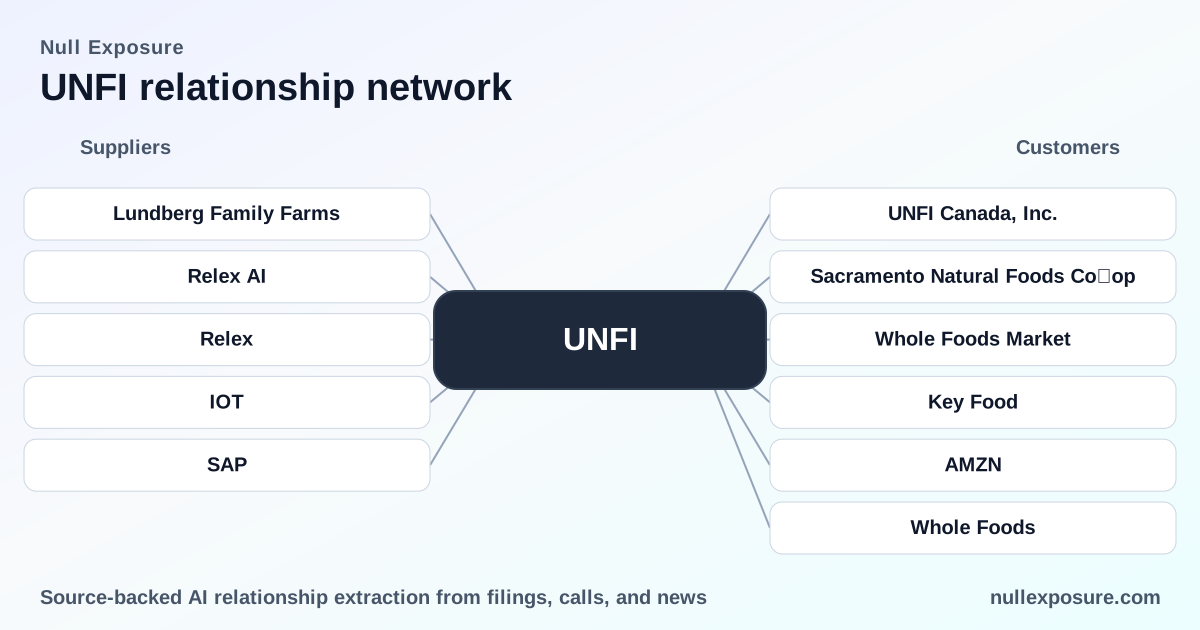
UNFI’s customer map: concentration, contract terms, and operational leverage
United Natural Foods, Inc. (UNFI) is a North American grocery distributor that monetizes by selling and delivering natural, organic and conventional food and non‑food products to retailers, while charging for logistics, category services and private‑label programs; its earnings track volume, fulfillment efficiency and a narrow set of large retail relationships that drive operating leverage. Investors should focus on customer concentration, contract tenure and execution risk—these variables explain most of the company’s revenue volatility and capital allocation priorities. For a more detailed counterparty breakdown, see https://nullexposure.com/.
How UNFI’s operating model shapes revenue and risk
UNFI runs a classic distribution business: product margin plus logistics and service fees, delivered through a network of warehouses and long‑standing commercial agreements. The company’s disclosure and third‑party reports together signal several durable characteristics:
- Contracting posture: long‑term anchor agreements exist. Company filings reference an amended distribution agreement with a term through May 20, 2032, demonstrating that at least some major relationships are formally contracted for many years.
- Concentration and materiality: revenue is skewed to a few large customers. UNFI reports that its largest customer accounted for roughly 25% of net sales in fiscal 2025, and other disclosures show $1 billion in annual sales attributable to a Northeast customer—evidence of meaningful counterparty concentration.
- Geographic focus: North America. Customers and distribution are predominantly across the United States and Canada.
- Counterparty mix: large enterprises and small independents coexist. UNFI serves both national chains and thousands of smaller retail and co‑op locations, which diversifies volume but concentrates financial exposure in the largest accounts.
- Maturity and stage: a mix of mature, active long‑term relationships and a small number of recent terminations. Filings note long‑standing relationships alongside a mutual termination in the East region in FY2025.
- Spend bands and criticality: several customers are $100M+ relationships. Public excerpts identify at least one ~$1B customer and repeated top‑customer contributions in the mid‑20s percent of revenues.
These company‑level signals explain why execution disruptions—cyber incidents, contract loss or labor unrest—translate quickly into measurable top‑line impact.
For an enterprise view of exposure to the major counterparties discussed below, visit https://nullexposure.com/.
Customer relationships — direct takeaways for investors
Below are concise, source‑backed summaries of every customer relationship mentioned in the search results.
UNFI Canada, Inc.
UNFI’s Canadian operations represent the company’s primary international sales channel and accounted for approximately 1% of net sales in fiscal 2025, making Canada a modest but strategic portion of revenue. According to UNFI’s FY2025 Form 10‑K filed August 2025, UNFI Canada is the primary driver of international net sales.
NGVC (Natural Grocers by Vitamin Cottage)
Natural Grocers discloses heavy operational reliance on UNFI, with UNFI accounting for roughly 69% of NGVC’s purchases in fiscal 2025, and the company also reported that UNFI’s June 2025 cybersecurity incident constrained order fulfillment and reduced sales in June and July (NGVC FY2025 10‑K and FY2025 Q4 earnings call). These citations show both material supplier concentration and direct execution exposure.
SFM (Sprouts Farmers Market)
Sprouts’ FY2024 disclosure identifies UNFI as a secondary supplier for dry grocery and frozen products, representing about 3% of total purchases in FY2024 and FY2023, indicating a modest commercial role for UNFI within Sprouts’ procurement mix (SFM FY2024 10‑K).
HCWC
HCWC’s FY2024 filing reports that UNFI accounted for approximately 25% of total purchases in 2024 (and 41% in 2023), illustrating a substantial procurement dependence for this customer group and signaling a concentrated sourcing relationship that materially affects HCWC’s cost base (HCWC FY2024 10‑K).
Sacramento Natural Foods Co‑op
Sacramento Natural Foods Co‑op was recognized by UNFI in a 2026 company press release for a decades‑long partnership, highlighting UNFI’s role supplying long‑standing cooperative customers and its embedded position in local‑market organic distribution (UNFI corporate press release, March 2026).
Whole Foods Market / Whole Foods
Whole Foods has been a core long‑term account for UNFI; industry reporting credits UNFI as the primary distributor for Amazon‑owned Whole Foods, and third‑party analysis notes the extension of the Amazon/Whole Foods distribution arrangement through 2032—an outcome described as removing a major overhang on UNFI’s outlook (PredictStreet and Teamster coverage, FY2026; Tikr research, May 2026). Separately, unionization activity among UNFI warehouse workers has been reported in relation to Whole Foods fulfillment sites (Teamsters, Dec 2025).
Key Food
News outlets and analyst commentary connect UNFI’s recent cybersecurity breach and the subsequent loss of the Key Food contract, framing the Key Food exit as an example of how execution failures can quickly erode commercial momentum and revenue expectations (SimplyWall.St and WhatNow coverage, FY2025–FY2026).
Amazon (AMZN)
Amazon’s involvement is material via ownership of Whole Foods; market commentary notes that the extension of the Amazon/Whole Foods contract through 2032 provides earnings stability and could accelerate UNFI’s deleveraging goals, with analysts citing possible one‑time cash infusions tied to contract arrangements and balance‑sheet objectives (PredictStreet and FinancialContent reporting, FY2026).
Investment implications and risks for operators and allocators
- Revenue concentration is a double‑edged sword. Large, long‑dated contracts provide predictable volumes but create idiosyncratic counterparty risk: the loss or partial disruption of a single anchor account produces outsized top‑line effects.
- Execution and systems risk are first‑order. The June 2025 cyber incident materially affected end customers’ sales and demonstrates the immediacy with which operational failures transmit through retailer P&Ls.
- Labor and industrial relations are relevant. Warehouse union drives and organizing successes heighten fixed‑cost pressures in fulfillment centers tied to major customers.
- Diversification is present but incomplete. UNFI serves over 30,000 locations across the U.S. and Canada, which hedges product mix shifts, but a small handful of large enterprise accounts still drive the majority of risk and reward.
Bottom line
UNFI is a distribution platform whose valuation will be driven by customer retention, operational execution and debt reduction progress. Concentration to a few large retailers and the evidence of long‑term contractual ties provide revenue visibility, but investors must underwrite execution risk—cybersecurity, fulfillment and labor—when modeling upside. For deeper counterparty exposure analytics and ongoing monitoring, visit https://nullexposure.com/.