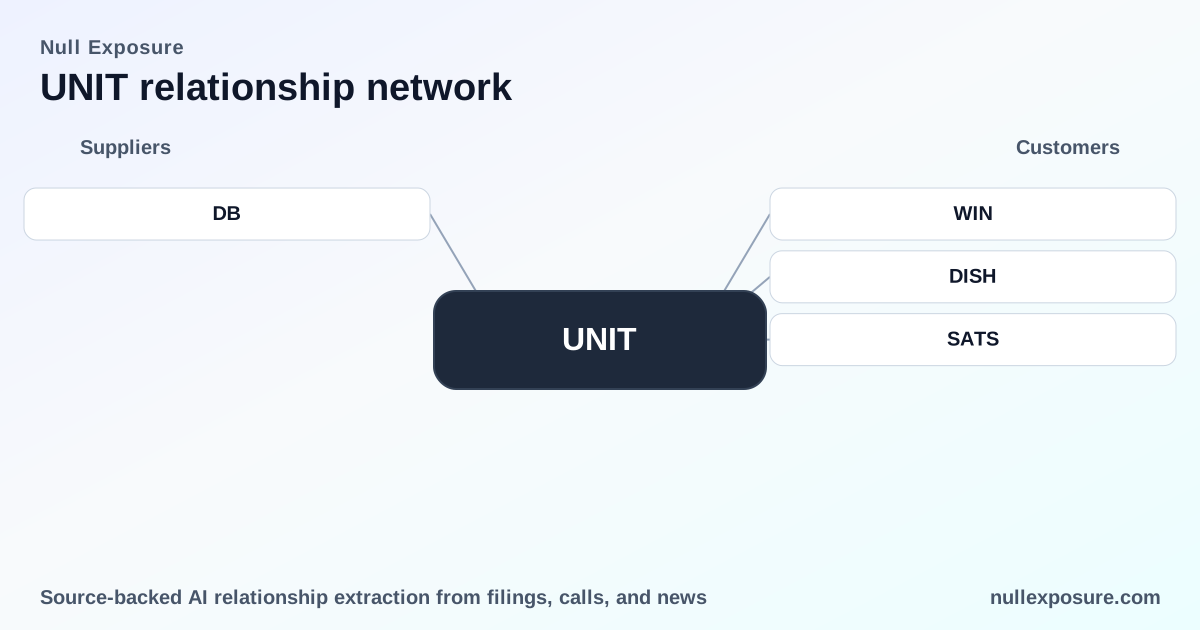
Uniti Group (UNIT): Customer Relationships that Drive Cash Flow and Risk
Uniti Group is an internally managed REIT that acquires, builds and leases mission‑critical communications infrastructure—primarily fiber and tower assets—to large service providers. The company monetizes by converting owned and constructed network assets into long‑term lease revenue and fiber services, generating high gross margins and strong EBITDA conversion from recurring contractual cash flows. For investors, Uniti is a lease‑heavy play: asset ownership and tenancy economics determine valuation, while tenant concentration and contract enforceability shape risk. Learn more at https://nullexposure.com/.
Why customer relationships are the operative valuation driver
Uniti’s financials reflect a business built on long‑dated contracts and portfolio scale: Revenue TTM of $2.2345bn, EBITDA of $1.118bn, and a reported profit margin of 58.4% show how leasing and fiber services convert into cash. That margin profile signals that operating leverage and tenant uptime translate directly into free cash flow. At the same time, Uniti’s internally managed REIT structure concentrates decision‑making and capital allocation inside the company rather than with an external manager—a governance signal that aligns asset strategy with capital markets outcomes.
From an operating posture perspective, Uniti behaves like a stabilized infrastructure landlord: it pursues long‑term leases, incremental fiber lease‑ups, and targeted acquisitions to increase tenancy. These characteristics create a contracting posture that is contract‑driven and counterparty‑sensitive, where customer defaults or force majeure disputes can materially affect near‑term cash flow despite healthy EBITDA margins.
What our coverage found about every reported customer relationship
WIN (listed as WIN in coverage)
Uniti continues to be publicly discussed for its dependence on lease payments from Windstream, with analysts highlighting that legacy litigation has eased while management pursues fiber‑rich acquisitions and lease‑up of existing network capacity. According to Ad‑Hoc News coverage (March 10, 2026), Windstream remains a focal point for investor nerve testing. Source: Ad‑Hoc News, March 10, 2026.
Windstream (same coverage, distinct entry)
The same reporting reiterates that Uniti’s cash flow profile is sensitive to Windstream lease performance and the company’s efforts to grow via fiber acquisitions and lease‑up activity. Ad‑Hoc News emphasized the investor focus on the Windstream relationship and the balance‑sheet implications. Source: Ad‑Hoc News, March 10, 2026.
DISH
Uniti reported that revenue exposure to DISH is below 1%, classifying the account as immaterial to consolidated revenues; management presented this figure during the Q4 2025 earnings call. For underwriting and operational planning, DISH does not represent a concentration risk at current levels. Source: Q4 2025 earnings call transcript as reported by InsiderMonkey, March 2026.
EchoStar
EchoStar has been public about canceling certain leases and invoking force majeure positions on some infrastructure, and Uniti disclosed active dialogue with EchoStar while calling the force majeure posture inappropriate. This is an operationally sensitive dispute because lease cancellations and force majeure claims can interrupt expected fiber and site revenues. Source: Q4 2025 earnings call transcript as reported by InsiderMonkey, March 2026.
SATS (EchoStar identified as SATS in matching)
The same commentary was captured under the SATS identifier, recording management’s acknowledgment of EchoStar’s lease cancellations and public force majeure stance and confirming Uniti’s engagement with the counterparty and industry peers on the issue. Source: Q4 2025 earnings call transcript as reported by InsiderMonkey, March 2026.
What these relationships mean in practical terms for investors and operators
- Concentration risk is real and measurable. Windstream shows up repeatedly in market commentary as a legacy anchor tenant whose payment profile affects investor sentiment; even if not all exposure is disclosed in a single metric, public reporting and analyst focus make it a primary risk vector.
- Counterparty enforcement matters. The EchoStar/EchoStar‑SATS situation illustrates that force majeure claims and lease cancellations can create operational uncertainty even for well‑capitalized landlords; legal outcomes and negotiated settlements will drive short‑term cash flow variability.
- Small exposures can be ignored operationally—when they are small. DISH is explicitly immaterial at under 1% of revenue per management comment, so it does not affect underwriting or covenant stress tests at current levels.
- Business model characteristics favor stable, contract‑based income but require active tenant management. Uniti’s internally managed REIT structure and high gross margins translate asset performance into corporate earnings, but the company’s financial health is sensitive to large tenant disputes and lease concentration.
Company‑level signals and operating constraints
There were no explicit contractual constraints or restriction excerpts recorded in the coverage set reviewed; treat that absence as a company‑level signal: no new public constraints were captured by the sources in this round of coverage, which itself indicates management has not disclosed fresh, binding limitations on contracting posture. From a governance and operating model view:
- Contracting posture: Long‑term leases are central and enforceability is the primary operational control. Management focuses on lease‑up of fiber assets and selective acquisitions to diversify tenant mix.
- Concentration: Public commentary repeatedly flags legacy large tenants as the dominant counterparty risk, implying a need for active de‑risking via new customers and sublease/augmentation strategies.
- Criticality: Uniti’s assets are mission‑critical infrastructure; outages or tenant disputes have outsized impact on cash flow and market sentiment.
- Maturity: The company shows the maturity profile of a REIT transitioning from acquisition‑led growth to lease‑up and portfolio optimization, with higher margins and EBITDA conversion consistent with established infrastructure landlords.
If you want layered tracking of these tenant dynamics over time, consider a subscription plan at https://nullexposure.com/ for continuous coverage and signal alerts.
Risk checklist and investor takeaways
- Primary risk: Lease concentration with legacy tenants like Windstream; investor focus remains on how lease payments and litigation overhang are managed.
- Secondary risk: Counterparty disputes and force majeure claims (EchoStar) that can interrupt revenue recognition and create negotiation risk.
- Offsetting strengths: High gross margins, strong EBITDA, and an internally managed REIT structure that aligns asset strategy with capital deployment.
- Tactical action: Monitor lease renewal schedules, litigation updates, and any reclassification of revenue exposure in quarterly filings; prioritize scenarios where a 5–10% revenue disruption could stress covenants or liquidity.
Bottom line
Uniti is a cash‑flow infrastructure REIT whose valuation hinges on long‑term tenant performance and the enforceability of lease contracts. Windstream functions as the headline concentration risk; EchoStar’s force majeure posture is an immediate operational issue; DISH is immaterial at present. For investors and operators, the strategic imperative is twofold: defend contracted cash flow through legal and commercial engagement, and accelerate lease‑up and tenant diversification to reduce single‑counterparty exposure.