Unum Group (UNM): Customer relationships that drive durable insurance economics
Unum Group is a Fortune 500 life and disability insurer that monetizes through long-duration benefit contracts sold to employers and individuals, supplemented by fee-based solutions and reinsurance arrangements that manage capital and liability volatility. Its operating model combines workplace-distributed group products, individual closed-block portfolios, and service revenues from leave-management and administrative offerings. For a deeper look at the customer footprint and partner flows that shape Unum’s economics, visit https://nullexposure.com/.
Why these customer relationships matter to investors
Unum’s revenue quality is defined by two interacting forces: long-term policy liabilities that create persistency and capital requirements, and distribution and reinsurance partnerships that shape both growth and risk transfer. Understanding who pays, who distributes, and who reinsures Unum’s books is essential to forecasting reserve trends, capital needs, and margin stability.
Operating model signals from contractual and geographic constraints
The public record and company disclosures indicate a long-term contracting posture—policies typically begin after 90–180 day waiting periods and can persist for many years; the company also reports closed‑block reserves for legacy long-duration products (confidence: 0.90). Unum’s customer base is primarily North America with meaningful operations in the United Kingdom and Poland (EMEA), so claims cycles and regulatory regimes span both markets (EMEA confidence: 0.85; NA confidence: 0.80). The firm functions as both a service provider (fee income from leave management and administrative services) and a seller/reseller through field sales and broker distribution, reinforcing diversified go-to-market channels. These are company-level characteristics that frame how the individual relationships below affect earnings and capital.
Reinsurance and closed-block capital management: the Northwind Re arrangement
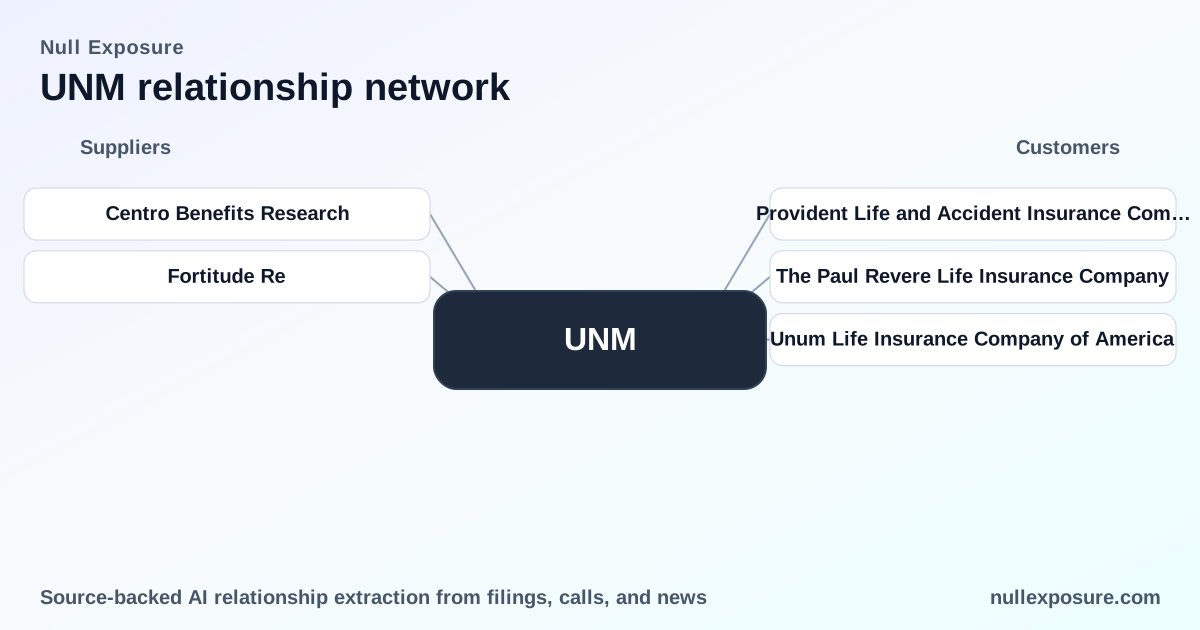
Provident Life and Accident Insurance Company — Northwind Re was established to provide reinsurance coverage to Provident Life and Accident Insurance Company as part of an arrangement that also supports funding for a closed block of individual disability income policies. This transaction is a capital-management and liability-transfer mechanism designed to stabilize reserve volatility. (Captive Insurance Times, March 10, 2026: https://www.captiveinsurancetimes.com/captiveinsurancenews/reporterarticle.php?article_id=6616)
The Paul Revere Life Insurance Company — Paul Revere is one of the three Unum subsidiaries reinsured by Northwind Re, receiving reinsurance protection alongside Provident Life and Unum Life Insurance Company of America in order to facilitate funding support for legacy individual disability blocks. The arrangement reduces direct capital strain and isolates long-duration liabilities. (Captive Insurance Times, March 10, 2026: https://www.captiveinsurancetimes.com/captiveinsurancenews/reporterarticle.php?article_id=6616)
Unum Life Insurance Company of America — Unum Life is the third Unum subsidiary included in the Northwind Re reinsurance program, making it a direct beneficiary of the capital and liability management strategy that targets closed-block individual disability exposure. This supports Unum’s broader objective of de-risking legacy portfolios while continuing to write new group business. (Captive Insurance Times, March 10, 2026: https://www.captiveinsurancetimes.com/captiveinsurancenews/reporterarticle.php?article_id=6616)
Portfolio pruning and strategic disposition: Medical Stop Loss sale
Amynta Agency Inc. — Amynta entered into a definitive agreement to acquire Unum’s Medical Stop Loss business, signaling a selective divestiture of lines that are less central to Unum’s core group disability and life underwriting strategy. This sale is consistent with management’s emphasis on core-product economics and capital redeployment toward higher-return activities. (Simply Wall St summary, first seen May 2026; announcement reference Jul 09: https://simplywall.st/stocks/us/insurance/nyse-unm/unum-group)
Distribution integration and channel partnerships
Employee Navigator — Unum launched “Unum Broker Connect” for Employee Navigator (June 19), formalizing a digital distribution tie that streamlines employer-side enrollment and broker workflows. This integration increases distribution efficiency and supports faster quoting and issuance for group voluntary and supplemental products. (Simply Wall St summary, May 2026: https://simplywall.st/stocks/us/insurance/nyse-unm/unum-group)
How these relationships affect Unum’s economics and risk profile
- Capital management through reinsurance: The Northwind Re structure covering three Unum subsidiaries is a clear capital-management lever. By transferring segments of closed-block disability exposure, Unum protects capital ratios and reduces earnings volatility tied to legacy claims runs.
- Concentration and maturity: The closed‑block legacy business is mature and declining, which reduces growth but also creates predictable runoff dynamics; long waiting periods and long-term benefit horizons amplify liability duration and the need for deliberate asset-liability management.
- Distribution elasticity: Integrations like Unum Broker Connect and the use of brokers/resellers diversify distribution and lower friction for group sales, improving new-business velocity without materially increasing underwriting risk.
- Strategic portfolio focus: Disposing non-core lines such as Medical Stop Loss to Amynta frees capital for core group and individual disability/life segments and reduces earnings volatility from stop-loss claim spikes.
- Geographic diversification: North American revenue concentration is balanced by operations in the U.K. and Poland; this provides diversification benefits but introduces foreign regulatory and mortality morbidity variability.
Investor implications and risk checklist
- Positive: Long-duration contracts and high policy persistency translate to durable premium streams and predictable lapses; reinsurance arrangements reduce capital strain on legacy blocks. Digital distribution tie-ins can lift new-business efficiency and reduce acquisition costs.
- Negative: Closed-block liabilities are persistent and require ongoing reserve management; divestitures can remove low-return but high-premium lines and temporarily depress top-line while improving return on capital. Multijurisdictional operations expose Unum to varying morbidity and regulatory environments.
For portfolio analysts, the key metrics to monitor are reserve development on closed blocks, the pace and economics of reinsurance transactions like Northwind Re, and earnings impact from the Medical Stop Loss sale. For operators, watch distribution KPIs post-Unum Broker Connect rollout and integration metrics that affect new business delivery.
If you want a structured view of Unum’s customer counterparties and capital-management relationships for model inputs or diligence, explore more at https://nullexposure.com/.
Bottom line
Unum’s customer relationships are a mix of durable long-term policyholders, broker and reseller channels, and targeted reinsurance partners that together shape earnings stability and capital efficiency. The Northwind Re reinsurance program and the strategic sale of Medical Stop Loss are two recent, high-impact moves that clarify management’s focus on de‑risking legacy portfolios while optimizing for return on capital. Investors should value Unum for its predictable cashflows tempered by legacy liability management needs.