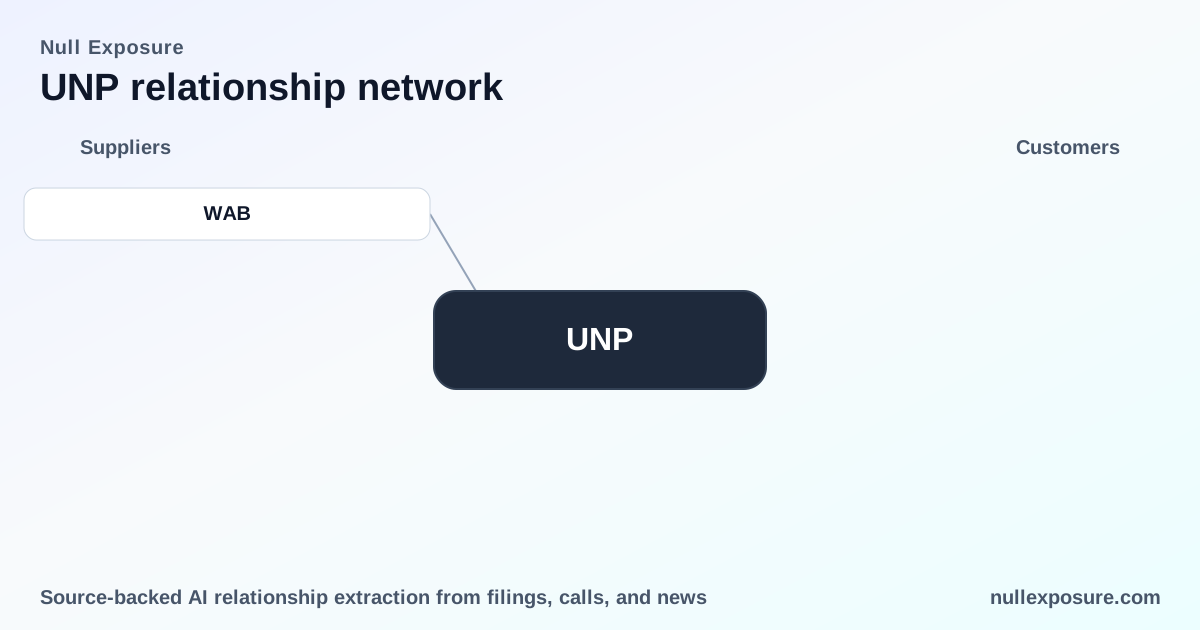
Union Pacific: Customer Relationships That Drive Network Value
Union Pacific monetizes a continent-spanning freight franchise by selling transportation and service commitments to industrial shippers, utilities, ports and intermodal partners across North America. The company converts network scale and service reliability into recurring contract revenues—reflected in $24.7B of trailing revenue and strong operating margins—while selectively winning incremental volumes (automotive, chemicals, polymers, and coal) that leverage existing track, terminals and switching capabilities. For primary source analysis and relationship signals, see NullExposure.
How Union Pacific actually makes money and how relationships matter
Union Pacific is a freight railroad holding company that sells movement and service of goods rather than physical commodities. Revenue derives from contracts for freight transportation and related service levels; customers pay for origin-to-destination movement, unit train access, and terminal switching. Management emphasizes service execution as the commercial lever to win and retain business, which directly drives pricing power and utilization of the asset base. Union Pacific’s financials—$12.586B EBITDA and a nearly 30% profit margin—show that service-driven volume growth and network density are primary profit drivers.
Company-level operating signals from filings and transcripts reinforce this commercial posture:
- Geographic focus is North America, with meaningful cross-border flows into Canada and Mexico and port gateway exposure. This is a structural feature of the business rather than a transient trend.
- Relationships are material and revenue-driving, reflecting significant contracts that connect the railroad to international commodity flows.
- Union Pacific functions both as seller (service provider) and buyer (in logistics/terminal arrangements) depending on contract terms and partnership roles.
- Relationships are active and operationally critical: management describes committed service levels and joint execution with customers as central to strategy.
- The company’s revenue segmentation is service-oriented, not product resale.
These signals shape commercial risk and opportunity: service disruption, port switching wins, or new unit-train customers can swing utilization and margin leverage quickly.
The customer map — who Union Pacific is actively moving for right now
Below are every customer relationship identified in the collected results, summarized in plain English with source context.
Smart Sand (SND) — Smart Sand completed a unit-train capable facility in Byron Township, Wisconsin and moved its first unit train on Union Pacific on December 26, 2017, establishing UP as the carrier for fracturing sand unit trains from that site. — RT&S freight/terminals coverage, December 2017.
BMW (BMW.DE) — Union Pacific reported that softening vehicle market volumes were partially offset by incremental volume won with BMW, showing UP’s ability to capture auto-carrier flows even in a softened market. — Union Pacific Q1 2026 earnings transcript coverage (The Globe and Mail / earnings release), May 2026.
LCRA (Lower Colorado River Authority) — New coal business with LCRA began in April (prior year), and management cited this customer as a contributor to strength in coal volumes supported by service execution. — Q1 2026 earnings call transcript coverage published in May 2026 (InsiderMonkey / The Globe and Mail excerpts).
Port of Los Angeles / Long Beach (Alameda Belt Line shortlisting) — Union Pacific, together with BNSF via the jointly owned Alameda Belt Line, was shortlisted for a rail switching contract at the Ports of Los Angeles and Long Beach, underlining UP’s strategic push into port switching and intermodal gateway economics. — Simply Wall St coverage summarizing port role and shortlisting, May 2026.
Hub Group (HUBG) — Evercore ISI commentary noted that Hub Group could be a beneficiary in the event of a proposed Union Pacific–Norfolk Southern merger, reflecting Hub Group’s role as an asset-based intermodal provider that sits atop both rail networks. This flags competitive intermodal dynamics for UP. — Sahm Capital summary of Evercore ISI views, January 2026 (analyst note coverage).
Metra — Union Pacific completed the transfer of Metra commuter rail services out of its network in 2025, a change that materially affected non‑freight revenue lines tied to passenger/commuter operations. — Union Pacific Q1 2026 earnings transcript summary (The Globe and Mail), May 2026.
Entergy subsidiaries (ELC, EMP, ENJ, ENO, ETR) — Multiple Entergy entities disclose that coal will be transported to Arkansas under an existing Union Pacific transportation agreement expected to supply Entergy Arkansas’s rail transportation requirements for 2025, signaling a multi-entity utility contract routeed through UP. — Entergy FY2024 Form 10‑K filings for Entergy Louisiana (ELC), Entergy Mississippi (EMP), Entergy New Orleans (ENO), Entergy Texas (ETR), and related subsidiaries, FY2024 filings.
Bartlett (grain customer example) — Management cited record grain volume in Q1 driven by export demand and expansion into Mexico, specifically naming Bartlett’s new Monterrey facility as an example of customers expanding cross-border flows that use UP’s network. — Q1 2026 earnings call transcript coverage (InsiderMonkey), May 2026.
Golden Triangle Polymers Company (joint venture) — Union Pacific called out the Golden Triangle Polymers Company joint venture with Chevron Phillips Chemical (CPChem) as an example of a new world‑scale facility that will create inbound/outbound rail volumes when it starts up in the third quarter. — Q1 2026 earnings call transcript coverage (InsiderMonkey), May 2026.
CPChem (Chevron Phillips Chemical) — Named alongside the Golden Triangle venture, CPChem is a major chemical customer whose new polymer plant start-up will generate significant rail traffic for feedstocks and finished product. — Q1 2026 earnings call transcript coverage, May 2026.
What these relationships tell investors about upside and risk
Collectively, the relationship set shows four commercial themes that drive near- and medium-term value:
- Diversified end markets with concentrated execution leverage. UP serves automotive, chemicals/polymers, grain, coal and ports; winning or losing a single large account can materially affect volumes and asset utilization. The BMW, CPChem/Golden Triangle and Entergy flows illustrate both diversification and concentration of economic impact.
- Port and intermodal optionality is strategic. The Alameda Belt Line shortlisting at Los Angeles–Long Beach and the Hub Group analysts’ notes highlight how gateway and intermodal contracts translate into density and pricing power. Port switching wins create disproportionate margin upside.
- Utilities and bulk commodities remain material. Multiple Entergy filings and the LCRA win show that utility coal transport and fuel cycles remain company-relevant, anchoring base volumes even as energy markets evolve.
- Service execution is the competitive fulcrum. Management repeatedly links new wins and volume recoveries to service delivery; UP’s contracting posture is therefore one of performance-based retention and expansion, not purely price-driven competition.
Risk considerations flow directly from these themes: volume sensitivity to end-market cycles (autos, chemicals, export grain), gateway congestion or contract loss at major ports, and execution lapses that can shift customers to alternatives. These are company-level signals tied to the active, service-oriented nature of UP’s revenue model and its North American geographic footprint.
Bottom line for investors
Union Pacific’s customer relationships are both the engine of growth and the source of execution risk. The firm wins incremental, high-value volumes through targeted industrial customers and port contracts while anchoring base load with utility and bulk-commodity agreements. Monitoring port switching outcomes, large account renewals (automotive and polymer initiatives), and coal-utility contract performance will give the earliest read on revenue durability and margin trajectory.
For a concise feed of relationship signals and to track material customer movements that influence rail volumes, visit NullExposure.