Unity Bancorp (UNTY): Customer Relationships Drive a Deposit-Funded Community Bank
Unity Bancorp operates as a regional community bank that monetizes through net interest margin on commercial and consumer loans and fee income from deposit services. The franchise funds growth primarily with retail, municipal and commercial deposits, supplements lending with committed advances, and places strategic emphasis on Small Business Administration (SBA) lending as a differentiated product. For investors, the key question is whether Unity’s deposit mix and borrower base support stable margins while permitting measured credit growth; this note parses customer relationships, operating constraints and a concrete customer example to illuminate that assessment. For deeper counterparty intelligence, visit https://nullexposure.com/.
How Unity makes money and how customers fit into that model
Unity is a traditional community bank offering checking, savings, time deposits, money market accounts, debit/credit processing and commercial lending across a concentrated New Jersey–Pennsylvania footprint. Deposits are the primary source of funding for interest-earning assets and also generate meaningful noninterest fee income through interchange, wire fees and service charges, per the company’s disclosures as of December 31, 2024.
The bank emphasizes commercial credit to middle-market and small business customers while maintaining consumer and municipal relationships. SBA lending is explicitly material to the business, supplying both loan volume and a relationship channel into local small-business owners. The business model therefore blends margin economics on conventional loans with fee generation from account services and the franchise value of branch-based customer origination.
Where Unity sells — geography and customer concentration matter
Unity operates 21 branches primarily along the Route 22 / Route 78 corridors with locations in Bergen, Hunterdon, Middlesex, Morris, Ocean, Somerset, Union and Warren counties in New Jersey and one county in Pennsylvania, which anchors its New York metro exposure. The firm reports that through its branch network and online services it supports customers across the New York City metropolitan area, while some loan collateral is geographically dispersed across the U.S.
Implication: Unity’s customer book is locally concentrated, which strengthens relationship depth and cross-sell but increases sensitivity to regional economic cycles.
Contracting posture, maturity and relationship dynamics
Unity’s public disclosures point to a short-term contracting posture in funding: as of December 31, 2024, time deposits totaled $815.1 million (38.8% of deposits), and $768.6 million (94.3% of those time deposits) was scheduled to mature within one year. The bank also reports being committed to advance roughly $322.3 million to borrowers, with $167.1 million of those commitments expiring within one year, indicating both active ongoing lending and near-term funding/advance turnover.
- Short-term funding concentration: Large share of time deposits maturing within 12 months increases rollover risk but also creates pricing flexibility for management.
- Active lending pipeline: Commitments to advance at year-end show continued origination capacity and active customer engagement.
These are company-level signals reflecting the bank’s operating cadence rather than attributes of any single customer relationship.
Who the customers are: mix and materiality
Unity’s customers include state and local government depositors, individuals, small businesses and middle-market commercial borrowers. The firm reported $400.6 million of government deposits at year-end 2024, up from $346.3 million a year earlier, signaling that public-sector deposits are a meaningful and stable funding pillar. The company also highlights that commercial credit is extended primarily to middle-market and small business customers, and that SBA lending is an important part of the business.
Implication: Government deposits provide ballast to funding; small-business and SBA channels supply fee and loan-growth opportunities — together they shape both credit mix and interest-margin dynamics.
Customer example: Bridgeside Deli and Catering
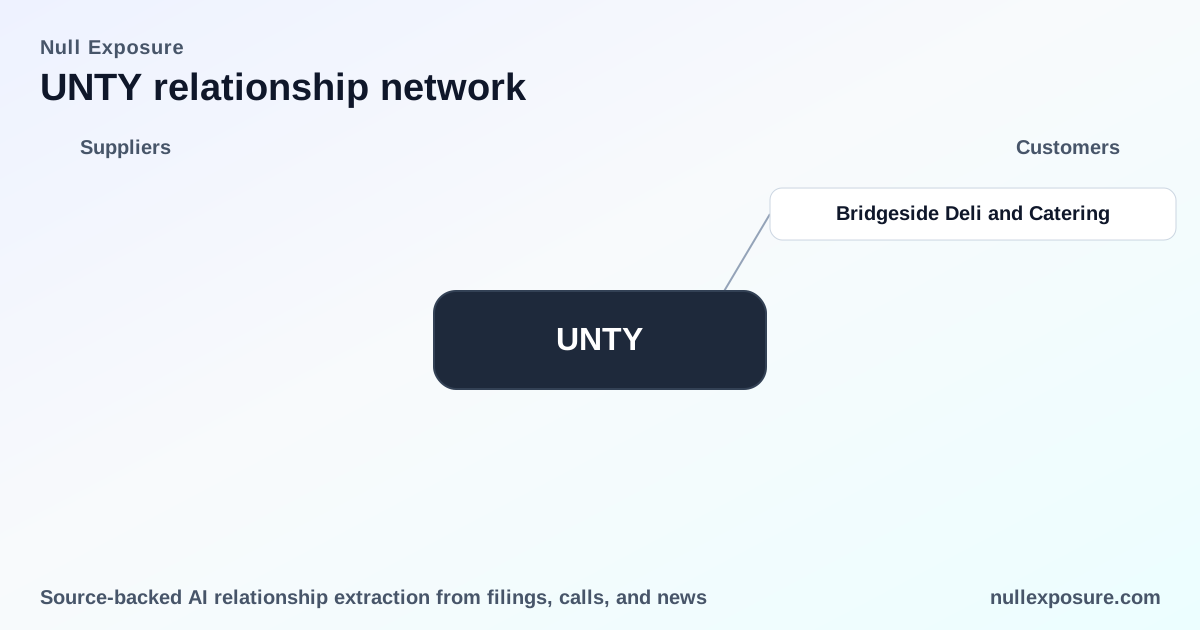
Unity Bank provided a $350,000 SBA loan to Michael Coons and Joseph Trinchetta to fund the purchase and expansion of Bridgeside Deli and Catering at 1156 Atlantic Avenue in Baldwin, New York. A local news report on Patch (March 10, 2026) covered the transaction and identified the loan as an SBA-backed small-business facility (https://patch.com/new-york/longisland/unity-bank-provides-350-000-loan-bridgeside-deli-catering). This transaction is representative of Unity’s focus on community-level SBA lending and relationship banking.
Operating constraints and what they signal about customer dependence
Unity’s public disclosures produce several company-level constraint signals that matter for investors evaluating customer relationships:
- Contracting posture — short-term: A high proportion of time deposits mature within one year, so the bank operates with significant near-term rollover exposure, which requires active deposit management and pricing discipline.
- Balance between short- and long-term obligations: Commitments to advance show a mix of near-term lending obligations and longer-term exposure; the existence of $167.1 million of commitments expiring within a year highlights ongoing draw risk.
- Counterparty mix — government and local business-focused: Large government deposits are a stabilizing counterweight, while concentration in small and middle-market business borrowers concentrates credit risk in local economic cycles.
- Materiality — SBA lending and deposit fees matter: The company states that SBA lending is an important part of the business and that deposits not only fund assets but produce noninterest income.
- Maturity and active relationships: The bank’s committed advances and branch footprint point to an active, relationship-driven lending franchise rather than a passive investor-lender model.
- Geographic concentration: Branch network and customer focus anchored in New Jersey and nearby Pennsylvania create higher local cyclicality compared with national peers.
- Spend/scale signal: The company reports an average deposit size of $7.7 million within a portfolio segment, which suggests the presence of some large or institutional deposit relationships alongside retail customers.
These are company-level signals drawn from the firm’s disclosures as of December 31, 2024; none of these constraints are specifically attributed to Bridgeside Deli.
Investment implications and risk checklist
Unity’s customer profile underpins both opportunity and risk. Strengths include a diversified revenue mix (interest margins plus fee income), a sizable government deposit base and an originating branch footprint that supports SBA and small-business lending. Risks center on short-term deposit rollover, local economic concentration, and the execution of underwriting on small-business portfolios.
Key considerations for investors:
- Monitor time-deposit rollovers and management’s ability to reprice without margin erosion.
- Track government deposit stability and whether municipal relationships deepen or concentrate.
- Evaluate asset quality in SBA and small-business portfolios alongside loan commitments that can be funded on near notice.
- Assess branch economics and digital adoption as determinants of customer retention and fee income sustainability.
For an investor-focused view of counterparty profiles and to see how these relationship signals map to risk exposure, visit https://nullexposure.com/.
Bottom line: customers are central to UNTY’s valuation
Unity Bancorp is a classic deposit-funded community bank where customer relationships drive both the funding mechanics and loan growth. Unity’s emphasis on SBA and small-business lending, combined with a substantial government deposit base, creates a characteristic mix of relationship depth and local concentration. The company operates with meaningful near-term funding turnover that requires ongoing deposit management; this is the principal operational constraint investors should monitor as they appraise UNTY’s risk-adjusted return profile.