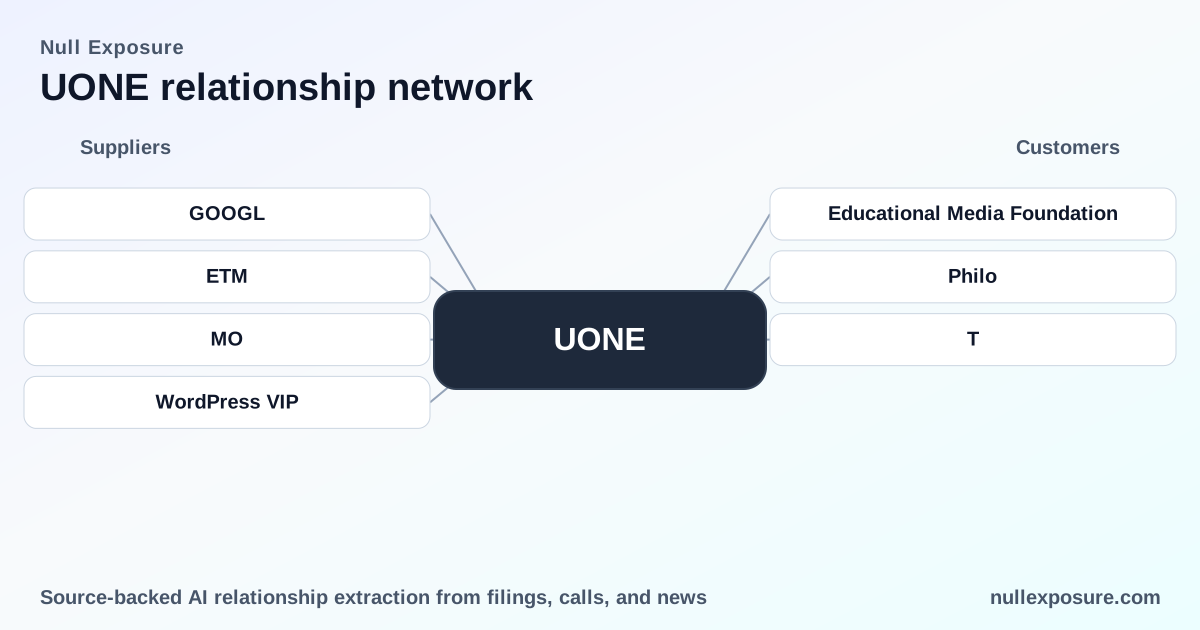
Urban One (UONE): Customer Relationships and Commercial Footprint
Urban One operates a vertically integrated urban-focused multimedia platform that monetizes through radio advertising, affiliate carriage fees for TV networks, content licensing, management fees for station operations, and opportunistic asset sales. The company’s core revenue engine is its radio franchise and TV One networks, which together generate recurring ad and affiliate fee cash flows while management and station dispositions provide episodic liquidity.
For a deeper view of Urban One’s commercial counterparties and relationship dynamics see https://nullexposure.com/.
How Urban One’s commercial model actually works
Urban One is a media operator built on a mix of recurring and transactional revenue streams. Radio advertising represented roughly 35% of net revenue in FY2024, making local and national ad sales a material and recurring source of cash. TV One generates affiliate fees under multi-year, per-subscriber royalty contracts, which create long-dated, usage-linked revenue that scales with distribution. The company also sells station assets and sometimes provides management or consulting services to third parties for contractual fees, delivering a repeatable but opportunistic income component.
These signals imply the following operating characteristics:
- Contracting posture: a hybrid of long-term carriage agreements (TV affiliate fees) and short-cycle ad sales (radio), so revenue durability is diversified across contract tenors.
- Revenue concentration: material exposure to the U.S. urban radio market — a firm-level signal rather than tied to any single counterparty — which concentrates risk geographically and demographically within the United States.
- Criticality and maturity: affiliate agreements are mission-critical for TV One’s distribution economics and are generally mature, multi-year arrangements; radio ad sales are cyclical and sensitive to macro and local demand.
- Commercial roles: Urban One operates as seller (ad inventory), licensor (TV affiliate fees), buyer (media inventory and audience), and service provider (management/consulting for station operations) depending on the contract.
Relationship snapshots: what the records show
Below are the individual relationship mentions drawn from recent news records and filings. Each entry is a plain-English summary with a short source reference.
Educational Media Foundation — WPZR-FM sale (FY2018)
Urban One signed an agreement to sell its Detroit FM station WPZR‑FM (102.7 FM) to Educational Media Foundation for total consideration of $12.7 million, reflecting a strategic disposition of a legacy radio asset. According to RadioInsight, the sale was announced as definitive in the disclosure (first seen March 10, 2026). Source: RadioInsight (article URL published/first seen 2026-03-10).
Educational Media Foundation — WPZR-FM (alternate report, FY2018)
Industry trade RBR also reported the Detroit sale, noting the 50 kW Class B station transaction for $12.7 million, corroborating the media market exit and asset monetization strategy. Source: RBR (report first seen March 10, 2026).
Philo — TV One carriage (FY2020)
Streaming operator Philo added TV One to its lineup, expanding distribution of Urban One’s TV network to an Internet-based pay-TV alternative and increasing audience reach and affiliate-fee potential. Source: The Desk (coverage first seen March 10, 2026).
Educational Media Foundation — WWLG (Columbus) sale filing (FY2024)
Educational Media Foundation filed to buy Columbus FM station WWLG (107.1 “La Mega”) from Urban One for $2.06 million, documenting another instance where Urban One monetized broadcast assets via sale filings. Source: InsideRadio (deal digest first seen May 4, 2026).
Charter Communications — expanded carriage of TV One networks (FY2022)
Charter expanded carriage of Urban One’s TV One and Cleo TV networks across its footprint, enhancing distribution and affiliate-fee scale for Urban One’s TV assets. NextTV reported a Charter announcement quoting TV One leadership on the expanded carriage. Source: NextTV (coverage first seen May 4, 2026).
AT&T — sponsorship of IONE Digital event (FY2019)
AT&T’s Dream in BLACK sponsored Urban One’s IONE Digital event “The Creative Class,” demonstrating a commercial partnership where a major telecom brand funded sponsored content and brand initiatives tied to Urban One’s audience. Source: PR Newswire (press release first seen March 10, 2026).
T (AT&T) — duplicate PR notice of sponsorship (FY2019)
The same PR Newswire announcement is catalogued under the ticker T, reiterating AT&T’s sponsorship role for the 2019 IONE Digital event and highlighting advertiser-brand partnership activity with Urban One. Source: PR Newswire (press release first seen March 10, 2026).
What the relationship map implies for investors
- Recurring backbone with usage-based upside. Long-term affiliate agreements for TV One are structured on per-subscriber royalties, translating distribution gains into usage-based recurring revenue that scales as carriage expands (company-level excerpt supporting long-term and usage-based contract types).
- Ad sales remain material and cyclic. With ~35% of net revenue from radio advertising (FY2024), Urban One’s earnings are sensitive to advertising cycles and local market conditions; ad revenue is a core product and a material source of cash flow.
- Asset-light monetization via disposals. Multiple sales to Educational Media Foundation illustrate a deliberate strategy of asset realization—converting broadcast licenses and stations into liquidity when markets permit.
- Diversified commercial roles reduce single-counterparty risk. Urban One acts as seller, licensor, buyer and service provider across its relationships, which reduces reliance on any single commercial function but does keep exposure concentrated in U.S. urban media markets.
- Geographic concentration in the U.S. The firm operates primarily in North America (U.S.) with a portfolio of stations in major African‑American markets, concentrating both audience and revenue risk domestically.
Mid-read: for a consolidated relationship map and commercial risk scoring, review the Urban One customer dossier at https://nullexposure.com/.
Investment conclusion: opportunities and watch points
Urban One combines stable affiliate-fee economics with cyclical advertising and opportunistic asset sales — a mix that supports downside protection through carriage royalties while leaving upside exposed to distribution expansion and ad-market recoveries. Key watch items for investors: ad revenue trends, renewals/expansion of affiliate carriage (distribution scale), and the pace of further station dispositions. The balance between long-term usage-linked TV revenue and short-term radio ad volatility defines the company’s risk-return profile.
Bottom line: Urban One’s customer relationships show a pragmatic commercial strategy—monetize distribution through affiliate fees, monetize audience through advertising, and recycle capital through strategic station sales—positioning the company as a niche media operator with concentrated U.S. market exposure and clear levers to manage revenue durability.