Upstream Bio (UPB): One customer dominates the commercial footprint — what investors need to know
Upstream Bio is a clinical-stage biotechnology company that monetizes its R&D capabilities by performing development services and transferring intellectual property tied to its inflammatory and severe respiratory programs. Revenue is currently driven by reimbursed research and development services from a single related-party customer in Japan, and intellectual property licensing activity under contract. For investors and operators evaluating customer relationships, the structure and terms of that counterparty agreement determine both near-term cash flow and the company’s long-term upside from its lead asset.
If you want a concise dossier for deal screening or counterparty due diligence, visit the Null Exposure research home page: https://nullexposure.com/
Quick take: concentrated customer exposure with service revenue and a permanent license transfer
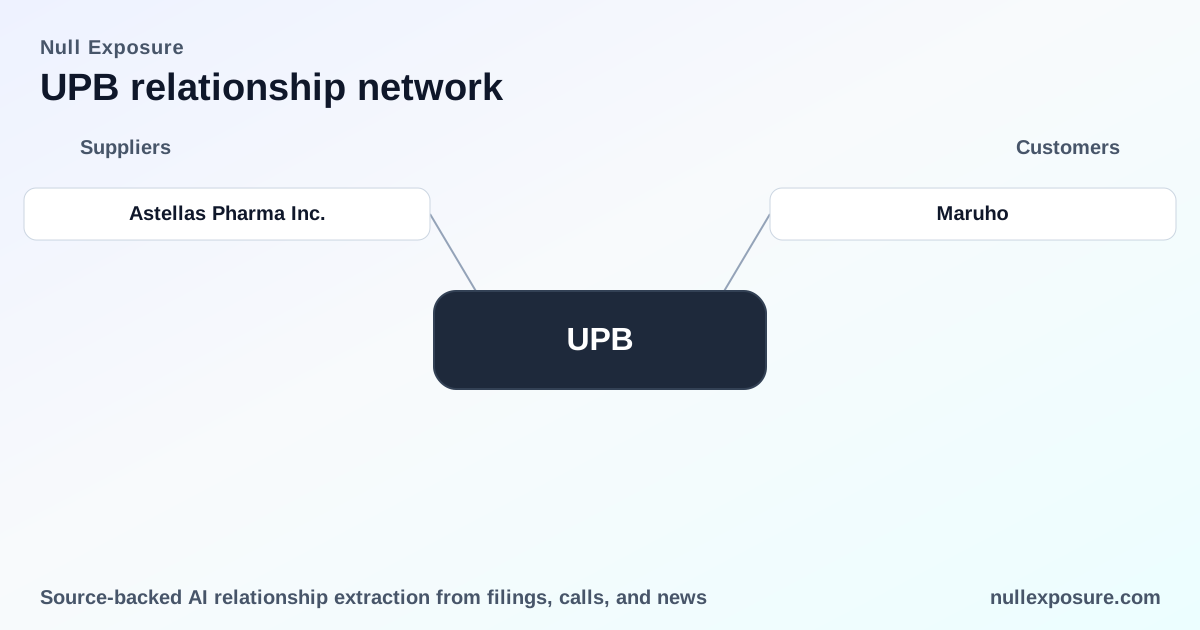
Upstream records virtually all commercial revenue from a single agreement with Maruho Co., Ltd., where it provides R&D services and has granted a broad license to its technology. This is a high-concentration, services-first arrangement that also includes a permanent intellectual property transfer element — a combination that limits royalty upside while supporting near-term reimbursed cashflows. The company’s FY2024 disclosures make the arrangement both explicit and material to reported revenue.
The Maruho relationship — the definitive investor summary
Maruho is a related-party customer in Japan that contracted Upstream to perform research and development services related to the program verekitug; Maruho reimburses Upstream for costs incurred performing those services, and the contract has been accounted for under ASC 606. According to Upstream’s Form 10‑K for the fiscal year ended December 31, 2024, the company also granted Maruho an exclusive, irrevocable, perpetual, royalty-free, sublicensable (subject to a right of first negotiation) license under the Maruho Agreement. (Source: Upstream Bio Form 10‑K, FY2024; Note 15 and agreement excerpt.)
All customer relationships (complete, with source citations)
- Maruho — Upstream provides reimbursable research and development services tied to verekitug in Japan and recognizes the counterparty as a customer under ASC 606; the agreement also includes a perpetual, royalty‑free license grant to Maruho. (Source: Upstream Bio Form 10‑K, fiscal year ended 2024; referenced agreement language and Note 15.)
How the contract terms shape commercial economics and operational posture
- Contracting posture — short-term service orientation with limited long-term transaction revenue disclosure. The company excludes certain disclosures for contracts with an initial expected term of one year or less, reflecting a short‑term contracting pattern for the reimbursable service work captured in its accounting narrative. This signals that the operative cash flows are structured around cost reimbursement and discrete project phases rather than multi‑year, royalty-backed payments. (Company-level signal from FY2024 10‑K disclosures.)
- Concentration — a single related-party relationship drives reported revenue. Upstream reports revenue generated exclusively from transactions with a related party located in Japan, establishing a very high customer concentration. For investors, this is a concentrated counterparty risk: operational continuity and financial visibility depend heavily on continued collaboration with that single customer. (Source: FY2024 Form 10‑K revenue disclosures.)
- Criticality — services are core to the company’s current operating model and essential to the clinical program. The Maruho Agreement identifies a single performance obligation: delivery of research and development services. Upstream expects to continue providing these services through completion of its Phase 2 trials and, contingent on success, into Phase 3. That makes the relationship operationally critical to progression of the lead program. (Source: FY2024 Form 10‑K; revenue recognition and business discussion.)
- Maturity and lifecycle — active, ongoing collaboration tied to clinical milestones. The relationship is active across FY2023 and FY2024 and is planned to persist through clinical development milestones, indicating a mid-stage, development‑phase partnership rather than a legacy commercial royalty stream. (Source: FY2024 Form 10‑K statements on expected ongoing service provision.)
Financial scale and revenue implications
Upstream recorded related‑party collaboration revenue of approximately $2.4 million during each of the years ended December 31, 2023 and 2024, which is the material source of its reported revenue. This revenue profile is service‑reimbursement focused and not indicative of downstream royalty economics because the license granted is royalty‑free. As a result, investors should treat the current income as project‑level cost recovery rather than an expanding commercial revenue base. (Source: FY2024 Form 10‑K; revenue tables and related party disclosures.)
Strategic consequences for investors and operators
- Near-term: predictable, reimbursed cash flow tied to trial activity. The reimbursement model funds ongoing development and reduces short-term cash burn pressure to an extent, but it does not generate scalable margin expansion in the way product sales or royalties would.
- Long-term: capped upside from the licensed asset due to the perpetual royalty‑free license. The license language in the Maruho Agreement — exclusive, irrevocable, perpetual and royalty‑free — significantly constrains long-term monetization opportunities for Upstream on the licensed territory and indications covered by the agreement. Investors must adjust valuation assumptions accordingly and not rely on future royalty streams from this arrangement.
- Counterparty concentration elevates commercial and execution risk. With revenue concentrated in one related-party customer located in Japan, a disruption or strategic change at Maruho would have outsized operational and financial consequences for Upstream.
Operational checklist for diligence
- Confirm the geographic and scope boundaries of the perpetual license in the underlying contract language to determine what rights remain with Upstream and where monetization opportunities survive.
- Reconcile the $2.4M per‑year collaboration amounts to overall cash runway assumptions; model sensitivity to the continuation or termination of the Maruho Agreement.
- Assess the governance and strategic alignment with Maruho given the related‑party status and the company’s dependence on that counterparty for trial progression.
For a consolidated view of counterparty exposures across life‑science issuers and deeper, comparable relationship analytics, consult Null Exposure’s research portal: https://nullexposure.com/
Bottom line
Upstream Bio’s customer footprint is clear and concentrated: one related‑party partner in Japan funds R&D through reimbursed service contracts while holding a perpetual, royalty‑free license to the technology. That structure delivers near‑term funding for development but removes a significant portion of long‑term royalty optionality and heightens single‑counterparty risk — facts that must be incorporated into any investment or operational evaluation. (Source: Upstream Bio Form 10‑K, fiscal year ended 2024.)