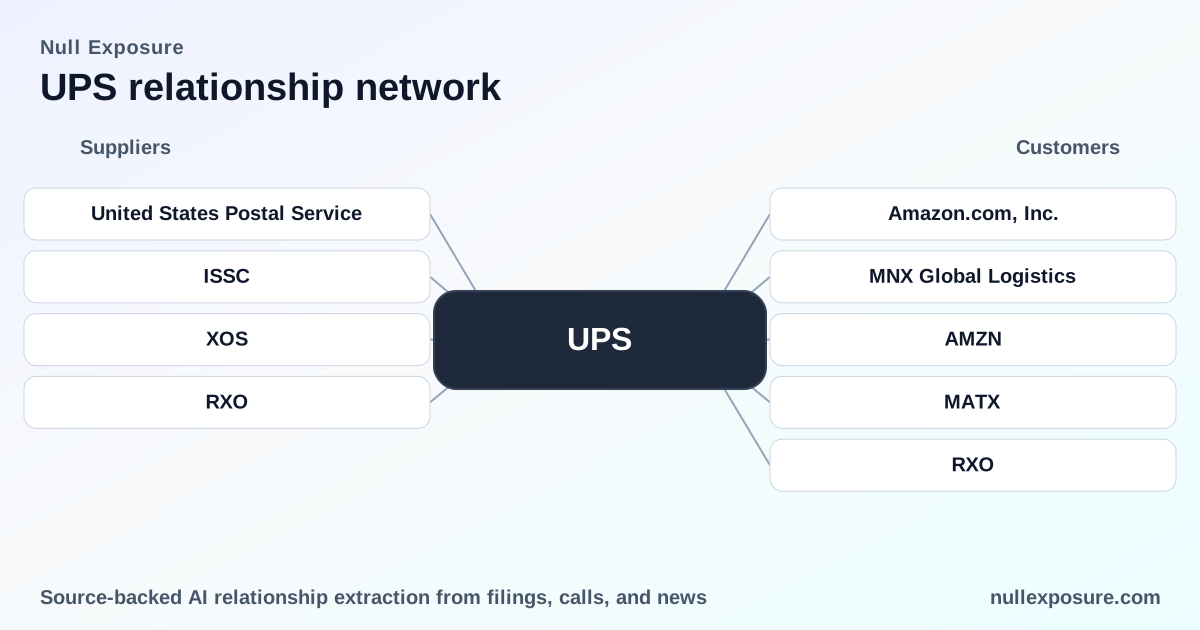
UPS customer map: concentration, reconfiguration, and the commercial plumbing that pays the bills
United Parcel Service (UPS) operates a global logistics network that monetizes primarily by selling time‑definite package, freight and supply‑chain services to enterprises and small businesses, billing customers on short payment cycles and reporting revenue on a gross basis as principal. Its cash flow is driven by network density, time‑sensitive domestic package volumes, higher‑value verticals (healthcare, returns and B2B), and pricing discipline as volumes shift. For investors evaluating customer risk and runway, UPS’s mix is a combination of a material anchor customer, broad SMB exposure, and targeted strategic moves to trade volume for margin. Learn more at https://nullexposure.com/.
What the customer evidence says about how UPS operates and contracts
UPS presents as a service‑centric, mature seller with short payment terms and global reach. The company uses short payment cycles (commonly seven days in U.S. domestic package) and does not embed significant financing in customer contracts, signalling a transactional, cash‑focused contracting posture rather than long, receivable‑heavy agreements. According to company disclosures, UPS emphasizes long‑term relationships while acting as principal in its revenue arrangements and serving both SMBs and large enterprise clients across more than 200 countries. These are company‑level signals that shape commercial risk and working capital dynamics.
- Contracting posture: short‑term payment terms; limited financing component to customer contracts (per FY2024 10‑K).
- Customer profile: mix of SMBs, B2B and verticals such as healthcare; strategy explicitly targets SMB and international growth.
- Geographic reach: global network with a significant North American domestic package franchise.
- Relationship maturity and role: customers are generally mature and long‑standing; UPS reports acting as principal in its revenue arrangements.
Customer relationships: the landscape you need to know
Below are the customer and partner mentions in the record set, each summarized with the source context.
Amazon (Amazon.com, Inc. / AMZN)
Amazon represented approximately 11.8% of consolidated revenues in FY2024, concentrated largely in UPS’s U.S. Domestic Package segment, and management disclosed a targeted reduction of about 1 million Amazon pieces per day by year‑end as part of a network reconfiguration. According to UPS’s FY2024 10‑K and the Q4 2025 earnings call, the company is deliberately stepping down low‑margin Amazon volumes to improve overall margin and network efficiency.
Source: UPS FY2024 10‑K; UPS 2025 Q4 earnings call.
MNX Global Logistics
MNX Global Logistics contributed to freight forwarding revenue growth after its acquisition by UPS in Q4 2023, supporting stronger demand out of Asia. UPS cites the MNX acquisition as a driver of international freight forwarding expansion in the FY2024 filing.
Source: UPS FY2024 10‑K (discussion of acquisition and freight forwarding growth).
RXO, Inc. / Coyote Logistics (buyer of Coyote)
UPS agreed to divest Coyote Logistics to RXO for roughly $1 billion, reflecting a disposition of a third‑party freight brokerage asset and a move to streamline core capabilities. News coverage documents RXO’s definitive agreement to acquire Coyote, finalizing a strategic sale of a non‑core business.
Source: Industry press reporting on RXO’s acquisition of Coyote (news coverage, 2026).
XGN (clinical laboratory customer)
Biotech/diagnostic companies report using UPS for secure, point‑to‑point transport of patient specimens and enhanced tracking, illustrating UPS’s penetration into healthcare logistics. An SEC filing from a clinical lab referenced UPS (and FedEx) as carriers for specimen transport.
Source: Company filing (SEC annual report) referencing logistics for lab specimens (FY2026).
Educational Development Corporation (EDUC)
Educational Development Corp. recounts using UPS professional services to optimize warehouse and distribution operations, reflecting UPS’s advisory and third‑party logistics capabilities for mid‑market retailers. Historical trade press documents the hands‑on role UPS played in reconfiguring distribution for EDUC.
Source: Trade reporting and MMH coverage (historical articles cited in news sentiment).
Pitney Bowes (PBI)
Pitney Bowes’ ShipAccel platform lists UPS among integrated carrier partners, indicating commercial partnerships where UPS provides carrier capacity and rate offerings through third‑party shipping platforms. This highlights UPS’s role as a carrier feed for shipping software and resellers.
Source: SupplyChainDive coverage of ShipAccel integrations (FY2024 reporting).
Matson Inc. (MATX)
Market commentary referenced Matson alongside UPS in competitive context for certain intermodal or expedited sea‑to‑land hybrid services, suggesting competitive dynamics where niche ocean‑land models pressure traditional parcel economics. The mention illustrates how logistics innovation from partners or rivals feeds into UPS’s market positioning.
Source: MarketMinute coverage and industry commentary (FY2026).
Newegg (NEGG)
Newegg’s trade‑in program uses prepaid UPS shipping labels to move returns and trade‑ins from consumers to Newegg’s facilities, demonstrating UPS’s role in e‑commerce reverse logistics and prepaid label services for retailers. Press releases and trade coverage describe customers receiving prepaid UPS labels by email.
Source: ChainstoreAge and company press coverage (FY2026).
WakeMed (healthcare pilot partner)
UPS tested drone deliveries and intra‑campus sample transport at WakeMed hospital campuses, an example of UPS piloting advanced delivery modalities in healthcare. This local pilot underlines UPS’s investment in last‑mile innovation for high‑value, time‑sensitive healthcare flows.
Source: Reporting of trials and pilot programs (news sentiment, FY2026 references).
The UPS Store (retail network)
UPS’s own retail network—The UPS Store—acts both as a distribution point and a technology deployment channel, with RFID and sensing rollouts covering shipments from over 5,500 locations. Company commentary on RFID and return‑bar expansions underscores how UPS leverages its retail footprint to scale new services.
Source: Investment commentary and company descriptions cited in industry writing (FY2026).
Happy Returns (returns network partner)
UPS expanded a consolidated Return Bar network in partnership with Happy Returns to 10,000 U.S. drop‑off locations and rolled out RFID sensing across its U.S. small‑package network, expanding returns handling and data capture. This is a strategic push into higher‑margin reverse logistics and improved package visibility.
Source: Industry reporting on expanded Happy Returns network and UPS RFID rollout (FY2026).
What this customer map means for investors
- Concentration risk is real but manageable: Amazon is a material customer at ~11.8% of revenue (FY2024), but management is trading volume for margin, reducing low‑margin pieces by target volumes disclosed on the Q4 2025 call. That is a deliberate commercial shift rather than a passive loss of business.
- Higher‑value verticals support margin upside: Expanded healthcare, returns (Happy Returns), and international freight (MNX) shift the mix toward higher ASP and margin lines of business.
- Short payment cycles lower receivable risk: Short contract payment terms and UPS’s principal sales posture reduce financing risk embedded in customer contracts.
- Network reconfiguration is a near‑term execution risk: Closing and reconfiguring facilities, RFID rollout and automation create temporary disruption but are positioned as long‑term cost and quality levers.
Signals to watch next
- Quarterly disclosure of U.S. Domestic Package volumes from Amazon and the net impact on yield.
- Progress metrics on RFID rollout and automation investment returns across The UPS Store and network hubs.
- Integration outcomes from MNX and any further divestitures or bolt‑on sales similar to Coyote.
- Healthcare and reverse logistics revenue mix growth as a percentage of total.
If you want a structured, investor‑grade export of these customer relationship signals, visit https://nullexposure.com/ for more.