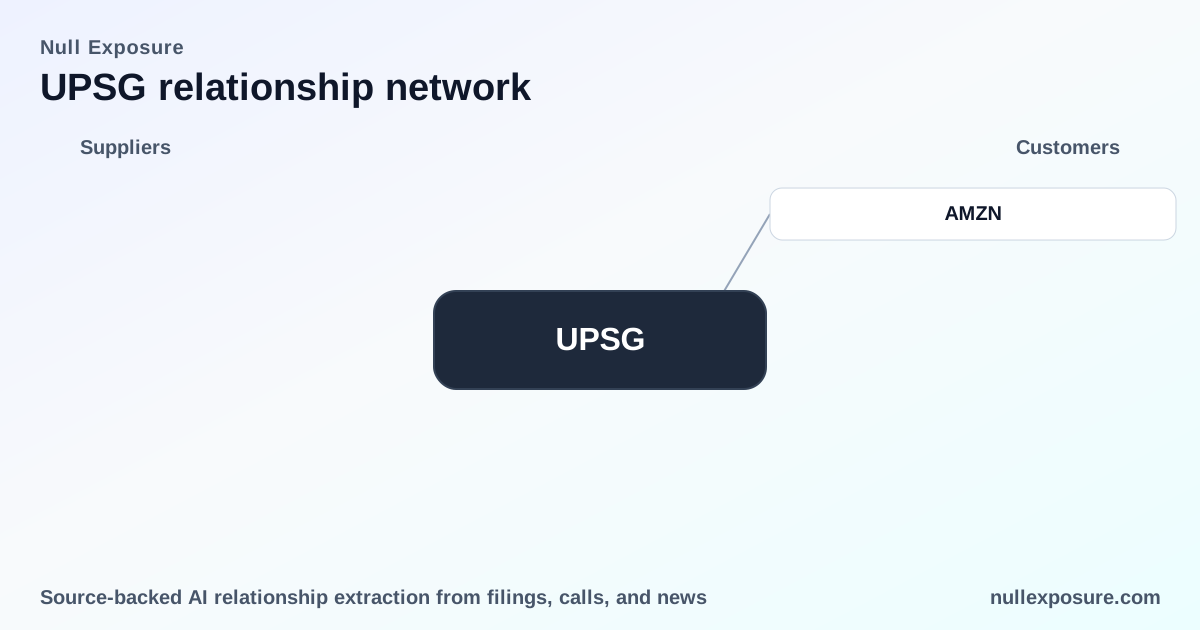
UPSG — Amazon relationship reshapes revenue mix and operations
UPSG operates an integrated parcel and logistics network that monetizes through contractually-sold transportation, last-mile delivery, and logistics services to large shippers, with a historically high exposure to one dominant client. Recent public reporting documents a negotiated rebalancing with Amazon that reduces UPSG’s volume from its single largest customer by over 50% into the second half of 2026, creating a structural change to mix, capacity planning, and labor needs that directly affects margins and free cash flow.
For a detailed view of customer-level intelligence and how it feeds investment decisions, visit https://nullexposure.com/ to review our sourcing and signal framework.
The commercial pivot with Amazon is explicit and time-bound
The company announced a deal with Amazon to cut Amazon-directed volume by more than 50% by H2 2026, a concrete contractual outcome that converts customer concentration risk into a defined runway for operational adjustment. That recontracting posture moves UPSG from an historically Amazon-dependent cadence to a materially different revenue mix over a known timeframe, which investors should treat like a scheduled contract unwind rather than an amorphous loss of demand (Barchart, March 10, 2026; fiscal reference FY2026).
What this means for operations and labor planning
The volume reduction is already embedded in operating decisions: UPSG trimmed its workforce contemporaneously with the agreement, citing the Amazon volume change as a clear rationale for headcount reductions. Management is matching headcount and network capacity to the new, lower Amazon volume profile, which lowers near-term labor and fixed-cost strain but also removes scale benefits that supported peak-season leverage (Barchart, March 10, 2026; referenced FY2025–FY2026 commentary).
How to think about contracting posture, concentration and criticality
- Contracting posture: The relationship transition is the result of an explicit negotiation with Amazon that establishes scheduled volume decline rather than an abrupt service termination. That creates predictability for planning and a clear timing vector for revenue recognition shifts.
- Concentration: Historically high concentration with a single large shipper is now being materially reduced; the change lowers single-counterparty revenue risk but raises questions about margin recovery absent Amazon-scale density.
- Criticality and maturity: Amazon was a critical customer for peak density and routing economics. The maturity of the relationship has moved from long-standing scale dependency into a managed unwinding phase, which requires recalibration of route density, hub utilization, and capital deployment.
No separate, explicit constraints were captured in the signals set; treat that absence as a company-level observation rather than a relationship-specific disclosure: the available relationship signals themselves drive the operating model interpretation above.
You can explore the underlying signals and source collection approach at https://nullexposure.com/.
Relationship-level evidence: each captured record and what it says
Amazon — Barchart report on job cuts tied to volume reduction (doc: 37255006)
UPS said in January 2025 it reached a deal with Amazon, its largest customer, to reduce Amazon-directed volume by more than 50% by the second half of 2026, a commercial agreement that directly prompted capacity and workforce planning decisions (Barchart news report, first seen March 10, 2026; fiscal period cited FY2026).
AMZN — duplicate record from the same Barchart piece (doc: 37255006)
The same Barchart article is indexed under the shorthand AMZN and reiterates that the company negotiated a substantial volume reduction with Amazon, reinforcing the point that the change is central to UPSG’s FY2026 operating assumptions (Barchart news report, March 10, 2026; FY2026).
Amazon.com, Inc. — coverage in comparative industry analysis (doc: 33301118)
A separate Barchart analysis comparing parcel carriers attributed UPS’ workforce trimming in FY2025 in part to the decision to reduce business with Amazon, linking human-capital adjustments directly to the changed customer mix and signaling measurable operational impacts in the prior fiscal year (Barchart analysis, first seen March 10, 2026; fiscal period FY2025).
AMZN — duplicate index entry for the comparative analysis (doc: 33301118)
The comparative piece listed under the ticker AMZN reiterates that UPS’ strategic decision to reduce volume from its largest customer was a material factor in its FY2025 workforce decisions, underlining the cross-period effect of the commercial deconcentration (Barchart analysis, March 10, 2026; FY2025).
Key investment takeaways and risk framing
- Immediate predictability, medium-term revenue pressure. The negotiated reduction with Amazon converts uncertain counterparty risk into a defined revenue contraction window; investors can model the volume decline explicitly through H2 2026 rather than relying on scenario guessing.
- Operational rebalancing has both cost and margin effects. Workforce reductions and de-densification of routes will lower near-term operating expenses but also remove scale efficiencies that supported margins during peak periods.
- Concentration risk transitions to re-grow risk. While single-customer concentration falls, UPSG now faces the harder task of redeploying capacity or winning new volume to restore network density and margin structure.
- Visibility is high but outcomes depend on replacement elasticity. The clarity of the deal provides planning certainty; the critical unknown is the company’s success in capturing replacement customers or optimizing the network for a lower Amazon share.
Final synthesis for investors
The available signals provide a clear, source-backed narrative: a contracted reduction of Amazon volume of more than 50% by H2 2026 and workforce actions tied to that change (Barchart reporting, March 2026; referenced fiscal periods FY2025–FY2026). For valuation and operations analysis, treat this as a scheduled deconcentration event that improves counterparty diversification but creates immediate revenue and margin headwinds until density is rebuilt or replaced.
For an ongoing, signal-driven view of UPSG’s customer relationships and to integrate these findings into quantitative models, visit our platform at https://nullexposure.com/.