Upstart’s customer map: who funds, who distributes, and what it means for investors
Upstart operates a cloud-based AI lending platform that connects borrowers, dealerships and credit unions with institutional capital; the company monetizes through platform and referral fees, licensing/subscription for dealer software, loan servicing revenue, and sales/forward-flow agreements with institutional buyers. These revenue streams create a hybrid software-and-finance model where usage-based economics and institutional funding partnerships drive unit profitability, while asset sales and forward-flow deals convert originations into near-term cash. Learn more at https://nullexposure.com/.
A compact thesis for investors
Upstart’s growth engine is its AI underwriting and dealer-facing software (Upstart Auto Finance) that generates originations which are then monetized via fees, servicing margins, and institutional purchases. The company is deeply concentrated in U.S. consumer credit and relies materially on a small set of large funding partners; recent months show an intentional shift toward forward-flow and portfolio sales to diversify funding and de-risk the balance sheet.
How the company contracts and what that implies
Upstart’s commercial posture combines multiple contracting models: usage-based fees for origination and referral, short-term subscription/licensing for dealer software, and long-term servicing commitments on loans sold into securitizations. These arrangements create a capital-efficient revenue profile — unit economics are positive at the transaction level — but also concentrate counterparty risk because the top three lending partners accounted for 83% of originations and 61% of revenue in 2025, a structural concentration investors must price into valuation. The business is primarily U.S.-centric, relies on individual borrower data flows, and is active with more than 100 lending partners, which supports scalability but does not eliminate counterparty concentration as a dominant risk factor.
Institutional buyers and forward-flow partners: the funding backbone
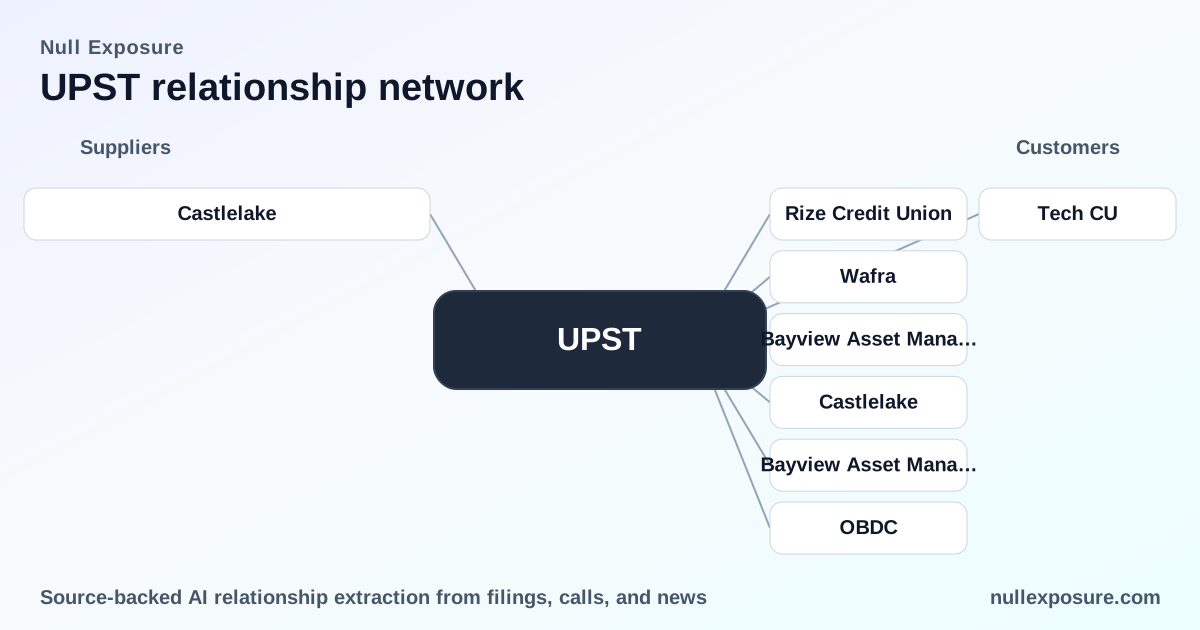
- Bayview Asset Management — Upstart sold a $333 million portfolio of Upstart Auto assets to affiliates of Bayview, a cash-converting move that reduces on-balance sheet exposure and recognizes realized economics from prior originations. (Finviz, March 2026)
- Wafra — Entered an inaugural $200 million 12‑month forward‑flow agreement to purchase assets from Upstart’s auto finance platform, establishing a predictable funding channel for future originations. (Investing News and AlternativesWatch, Feb–Mar 2026)
- Castlelake — Agreed in November to a 12‑month commitment to buy up to $1.5 billion of consumer loans originated through Upstart’s platform, demonstrating appetite from alternative managers for Upstart-originated credit. (AlternativesWatch, Feb 23, 2026)
- Blue Owl Capital (OBDC) — A prior commitment announced in October 2024 provides up to $2 billion over an 18‑month period to purchase consumer loans originated on the platform, fitting the pattern of large, multi‑period forward-flow transactions that supply originations with external capital. (AlternativesWatch, Feb 23, 2026)
Key takeaway: these institutional relationships convert originations into immediate funding and reduce balance sheet bearing, but they also connect Upstart’s economics to the appetite and underwriting tolerance of large asset managers.
Credit unions and dealers: distribution growth on the retail side
- Rize Credit Union — Partnered with Upstart to support personal loans for California members, expanding Upstart’s credit-union distribution in a key U.S. market. (Simply Wall St, March 10, 2026)
- Harborstone Credit Union — Announced a partnership enabling Harborstone to offer personal lending via Upstart’s platform, adding to the company’s growing credit-union footprint. (TradingView/Zacks, May 4, 2026)
- DuPage Credit Union — Selected Upstart’s platform for personal lending, signaling continued adoption among regional credit unions seeking digital origination capabilities. (TradingView/Zacks, May 4, 2026)
- Tech CU — Cited among partnerships helping the company scale auto and home lending, indicating dealer and credit-union channels are contributing to product expansion beyond unsecured personal loans. (TradingView/Zacks, March 2026)
Key takeaway: Upstart is deliberately broadening retail distribution through credit unions and dealers, which strengthens origination volume and diversification of point-of-sale channels while maintaining the U.S. consumer focus.
Other counterparty notes investors should track
- WSFS — In a Q4 2025 earnings call transcript WSFS noted it divested its Upstart exposure, indicating at least one regional bank reduced holdings of Upstart-originated assets or indirect exposure. This highlights that counterparty positions can change quickly and underscores reliance on asset buyers’ appetite. (InsiderMonkey, May 2026)
How these relationships show up in the company’s operating model
- Contracting: mixture of usage-based pricing, short-term subscriptions, and long-term servicing obligations creates predictable per-loan economics but requires continuous origination volume to maximize revenues.
- Counterparty mix: Upstart serves individual borrowers, dealers (as licensees), and institutional investors; the model benefits from scale but is sensitive to funding-partner concentration.
- Geography and scale: Operations are concentrated in North America (U.S.), which sharpens sensitivity to U.S. consumer-credit cycles.
- Materiality: Company-level data shows top-partner concentration is critical to revenue; conversely, provisions for bad debt and certain trailing liabilities have been immaterial in recent reporting, indicating credit performance and liability management have not produced large headline losses to date.
Valuation and risk implications for investors
Upstart’s move to structure forward‑flow commitments and portfolio sales is strategically sound for converting originations to cash and limiting balance-sheet duration, and institutional demand from Bayview, Wafra, Castlelake and Blue Owl supports near-term funding predictability. However, concentration of revenue and originations among a few lending partners elevates counterparty and re-pricing risk: a withdrawal or re‑pricing by a major buyer would materially impact revenue and liquidity. The combination of usage-based economics and subscription/licensing for dealer software supports high incremental margins as originations scale, but investors must price in macro sensitivity from U.S.-centric consumer credit cycles.
If you want a systematic view of how these funding and distribution relationships affect Upstart’s near-term cash generation and concentration risk, explore our developer-grade modeling and relationship dashboards at https://nullexposure.com/.
Bottom line
Upstart sits at the intersection of fintech software and asset origination: its revenue profile is diversified across fees, licensing and asset sales, but its economics are driven by a concentrated set of institutional buyers and U.S.-only end markets. For investors, the critical variables to monitor are the health and continuity of forward-flow partners, the pace of credit-union and dealer adoption, and the company’s ability to sustain positive per-loan unit economics under changing macro conditions.