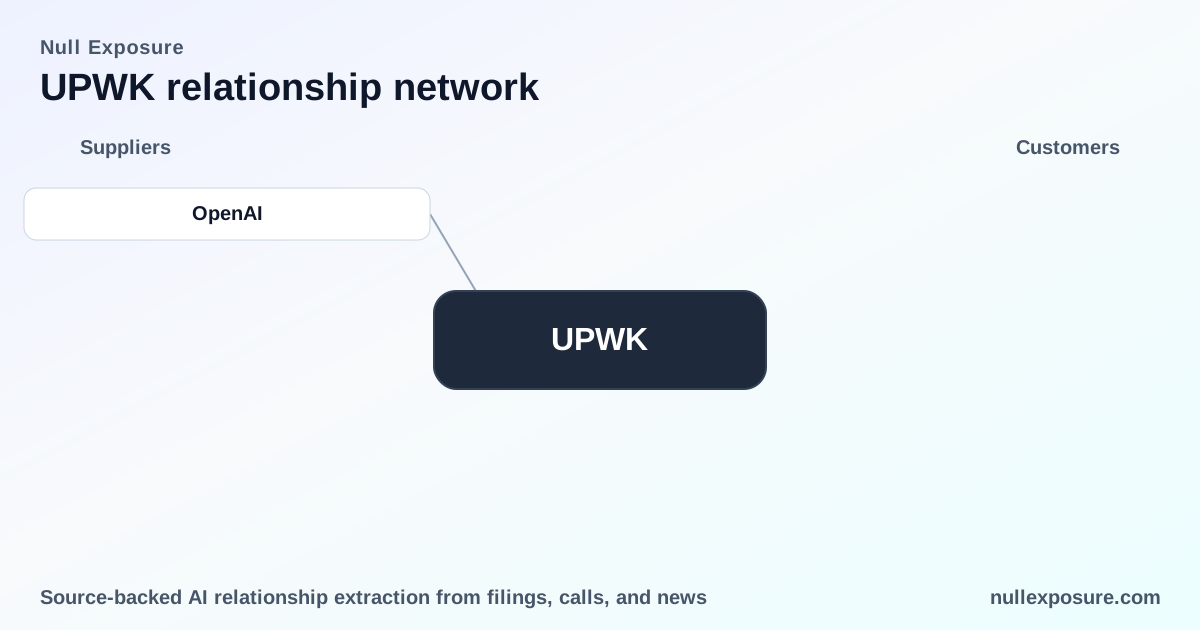
Upwork’s customer map: marketplace monetization, AI distribution, and the ChatGPT tie‑in
Upwork operates a two‑sided online talent marketplace that connects businesses with independent professionals and agencies worldwide and monetizes through transaction fees on marketplace spend plus subscription products for enterprise customers and enhanced offerings for SMBs and talent. Revenue derives from a blend of percentage fees on gross services volume (GSV), subscription contracts for Enterprise Solutions, and talent service fees, while recent product moves push distribution into third‑party AI interfaces to accelerate deal flow and lower customer acquisition cost. For deeper coverage of Upwork customer relationships and implications for partners and investors, see https://nullexposure.com/.
A concise operating thesis: marketplace economics with subscription anchors
Upwork’s core economics combine marketplace take rates on client spend with recurring subscription revenue from enterprise customers. For Enterprise Solutions the company charges monthly or annual subscription fees plus a service fee calculated as a percentage of client spend, and talent also pay a 10% service fee, creating both transaction‑linked and predictable recurring revenue streams. Company filings show the platform enabled roughly $4.0 billion of GSV in FY2025 while trailing twelve‑month revenue was roughly $788 million, underscoring that transaction volumes drive the top line while subscriptions improve revenue visibility.
- Business model driver: transactional leverage from GSV expansion and incremental revenue from Enterprise subscriptions and upgraded SMB offerings.
- Monetization levers: service fees on talent, client spend take rates, and subscription pricing for enterprise customers.
The strategic distribution play: Upwork embedded into ChatGPT
On April 9, 2026, Upwork launched an Upwork app within ChatGPT that lets businesses describe project needs, discover suitable talent, and draft job posts before moving to the Upwork Marketplace, where Upwork’s AI agent Uma™ helps scope projects, generate contracts, and start work. According to a Simply Wall St report published May 4, 2026, this integration routes demand directly from a high‑frequency conversational interface into Upwork’s funnel, shortening the path from discovery to purchase and deepening AI‑enabled workflow ownership.
- Key takeaway: embedding the marketplace in a widely used conversational AI creates a high‑intent inbound channel that increases funnel velocity and tightens Upwork’s value proposition for buyers seeking quick project scoping and execution. (Simply Wall St, May 4, 2026)
Full coverage of tracked customer relationships
- ChatGPT — Upwork launched an Upwork app within ChatGPT on April 9, 2026 that enables businesses to describe project needs, discover talent, draft job posts, and then progress into the Upwork Marketplace where the AI work agent Uma™ scopes and initiates work; this integration offers Upwork direct distribution through a high‑engagement AI interface. Source: Simply Wall St, May 4, 2026.
What the relationship landscape and constraints tell investors
The extracted commercial constraints from company disclosures and reporting provide a clear signal set about Upwork’s operating model:
- Contracting posture: Upwork operates a hybrid model with both transactional (marketplace fees) and subscription contracts—Enterprise Solutions are explicitly sold as monthly or annual subscriptions alongside percentage‑based service fees. This creates a mix of predictable revenue and volume sensitivity tied to client spend.
- Counterparty mix and concentration: Upwork serves a broad spectrum of counterparties—individual independent professionals and agencies, small businesses and SMBs, mid‑market, and large/very large enterprises including Fortune 100s—which diversifies demand sources but also requires segmented GTM and productization strategies to serve different retention drivers.
- Global footprint and scale: Upwork’s platforms have customers in over 180 countries, and the company reported approximately $4.0 billion of GSV for FY2025, confirming both geographic reach and the scale of transacted economic activity.
- Role and criticality: Upwork functions as a service provider platform, connecting buyers and sellers of labor and providing workflow tools (including AI assistants) that increase the platform’s criticality to buyer procurement and freelancer productivity.
- Relationship maturity and activity: Company disclosures define an active client as one with spend in the prior 12 months; active clients decreased 6% year‑over‑year as of December 31, 2025, signaling near‑term retention pressure even as monetization initiatives drove take‑rate expansion.
- Segment focus: The firm continues to expand Enterprise, SMB (Business Plus), and AI‑native experiences (Uma) as primary growth vectors, which aligns monetization toward higher‑value, stickier customers.
These constraints combine into a cohesive operational picture: Upwork balances exposure to cyclical marketplace volumes with subscription anchors, has a geographically diversified counterparty base, and is actively pushing AI integrations and product tiers to increase monetization per client.
Risks and tactical implications for operators and investors
- Retention and volume sensitivity: The 6% decline in active clients in 2025 demonstrates exposure to client churn and acquisition cyclicality; enterprises with subscriptions provide some insulation, but overall top‑line remains tied to GSV.
- Channel and platform dependency: Embedding Upwork into large third‑party interfaces like ChatGPT reduces customer acquisition friction but increases reliance on external distribution partners for demand generation and discovery.
- Counterparty complexity: Serving individuals through to very large enterprises requires continuous investment in differentiated product features, compliance, and pricing tiers; execution risk here affects margin and unit economics.
- AI as a double‑edged sword: AI capabilities such as Uma increase productivity and stickiness, but they also raise the bar for competitors and require continuous investment to preserve differentiation.
Where investors should focus next
- Track metrics that reflect the hybrid model: GSV growth, take rate trends, subscription ARR for Enterprise Solutions, and active client counts. Company filings already point to product initiatives—ads products, Connects pricing optimization, Lifted for contingent workforce solutions, and Business Plus for SMBs—that are designed to expand monetization across segments.
- Monitor partner distribution momentum from integrations like the ChatGPT app for signs of scaled channel effects versus one‑off trials.
If you want concise, relationship‑level intelligence and ongoing monitoring for Upwork and its distribution partners, explore our coverage at https://nullexposure.com/ for detailed mappings and signal tracking.
Investor takeaway: Upwork has engineered a monetization mix that pairs marketplace volume with subscription contracts, and recent AI and distribution integrations materially increase demand access and workflow lock‑in; the near‑term challenge is restoring active client growth while capturing higher take rates across customer segments.