Urban Outfitters (URBN): Customer relationships and what they mean for investors
Urban Outfitters operates a multi‑channel apparel and lifestyle retail platform that monetizes through retail sales, wholesale distribution, and a subscription rental business. The company drives revenue from its core retail brands (Urban Outfitters, Anthropologie, Free People) and from wholesale placements in department and specialty stores, while its Nuuly subscription generates recurring monthly fees that diversify cash flow and increase lifetime customer value.
For a focused view of URBN’s customer relationships and external signals, see NullExposure for deeper counterparty mapping: https://nullexposure.com/
Quick investment thesis
Urban Outfitters combines stable brick‑and‑mortar and digital retail economics with a growing subscription line that adds recurring revenues and customer data. Revenue TTM of roughly $6.17 billion and an operating margin near 8.8% show scale and margin resilience; the business mix and high institutional ownership position URBN as a mid‑cycle consumer retail operator with exposed, but addressable, top‑line sensitivity to fashion trends and wholesale partner decisions.
What the Target mentions in the news tell investors
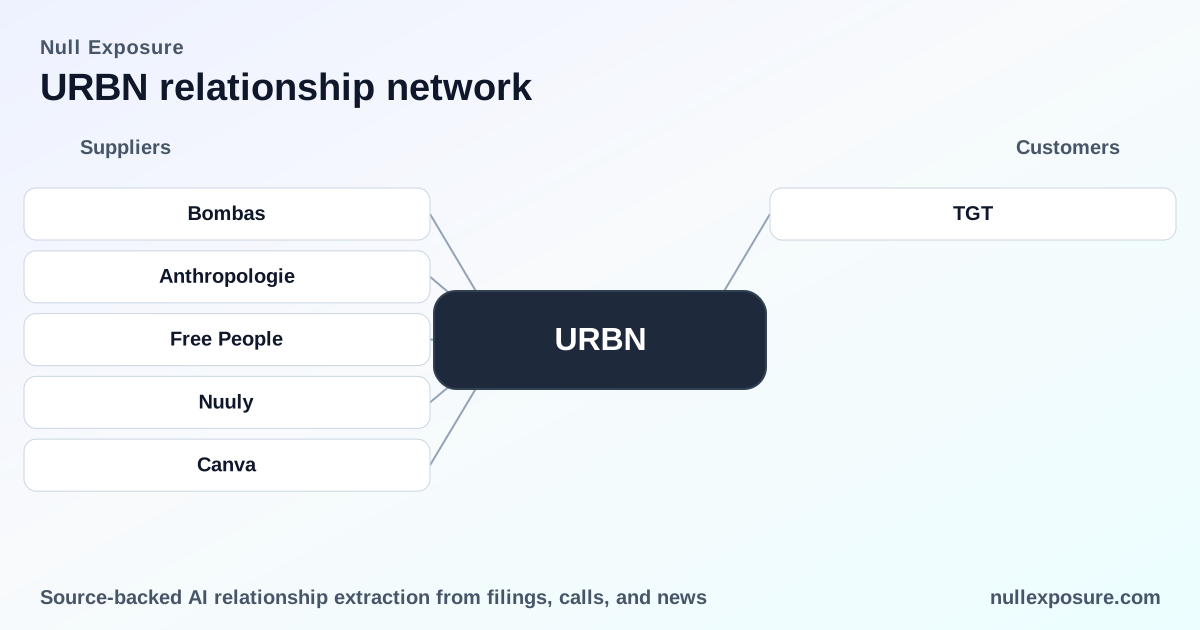
The relationship results in the provided signal set all reference Target (TGT) coverage in third‑party financial news discussing assortments and product placements tied to Urban Outfitters’ Free People brand.
-
Target debuts Free People intimates assortment — Finviz article linked to a Wells Fargo note (first seen Mar 10, 2026). This report documents Target carrying a Free People intimates assortment, indicating Wholesale placements of URBN brands into a mass merchant channel and the strategic reach of Free People beyond URBN’s own doors. (Source: Finviz news item referencing a Wells Fargo commentary, Mar 9–10, 2026.)
-
Target debuts Free People intimates assortment — duplicate reference in the Finviz Wells Fargo note (Mar 10, 2026) that reiterates the same placement detail and market reaction. The duplicate coverage underscores media attention on URBN brand distribution decisions that can affect wholesale revenue visibility. (Source: Finviz/Wells Fargo note, Mar 9–10, 2026.)
-
Target debuts Free People intimates assortment — Finviz reporting tied to Urban Outfitters’ Q4 CY2025 earnings coverage (first seen Mar 10, 2026) again highlights the Free People rollout at Target, and situates that development within quarterly performance commentary. This links wholesale channel execution to reported results and points to revenue recognition routes outside URBN’s own retail footprint. (Source: Finviz earnings coverage of URBN Q4 CY2025, Mar 9–10, 2026.)
-
Target debuts Free People intimates assortment — the repeating Finviz earnings/new‑note item confirms the same commercial arrangement noted above and the market’s focus on how brand extensions are being monetized through big‑box partners. Consistent press mentions across outlets indicate the placement is active and relevant to investor sentiment. (Source: Finviz earnings and market note, Mar 9–10, 2026.)
Each of the four relationship records points to the same real‑world commercial outcome: Free People assortments are being distributed through Target, translating URBN wholesale product into a higher‑velocity, mass market channel and creating an incremental revenue vector documented in public market commentary.
Operating model and business constraints investors should weigh
Urban Outfitters presents a hybrid operating model with several clear company‑level characteristics:
-
Contracting posture: subscription and recurring billing. The Nuuly subscription is a monthly rental business that invoices subscribers on an automatic monthly basis, creating a contractual cadence and predictable revenue stream separate from seasonal retail cycles. Company filings explicitly state that Subscription revenue is primarily generated through monthly subscription fees.
-
Counterparty concentration: individual consumers are the primary counterparties. URBN targets young adults (roughly 18–28), and Nuuly specifically serves individual subscribers who rent apparel through a digital platform, making consumer behavior and brand loyalty critical drivers.
-
Geographic footprint: North America first, material European exposure, and global wholesale reach. Store counts and foreign operations show heavy North American concentration with meaningful EMEA presence and wholesale distribution to department and specialty stores worldwide.
-
Relationship roles: seller, service provider, distributor and reseller. URBN operates simultaneously as a direct seller via stores and digital channels, a service provider through Nuuly’s subscription model, and a distributor/reseller where wholesale partners stock URBN brands.
-
Maturity and stage: core products are mature; subscription is an active, growing service. The Retail segment constitutes the core product line with decades of retail experience, while the Subscription segment is an active, recurring service that complements retail and wholesale lines.
-
Criticality and concentration risk: brand placements in large retailers carry outsized visibility but not single‑partner dependency. Wholesale placements with mass merchants increase scale quickly but create sensitivity to partner assortment decisions; repeated news items about Target carrying Free People show both opportunity and exposure to partner channel dynamics.
These constraints should be viewed as company‑level signals that explain how URBN monetizes across channels and how counterparty behavior (individual consumers, large retail partners) affects cash flow and growth.
What this means for cash flow and risk
-
Recurring subscription revenue reduces seasonality and improves cash flow visibility, but the subscription business competes for inventory and marketing dollars with retail and wholesale channels. The Nuuly model increases customer engagement but requires ongoing inventory maintenance and logistics expense.
-
Wholesale expansions into mass channels like Target accelerate revenue reach but compress margin profiles relative to full‑price retail; investors should watch gross margin and channel mix for signs of dilution or accretion.
-
Geographic expansion into EMEA and wholesale relationships create diversified revenue streams but add complexity to supply chain and FX exposure. URBN’s international store and franchise footprint materially diversifies sales but raises operating cadence demands.
Key takeaways for investors
-
URBN is a multi‑channel retailer that monetizes via retail sales, wholesale distribution, and a recurring subscription business (Nuuly). This mix creates both margin diversification and operational complexity.
-
The repeated media references to Target carrying Free People assortments confirm active wholesale execution that can meaningfully impact near‑term revenue recognition and investor sentiment. (Finviz coverage and related Wells Fargo notes, Mar 9–10, 2026.)
-
Company filings confirm subscription revenue is driven by monthly fees and that URBN’s customer base is predominantly individual consumers in North America with meaningful EMEA operations. These elements make consumer trends and partner assortment decisions key value drivers.
For deeper mapping of counterparty exposure and to monitor how URBN’s wholesale placements evolve over time, consult NullExposure’s relationship views at https://nullexposure.com/ — the platform surfaces placement and partner signals that matter for active investors.
Final observation
Urban Outfitters combines scale, brand breadth, and a subscription experiment that stabilizes revenue. Investors should weigh the upside of wholesale distribution expansion against margin pressure from mass‑merchant placements and the operational demands of a growing subscription service. Continuous monitoring of channel mix and partner assortment announcements—like the Target/Free People mentions—will be a leading indicator of near‑term revenue trajectory.