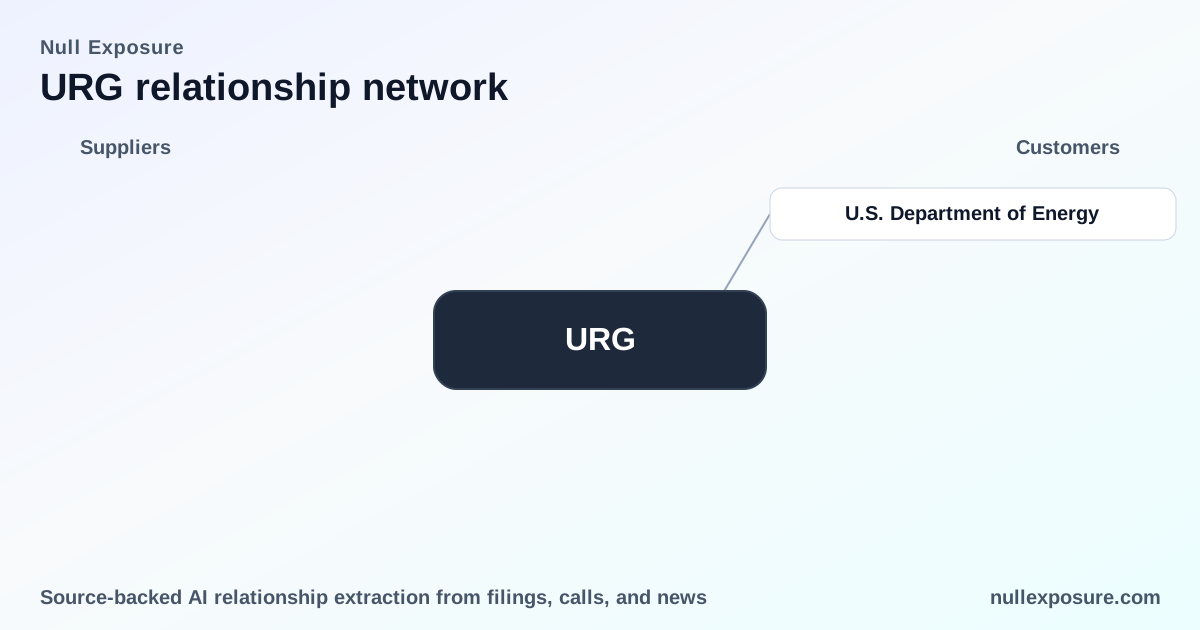
Ur-Energy (URG): Customer relationships define a seller-led, contract-heavy revenue model
Ur-Energy operates and monetizes as a producer and seller of uranium (U3O8), generating revenue primarily through multi-year sales agreements with utilities and large purchasers, supplemented by spot and government sales and occasional third‑party processing arrangements. The company is a seller of a single, mission‑critical commodity (yellowcake) with revenue concentrated in a small number of long‑term counterparties, and it leverages both direct sales and strategic government opportunities to stabilize cash flow. Learn more about our coverage at https://nullexposure.com/.
How Ur‑Energy’s customer profile shapes value and risk
Ur‑Energy’s operating model is defined by its contracting posture and customer concentration as much as by geology and production. Company disclosures and public reports consistently show a deliberate move into multi‑year contracts, government engagements and selective processing relationships. The practical implications for investors are:
- Long‑term contracting posture: Ur‑Energy has multiple multi‑year sales agreements that underpin future production receipts and reduce near‑term price exposure, which supports predictable revenue recognition across 2025–2030. Company disclosures cite seven multi‑year agreements with base annual delivery bands, establishing a baseline for near‑term cash flow.
- High concentration, high materiality: Disclosures indicate that a tiny number of buyers account for nearly all U3O8 sales in a recent period; two counterparties together represented roughly 98% of recorded U3O8 sales in the cited disclosure, concentrating counterparty credit and negotiation risk.
- Core-product criticality and seller role: Uranium sales are the core product and primary revenue source; Ur‑Energy acts primarily as a seller of produced U3O8 rather than a commodity trader, so customer relationships are central to operational value capture.
- Government counterparty engagement: The company has a documented history of working with the U.S. government — both as a seller under the national reserve program and as a bidder for additional procurements — which introduces a strategic, higher‑visibility revenue channel.
- Maturity and activity: Contracted deliveries and 2024 shipments show relationships are active and operational rather than exploratory; the business is in a commercialization phase with ongoing deliveries and processing discussions.
- Spend band and economics: Reported sales volumes and proceeds place most counterparty spend in the mid‑to‑large transaction band (roughly the $10m–$100m band cited), meaning individual contracts are economically meaningful to company cash flow.
These characteristics make Ur‑Energy a seller with predictable delivery obligations and concentrated counterparty exposure, which is attractive for predictability but increases exposure to counterparties’ credit quality and contract renewal terms.
Detailed customer relationships — who is buying (or talking with) Ur‑Energy
Noble Plains Uranium Corp. — potential processing partner under LOI
Ur‑Energy entered a non‑binding Letter of Intent with Noble Plains to outline potential future processing of uranium‑bearing solutions from the Shirley Central project in Wyoming, positioning Ur‑Energy as a service provider/processor in addition to its seller role and expanding its addressable revenue base beyond its own mined production. Source: Noble Plains press release, May 4, 2026 (Newsfile) — https://www.newsfilecorp.com/release/292658/Noble-Plains-Uranium-Announces-Strategic-Letter-of-Intent-with-UrEnergy-for-Potential-Processing-of-Shirley-Central-Uranium-Production.
U.S. Department of Energy — direct government procurement and reserve participation
Ur‑Energy has engaged the U.S. Department of Energy both as a seller and as a bidder: the company sold 100,000 pounds of U3O8 to the DOE’s National Nuclear Security Administration in January 2023 under the national uranium reserve program, and more recently submitted a bid proposal in response to DOE solicitations for up to one million pounds of domestically produced uranium. Government demand provides a strategic, non‑market demand channel that supports pricing and volume stability when utilized. Source: Resource World coverage of Ur‑Energy’s activities and DOE bid submission, March 10, 2026 — https://resourceworld.com/ur-energy-unveils-u-s-uranium-supply-agreement/. Company filings document the January 2023 DOE sale under the national uranium reserve program.
What each relationship implies for revenue certainty and optionality
Noble Plains LOI: The Noble Plains LOI signals potential upside through third‑party processing fees or tolling arrangements, which can convert idle processing capacity into incremental margin without immediate capital commitment; the LOI is non‑binding and therefore represents optional commercial expansion rather than guaranteed revenue.
DOE engagements: The DOE relationship is both a historical cash event (100,000 lbs sale in 2023) and an ongoing strategic channel through active bidding for larger procurements. Government transactions are high‑impact and high‑visibility, delivering concentrated revenue and policy‑aligned demand that de‑risks commodity cycles when awarded.
Company‑level concentration: Separate company disclosures show that Ur‑Energy’s revenue profile in reported periods is materially concentrated in two large buyers that together accounted for roughly 98% of U3O8 sales in the cited data; this structure delivers substantial revenue visibility while concentrating counterparty and renewal risk.
Investment implications and risk checklist
- Revenue stability vs. counterparty concentration: Multi‑year agreements and government contracts provide a foundation of demand, but a small number of counterparties dominate sales — monitor counterparty credit, contract expiration schedules, and renewal terms.
- Commercial expansion through processing: Non‑binding LOIs show management pursuing downstream options to monetize processing capacity and capture fees; these opportunities increase optionality but require conversion to binding contracts to affect cash flow.
- Policy sensitivity: Government purchases (e.g., DOE reserve) materially affect demand; shifts in procurement policy or funding timelines will directly affect Ur‑Energy’s near‑term bookings.
- Operational execution: Deliveries reported in 2024 and active contract fulfillment through 2025–2030 depend on steady production from assets; production disruptions would quickly stress a concentrated counterparty book.
Bottom line for investors
Ur‑Energy is a contract‑driven uranium producer whose value is tightly coupled to a handful of large counterparties and government procurement programs. The company’s multi‑year sales agreements and strategic government engagements deliver predictability, while LOIs with third parties like Noble Plains indicate a deliberate push to diversify revenue streams through processing services. Investors should weight the benefits of long‑term contracted revenue against concentrated counterparty exposure and policy dependence.
Explore our broader coverage for comparatives and counterparty analytics at https://nullexposure.com/.
Bold takeaway: Long‑term contracts and government business make Ur‑Energy a seller with high revenue visibility, but concentrated counterparties and the need to convert LOIs into binding contracts are the principal commercial risks to monitor.