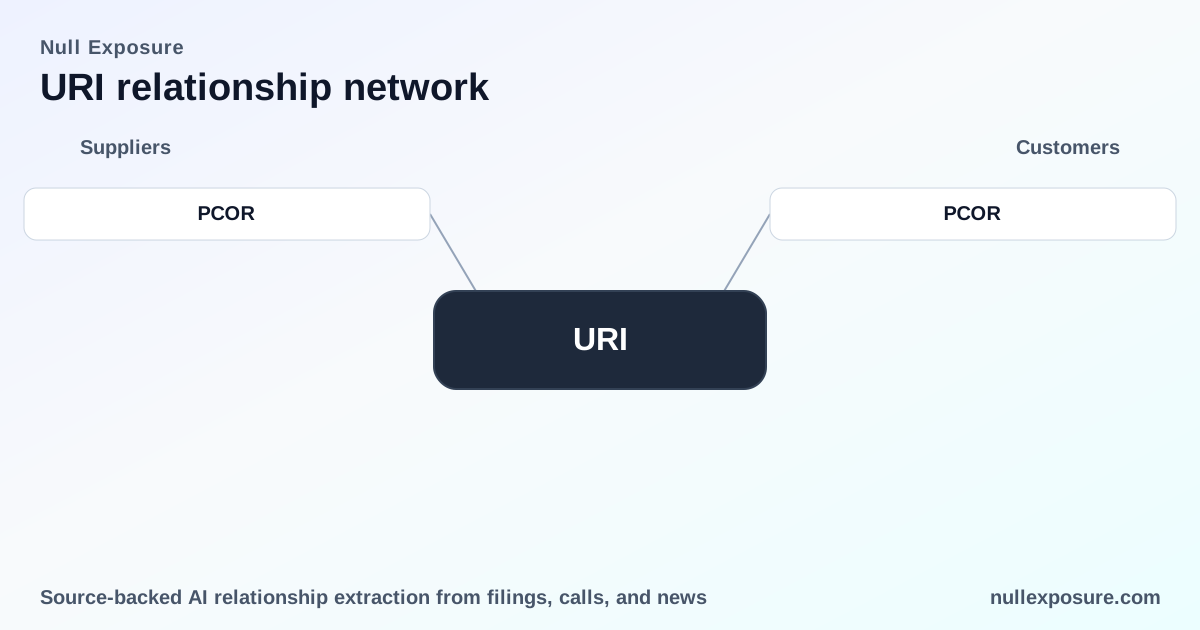
United Rentals (URI): How customer relationships and a new Procore link change the equipment rental story
United Rentals rents construction and industrial equipment on short-term cycles and monetizes through hourly-to-monthly rental fees, ancillary services, used-equipment sales and fleet financing, with equipment rentals representing the bulk of revenue. The company is the global leader in equipment rental, with a North American-focused footprint and diversified customer mix that ranges from homeowners and small businesses to Fortune 500 firms and government entities. For investors evaluating customer dynamics, the strategic question is how service differentiation and data integrations — not just fleet scale — convert into durable demand and margin expansion. For further signals on counterparties and relationship footprints, see https://nullexposure.com/.
Executive thesis: scale plus service, now augmented by data
United Rentals’ business is scale-driven and transaction-heavy: a very large owned fleet rented on relatively short contract durations, producing steady recurring revenue and high operating leverage when utilization trends upward. The company’s diversification across customer types and geographies reduces single-counterparty concentration, while proprietary service offerings like Total Control® and emerging telematics integrations increase switching costs for large account relationships. The new telematics partnership with Procore is an operational lever that enhances customer stickiness and cross-sell potential by embedding rental fleet visibility into customers’ project-management workflows.
Why the Procore integration matters to investors
The Procore integration is a concrete example of United Rentals shifting part of its competitive differentiation from pure fleet scale to data-enabled service. By feeding United Rentals’ telematics into Procore’s Resource Management platform, United Rentals increases the operational dependency of construction customers on its rental flows, which supports utilization, reduces idle time, and creates follow-on revenue from service and logistics. This is a customer-retention and efficiency play that improves the effective yield on the fleet without requiring proportional capex increases.
All reported customer relationships in the record (every entry)
Below I list each captured relationship mention from the results and provide a concise investor-facing summary with the relevant source.
-
United Rentals announced a telematics integration with Procore that pushes rental-equipment data into Procore’s Resource Management platform, giving shared customers unified visibility of owned and rented assets on jobsites. According to a Simply Wall St report dated March 10, 2026: https://simplywall.st/stocks/us/software/nyse-pcor/procore-technologies/news/is-procore-pcor-quietly-redefining-its-platform-edge-with-un/amp
-
The Procore link was characterized as a partnership delivering United Rentals’ telematics into Procore’s Resource Management to improve visibility and equipment coordination across jobsites. This detail is noted in Simply Wall St coverage on March 10, 2026: https://simplywall.st/stocks/us/software/nyse-pcor/procore-technologies/news/is-procore-pcor-quietly-redefining-its-platform-edge-with-un/amp
-
A news mention described the February 2026 partnership as United Rentals and Procore launching a telematics integration to bring rental equipment data directly into Procore’s Resource Management solution. See Simply Wall St (URI company news, March 10, 2026): https://simplywall.st/stocks/us/capital-goods/nyse-uri/united-rentals/news/united-rentals-procore-telematics-link-aims-to-deepen-custom
-
The integration is reported to be the first telematics linkage between the two companies, allowing mutual customers to feed United Rentals equipment data directly into Procore for better jobsite coordination. Source: Simply Wall St article dated March 10, 2026: https://simplywall.st/stocks/us/software/nyse-pcor/procore-technologies/news/is-procore-pcor-using-ai-telematics-to-deepen-its-constructi
-
Another entry repeats that United Rentals’ telematics data is being integrated into Procore’s Resource Management platform to give shared customers a unified view of equipment across jobsites. Reported by Simply Wall St on March 10, 2026: https://simplywall.st/stocks/us/software/nyse-pcor/procore-technologies/news/is-procore-pcor-quietly-redefining-its-platform-edge-with-un
-
A second URI news entry confirms the telematics link as an initiative to deepen customer relationships by surfacing rental data inside Procore’s workflow environment. See Simply Wall St (URI news, March 10, 2026): https://simplywall.st/stocks/us/capital-goods/nyse-uri/united-rentals/news/united-rentals-procore-telematics-link-aims-to-deepen-custom
-
Coverage reiterates the joint announcement in February 2026 and frames the integration as improving visibility and equipment coordination for mutual customers. Source: Simply Wall St (March 10, 2026): https://simplywall.st/stocks/us/software/nyse-pcor/procore-technologies/news/is-procore-pcor-using-ai-telematics-to-deepen-its-constructi
-
A follow-up mention again notes the integration is intended to feed United Rentals’ equipment data directly into Procore’s Resource Management platform to improve jobsite coordination. Reported March 10, 2026 on Simply Wall St: https://simplywall.st/stocks/us/software/nyse-pcor/procore-technologies/news/is-procore-pcor-quietly-redefining-its-platform-edge-with-un
-
A final entry duplicates the same announcement and purpose: the initial telematics integration gives construction customers better visibility over owned and rented equipment across job sites. Source: Simply Wall St news (March 10, 2026): https://simplywall.st/stocks/us/software/nyse-pcor/procore-technologies/news/is-procore-pcor-using-ai-telematics-to-deepen-its-constructi
(Each of the nine records reflects the same February 2026 Procore integration announcement reported across related Simply Wall St items.)
How company-level constraints shape customer risk and opportunity
United Rentals’ public disclosures provide clear, investable signals about its customer relationships:
-
Contracting posture: short-term and transactional. Rental contracts are hourly, daily, weekly or monthly, which produces high revenue churn but also rapid re-pricing and utilization sensitivity. This structure favors a business that can quickly scale utilization gains into EBITDA expansion.
-
Counterparty diversity: broad and multi-segment. The customer base explicitly includes municipalities, government entities, homeowners/individuals, small businesses and very large enterprises, which reduces single-counterparty concentration and supports steady demand across economic cycles.
-
Geographic focus: North America first. United Rentals primarily operates in the United States and Canada with smaller footprints overseas; this regional concentration ties performance materially to North American construction cycles.
-
Materiality: rental economics are core. Equipment rentals accounted for 86% of 2025 revenues, while the largest single customer represented ~1% of revenues, signifying low customer concentration but high business-line concentration in rentals.
-
Relationship maturity and criticality: mixed. Total Control® and long-term account services indicate mature, higher-touch relationships with larger customers, while the short-term contract cadence leaves many customer interactions transactional. The Procore integration is an example of converting transactional flows into sticky, workflow-embedded relationships.
-
Role and revenue capture: seller plus service provider. United Rentals is primarily a seller of rental services, and revenue recognition practices reflect credit adjustments against lease revenues, underscoring the service-delivery nature of the business.
Investment implications and risk drivers
-
Upside: Data integrations like Procore raise switching costs and can lift effective utilization and ancillary service sales without commensurate fleet capex, improving return on invested capital. United Rentals’ scale and franchise in North America remain competitive advantages.
-
Downside: Short-term contracts amplify cyclical exposure; utilization downturns depress revenue quickly. Geographic concentration in North America concentrates macro risk to the U.S./Canadian construction cycle.
-
Key monitorables: adoption metrics of telematics integrations, utilization rates, rental-rate realization, and revenue mix between rentals and services.
For a broader signal set on counterparties and relationship dynamics, visit https://nullexposure.com/ for more investor-focused analyses.
Bottom line
United Rentals runs a high-frequency, scale-led rental business with low customer concentration but high dependence on rental revenue. The Procore telematics integration is a strategically valuable move to embed United Rentals deeper into construction workflows, converting short-term rental transactions into more durable, data-driven relationships that lift both utilization and service revenue potential. Investors should track adoption of these integrations and utilization trends to assess the durability of margin improvements.