USA Compression Partners (USAC): How customer relationships with Energy Transfer shape the revenue base
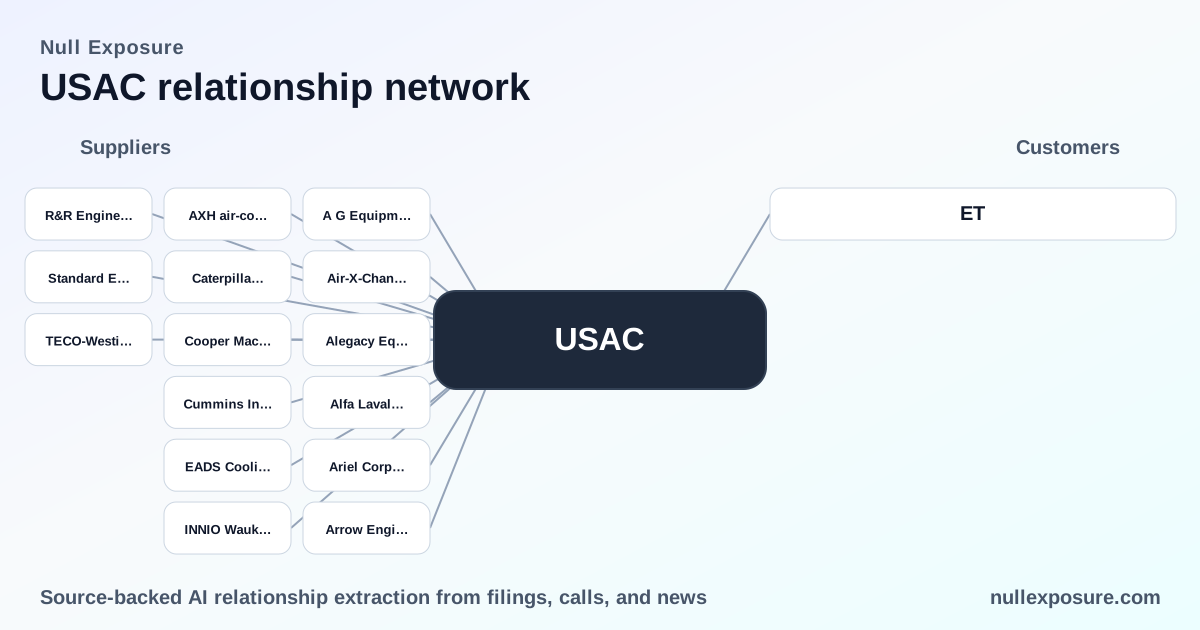
USA Compression Partners LP operates and monetizes by leasing and operating horsepower—mechanical compression capacity—under a mix of fixed-term contracts and month-to-month arrangements to oil and gas producers, processors and midstream operators across U.S. unconventional basins. Revenue is generated as recurring billings for revenue-generating horsepower, supplemented by ancillary compression services; the company reported roughly $998 million in trailing revenue and recognizes notable counterparty exposures under this model. For investors evaluating customer concentration and counterparty risk, the relationship with Energy Transfer (ET) is the single material customer link disclosed in the available records. Learn more at https://nullexposure.com/.
Investor thesis in one paragraph
USAC delivers a capital-intensive, service-oriented business: it sells uptime and throughput (horsepower) not hydrocarbons, and monetizes through contracted rental and service fees where the value proposition is operational continuity for producers and pipelines. The economics are driven by fleet utilization, contract tenure, and counterparty credit; commercial links to large midstream operators such as Energy Transfer translate into visibility on utilization but also create measurable concentration and related‑party governance considerations.
Two related entries in the record — what they say and why it matters
Energy Transfer (ET) — strategic commercial partner and related party
USA Compression provides compression and related services to entities affiliated with Energy Transfer and has disclosed transactions with those affiliates since Energy Transfer became a related party on April 2, 2018. Company disclosures note $41.3 million of revenue from Energy Transfer‑affiliated entities for the full year 2024, which places the counterparty within the $10m–$100m spend band disclosed by the company. This is both a revenue anchor and a concentration risk given its size relative to individual customer buckets. Source: company disclosures (related‑party revenue and related‑party status) and internal revenue summary for 2024.
ET — the same relationship reflected in market reporting on strategic focus
A market note discussing USAC’s strategic pivot to cleaner fuels and LNG export exposure highlighted that deeper detail on longer-term contracts and shared service efficiencies with Energy Transfer is material to understanding USAC’s commercial positioning. This reporting confirms the midstream tie is not only transactional but also relevant to USAC’s strategic dialogue with investors about future growth vectors. Source: Sahm Capital, “USA Compression Partners targets growth in cleaner fuels and LNG exports,” Feb 27, 2026 (https://www.sahmcapital.com/news/content/usa-compression-partners-targets-growth-in-cleaner-fuels-and-lng-exports-2026-02-27).
How the disclosed constraints inform the operating model and risk profile
The evidence provided in filings and company commentary supports the following company-level signals about USAC’s operating model and business characteristics. These are presented at the company level unless a constraint explicitly names a relationship.
- Contracting posture: mixed-tenor with meaningful short‑term exposure. Filings state that month‑to‑month horsepower billing produced similar per‑horsepower revenue as primary‑term contracts during the referenced period, indicating flexibility but also potential revenue variability as short‑term positions reprice quickly.
- Geographic concentration: U.S. unconventional basins. Operations are focused across the major U.S. shale plays (Permian, Marcellus, Utica, Eagle Ford, Haynesville, etc.), and the company operates as a single reportable segment with all assets located in the U.S. This geography reduces cross-border risk but concentrates exposure to U.S. shale cycles and regulatory regimes.
- Roles and commercial positioning: both provider and counterparty. USAC functions as a service provider delivering compression to producers and midstream systems, while also transacting with and selling to related parties—most notably Energy Transfer—reflecting an intertwined commercial and operational relationship.
- Segment focus: infrastructure and services. Compression is core infrastructure enabling processing and pipeline transport; revenue is therefore critical to counterparties’ operational continuity, giving USAC bargaining leverage when utilization is tight.
- Spend concentration: material single‑counterparty exposure. The $41.3 million in 2024 revenue from Energy Transfer affiliates sits within the $10m–$100m spend band, signaling a moderately concentrated customer mix where a handful of large counterparties can influence utilization and pricing dynamics.
- Relationship maturity and state: active, ongoing billing. Revenue‑generating horsepower is defined in filings as horsepower under contract for which USAC is billing, indicating these are active, revenue‑producing engagements rather than dormant or purely strategic arrangements.
What investors should weigh: opportunities and risks
- Opportunity — predictable cash flow when utilization is high. Compression services tied to midstream pipelines and oilfield production generate recurring cash flow, and long‑term or stable counterparty arrangements (like those with Energy Transfer affiliates) underpin dividend capacity and leverage planning.
- Risk — counterparty concentration and related‑party governance. The documented related‑party relationship and the $41.3 million revenue figure for 2024 create both credit exposure and governance scrutiny; investors should track the evolution of these transactions and disclosures.
- Operational sensitivity to commodity cycles. While USAC sells services rather than hydrocarbons, demand for horsepower is correlated with drilling and production activity across its core U.S. basins, so commodity‑driven capex cycles matter.
- Contract tenor tradeoff. The coexistence of short‑term, month‑to‑month billing and fixed‑term contracts supports flexibility but also introduces revenue volatility when short‑term positions are a material portion of the book.
- Strategic optionality in cleaner fuels and LNG. Market reporting indicates management is positioning the business toward projects tied to cleaner fuels and LNG export flows—relationships with major midstream players can accelerate that shift if counterparties allocate new volumes to compression services.
Tactical takeaways for analysts and operators
- Quantify counterparty exposure beyond headline revenue: evaluate percent of revenue and EBITDA tied to Energy Transfer affiliates and model the credit impact of a 20–50% decline in that revenue bucket.
- Stress test utilization under shorter contract scenarios, given the explicit short‑term contract signal in filings.
- Monitor disclosures for related‑party transactions and any changes in the nature of services delivered to Energy Transfer affiliates to assess governance and transfer pricing dynamics.
Bottom line
USA Compression is a capital‑intensive, service‑heavy business whose value derives from fleet utilization and stable commercial ties with midstream operators. The Energy Transfer relationship is the single material counterparty disclosed in the available record and represents both a source of revenue stability and a concentration risk; $41.3 million of 2024 revenue underscores its significance. For deeper, transaction‑level analysis or to track changes in customer relationships over time, visit https://nullexposure.com/ for updated monitoring and relationship intelligence.