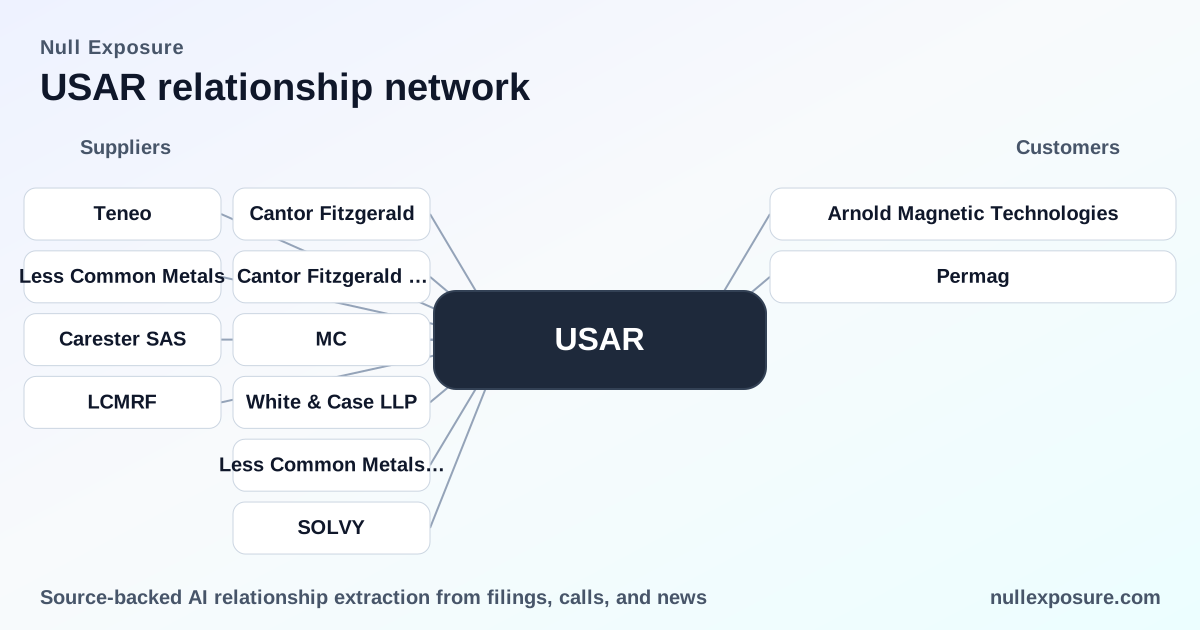
USA Rare Earth (USAR): customer relationships that underpin the mine‑to‑magnet strategy
USA Rare Earth operates and monetizes by extracting rare earths, processing them into feedstock and alloys, and moving downstream into sintered neodymium‑iron‑boron magnet production; revenue comes from commodity sales of rare earth materials and from marketing finished magnets through distribution and mutual‑sales arrangements with established magnet manufacturers and industrial partners. The investment case is execution‑driven: value depends on converting mines and processing capacity into reliable feedstock, securing customers/distributors, and scaling a Stillwater magnet line. For a concise dossier on partner signals, visit https://nullexposure.com/.
Company snapshot for investors: USAR reports a market capitalization in the mid‑billions while trailing revenue remains small (Revenue TTM ≈ $1.64M) and operating losses persist — an asset‑backed, growth‑stage mining/manufacturing play priced for successful commercialization and vertical integration.
What the market relationships actually look like — who is on the customer ledger
Below I summarize each relationship captured in public reporting and news: one crisp take per named counterparty, with the contemporaneous source.
Arnold Magnetic Technologies
USA Rare Earth has signed a non‑exclusive mutual sales and distribution agreement with Arnold Magnetic Technologies that links Stillwater output into Arnold’s existing magnet channels and supports initial fill of the company’s Stillwater magnet line. (Sahm Capital, March 2026; see reporting at https://www.sahmcapital.com/news/content/usa-rare-earth-and-arnold-deal-tests-mine-to-magnet-promise-for-investors-2026-03-24 and related March 26, 2026 article.)
Permag
Reports indicate Less Common Metals (LCM) and Solvay structured supply arrangements that position samarium metal toward Permag, a precision magnet manufacturer—an outcome that routes specialty rare‑earth outputs into high‑value magnet production. (TS2.tech, reporting December 2025: https://ts2.tech/en/usa-rare-earth-usar-stock-soars-on-new-supply-deal-latest-news-forecasts-and-outlook-as-of-december-4-2025/.)
Carester SAS
Carester SAS is described as a European processor partner in a co‑location / circular‑economy model that gives USA Rare Earth access to European processing technology while supplying Carester with feedstock from recycled materials and from USAR’s Round Top source. This creates a strategically valuable cross‑border processing channel. (TradingView / Market news summary, FY2026: https://fr.tradingview.com/news/marketbeat%3A53ce78f09094b%3A0-usa-rare-earth-s-2-8b-power-play-to-secure-the-supply-chain/.)
CODI‑P‑B (Compass Diversified preferred listing)
Market disclosures list a sales and distribution partnership framework between USA Rare Earth and Compass Diversified entities that anticipates reciprocal product distribution; the reference appears in Compass Diversified earnings/press materials. (MarketScreener, Compass Diversified Q1 2026 announcement referencing the partnership: https://www.marketscreener.com/news/compass-diversified-announces-first-quarter-2026-earnings-and-conference-call-information-ce7f59dbdf80f026.)
CODI (Compass Diversified / trading press)
Independent press coverage corroborates a sales, distribution pact with Compass Diversified, describing cross‑selling opportunities and distribution leverage that reduce USAR’s direct go‑to‑market burden. (The Globe and Mail / market commentary on Compass Diversified in FY2026: https://www.theglobeandmail.com/investing/markets/stocks/SERV-Q/pressreleases/1066044/analysts-offer-insights-on-industrial-goods-companies-compass-diversified-holdings-codi-and-serve-robotics-inc-serv/.)
How these partnerships fit the business model: operating and commercial constraints
The public signal set delivers four company‑level constraints that drive USAR’s contracting posture, concentration risk, criticality to customers, and relationship maturity.
-
Domestic strategic focus: Filings and press position USAR as establishing a domestic rare‑earth magnet supply chain to support U.S. energy, mobility, and national security needs. That geography signal implies priority customers are North American and that supply‑chain resilience is central to the commercial pitch.
-
Seller posture and go‑to‑market design: USAR is being framed as a seller of both raw materials and finished magnets; the company’s arrangements (mutual sales/distribution pacts) indicate a distribution‑leveraged model rather than pure direct‑to‑OEM locking. This reduces upfront sales cost but leaves margin capture shared with partners.
-
Prospect / early commercial stage: USAR explicitly states it does not yet have contractually committed customers for planned neo magnet output. That places current monetization in a prospecting phase — partnerships are proofs of channel access, not revenue contracts for full plant output.
-
Manufacturing and vertical integration: USAR is building a sintered neo magnet plant in Stillwater and intends to process and market surplus materials. This creates upstream feedstock optionality and downstream margin capture, but also concentrates execution risk in plant commissioning and process scale‑up.
Taken together: these constraints signal a company with high strategic value but early commercial maturity; partners reduce go‑to‑market friction but do not substitute for firm offtake contracts or demonstrated production scale.
Investment implications and risk profile
-
High valuation vs current cash flow: Market capitalization is in the multi‑billion range while revenue is effectively immaterial today, producing an execution‑sensitive valuation that rewards successful scaling and penalizes commissioning delays.
-
Customer risk is execution timing risk: Reported deals (Arnold, Compass Diversified) are distribution and mutual‑sales arrangements — they de‑risk commercialization channels but do not eliminate the need for consistent plant throughput and quality control to meet magnet specifications.
-
Concentration and criticality balance: Partnerships with established magnet manufacturers and processors increase the strategic criticality of USAR’s feedstock to downstream supply chains, which benefits long‑term pricing power; however, early stage contractual commitments are limited, leaving near‑term revenue uncertain.
-
Geopolitical and industrial premium: The U.S. domestic supply narrative bolsters strategic demand and premium pricing potential for domestically produced rare earth magnets — a persistent upside if USAR proves reliable supply.
If you want a consolidated counterparty and constraint brief for portfolio diligence, see our home page analysis hub at https://nullexposure.com/.
Bottom line
USA Rare Earth has crystallized promising distribution and processor relationships that map logically to a mine‑to‑magnet strategy: Arnold and Compass Diversified provide distribution channels, Carester brings European processing capability, and Permag is an example of manufacturer demand for specialty metal streams. The critical investor question is execution — converting partnerships into contracted, repeatable sales via an operational Stillwater magnet line. The upside is substantial if USAR proves consistent production and quality; the downside is concentrated timing and scale‑up risk while contractual offtake remains limited.