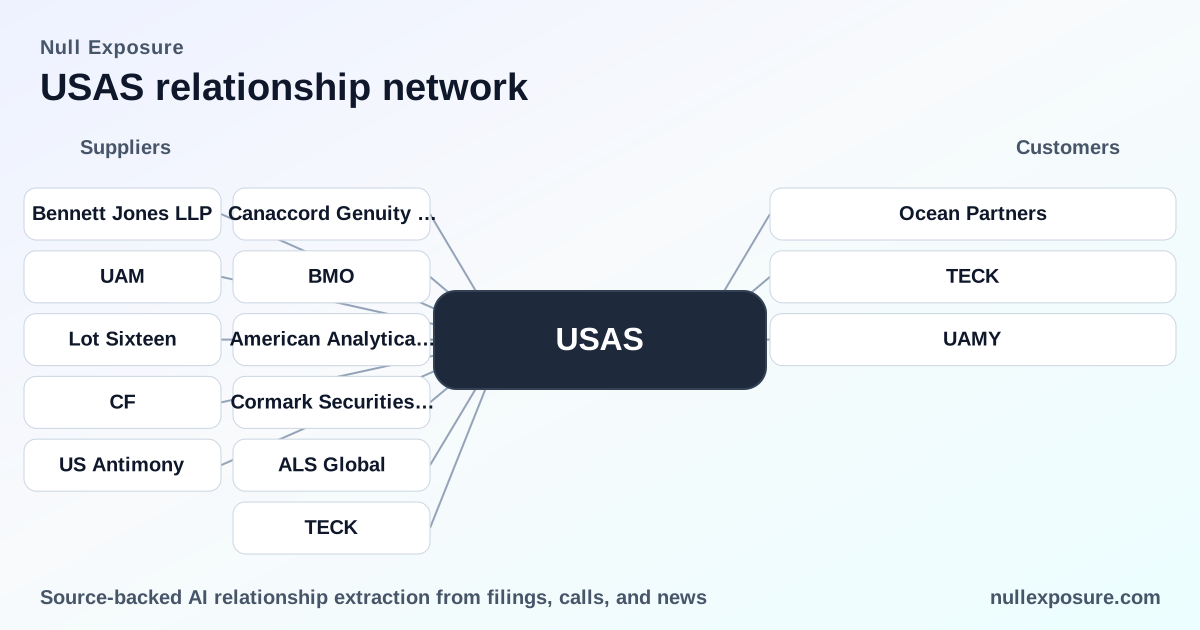
Americas Silver (USAS): Customer relationships that reconfigure downstream optionality and by‑product economics
Americas Silver (USAS) operates as a North American precious- and base-metals miner that monetizes through direct metal sales, concentrate offtakes and, increasingly, value‑added downstream partnerships. The company's recent arrangements—multi‑metal offtake agreements and a majority‑owned joint venture for antimony processing—convert previously low‑value by‑products into contracted revenue streams and optionality for downstream margin capture. Investors should value USAS both as a mining operator and as an owner/operator of processing options that change realized metal economics. Learn more at https://nullexposure.com/.
Why these customer relationships matter to investors
USAS historically sold concentrate into the smelting market and realized by‑product value through standard offtake terms. The new agreements pivot the company from a pure upstream concentrate seller toward a hybrid model that secures treatment capacity and creates direct receipts for antimony and other by‑products. That materially reduces the tail risk of weak by‑product pricing and creates pathways for higher margin capture if the JV and offtake arrangements execute.
What each counterparty brings to the table
United States Antimony (UAMY)
USAS formed a joint venture with United States Antimony in which USAS holds 51% and UAMY 49%, and UAMY contributes proprietary processing technology and operational expertise while USAS supplies land, ore and site infrastructure at Galena. According to press coverage and company announcements in March 2026, the JV targets antimony processing at Idaho’s Silver Valley and positions USAS to be paid market terms for antimony once the facility is operational. (Source: The Globe and Mail press release coverage and Finviz news, March 2026.)
Ocean Partners
USAS executed a non‑restrictive, multi‑metal offtake agreement with Ocean Partners covering treatment of Galena concentrates, contracting treatment capacity and establishing a revenue stream for by‑products beginning January 1, 2026. Company press releases and market reporting in late 2025–early 2026 state the five‑year offtake gives USAS optionality to route polymetallic concentrates for treatment and to receive by‑product proceeds. (Source: Newsfile press release and follow‑on coverage, Dec 2025–Mar 2026.)
Teck Resources (TECK)
Teck is the smelter/treatment counterparty named in the Ocean Partners arrangement: Teck’s Trail Operations in British Columbia is the designated smelter for treatment of Galena concentrates under the Ocean Partners agreement, securing a concrete path to tolling and treatment capacity. Public releases and investor commentary in Q4 2025–Q1 2026 reference Teck as the processing end‑point. (Source: Newsfile and InvestingNews coverage, Dec 2025–Mar 2026.)
NTEC Resources
NTEC Resources is referenced in USAS earnings commentary as the operational counterparty through which initial by‑product revenue flows were recognized: USAS stated it began receiving by‑product revenue under the new offtake arrangement that routed through NTEC Resources as announced in mid‑2025, indicating an implementation pathway for the Ocean Partners/Teck treatment cycle. (Source: Q4 2025 earnings call transcript coverage, InsiderMonkey, May 2026.)
How these relationships change USAS’s operating model and business characteristics
The relationship set collectively signals a deliberate shift in USAS’s commercial posture and maturity profile:
- Contracting posture: USAS has moved from spot concentrate sales toward multi‑year offtake and JV structures that lock in treatment capacity and create bilateral revenue triggers for by‑products. That produces more predictable cash flows from previously volatile by‑product streams.
- Concentration and counterparty risk: The Ocean Partners / Teck pathway centralizes treatment at a named smelter network, concentrating treatment counterparty exposure but removing the liquidity and processing risk associated with open‑market concentrate sales.
- Criticality of relationships: The UAMY JV is strategically critical because it internalizes downstream antimony processing capacity; antimony was previously monetized only as a contained by‑product. If the JV and offtake agreements operate to plan, USAS captures incremental margin and reduces reliance on external refiners.
- Maturity and execution risk: The agreements are early stage—announced in 2025–2026—and require capital deployment and commissioning to realize the promised uplift. Execution, permitting and commissioning timelines are the primary operational risks.
Constraints and signals for model stability
There are no static constraint records associated with the customer relationship dataset provided for USAS. As a company‑level signal, the absence of listed contractual constraints in the supplied data suggests that the public disclosures emphasize commercial terms and structure over enumerated limitations in the visible dataset. Investors should therefore treat contract duration, operating milestones and capital commitments as the primary operational levers to monitor going forward.
Risks and upside that flow from the partner slate
- Upside: Higher realized by‑product pricing and capture of downstream margins if the UAMY JV reaches commercial operation and the Ocean Partners/Teck treatment lane reliably processes concentrates at scale.
- Risk: Execution and timing risk—JV commissioning delays, permitting hurdles or smelter capacity disruptions would push projected revenue recognition later and compress short‑term cash flow improvement.
- Counterparty and concentration risk: Routing a large share of Galena concentrates through a limited set of counterparties concentrates settlement and treatment dependency.
Investment implications and next steps for analysts
The commercial arrangements materially change how USAS should be modeled: add a phased uplift to by‑product revenue from 2026 onward, model JV‑level capex and ramp assumptions separately, and stress‑test scenarios for treatment interruptions. Re-rate scenarios should hinge on JV commissioning timelines and realized antimony prices.
For a deeper look at how these relationships map to contract economics and execution milestones, visit https://nullexposure.com/ for ongoing tracking and analysis.
Key takeaway: USAS is closing the loop between mining and downstream processing—transforming by‑product credits into contracted revenue and optional margin capture—while tasking investors with monitoring execution milestones and smelter counterparty uptime.