US Gold Corp (USAU): Who the company is selling to — and who is buying into it
US Gold Corp operates as a Nevada-focused gold exploration and development company that currently monetizes through capital markets and, when production begins, by selling mineral concentrate for downstream metal extraction. The company funds exploration and project advancement with equity placements to institutional investors while planning to sell dried concentrate to smelters as a production revenue path. For relationship mapping and deeper counterparty intelligence, see https://nullexposure.com/.
Executive thesis: equity-driven today, commodity-seller tomorrow
US Gold’s near-term cash flow profile is dominated by equity raises rather than operating revenue: the firm has reported zero revenue TTM and negative EBITDA, so investor relationships function as the operational lifeline. Once its projects progress to production, revenue will come from concentrate sales to smelters, which transforms the company into an upstream seller whose critical commercial relationships will be offtake and tolling counterparties. Institutional backers that participate in equity raises are therefore both capital providers and indicators of market confidence in development plans.
The recent investor group that funded the company
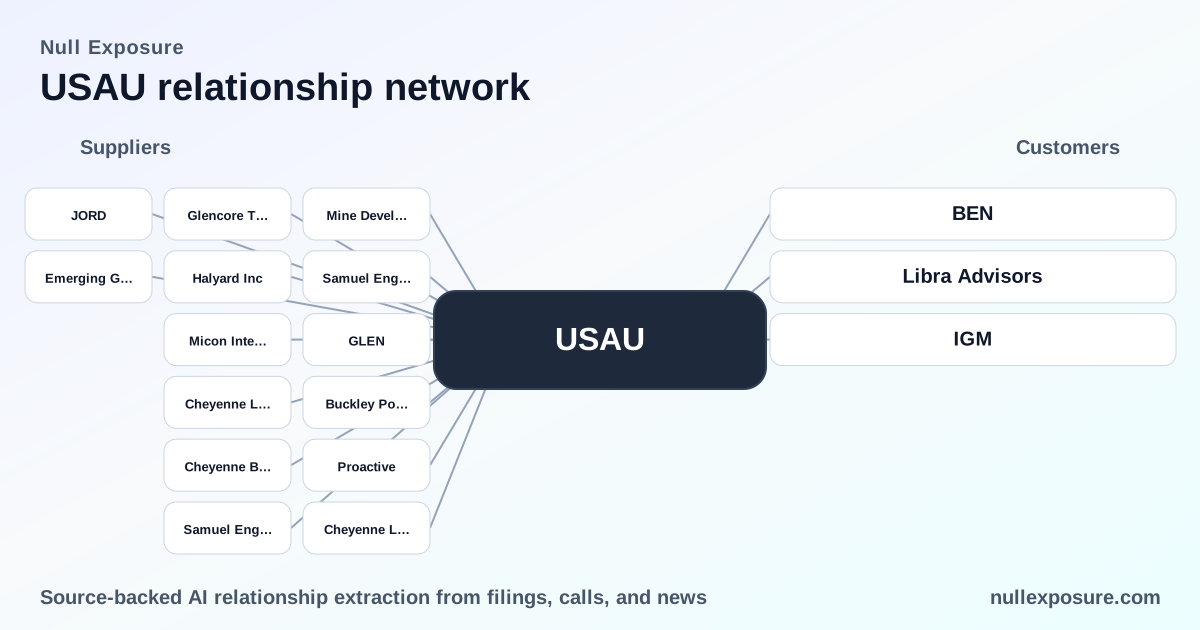
A March 2026 private placement raised $31.2 million and the disclosed investor group included Franklin Templeton Investments, Mackenzie Investments and Libra Advisors. These participants are not operating customers in the sense of smelter counterparties; rather, they are financing customers whose capital enables project advancement. Proactive Investors reported the private placement on March 10, 2026.
BEN
Franklin Resources (ticker BEN) shows up in the results as an identified participant name; this reflects institutional participation through Franklin’s investment platforms in the private placement that provided immediate liquidity for US Gold. Proactive Investors, March 10, 2026.
Franklin Templeton Investments
Franklin Templeton Investments is explicitly named among the private-placement investors that contributed to the $31.2 million raise, signaling active institutional support for project funding and near-term balance-sheet strength. Proactive Investors, March 10, 2026.
Mackenzie Investments (IGM)
Mackenzie Investments (inferred symbol IGM in the results) is listed as a participant in the private placement, reinforcing Canadian institutional appetite for junior developers and providing diversification among backers. Proactive Investors, March 10, 2026.
Libra Advisors
Libra Advisors is the third named investor in the placement; its inclusion completes the disclosed investor group that supplied the capital injection supporting exploration and project de-risking. Proactive Investors, March 10, 2026.
What these relationships mean operationally
- Capital provision is the immediate role these customers play: institutional investors supply the financing needed to advance permitting, drilling, or pilot processing work. That funding directly reduces short-term liquidity risk and preserves the company’s runway.
- These investor relationships are transactional and finance-focused, not equivalent to long-term offtake agreements that determine mine economics. Institutions are unlikely to function as processing or smelting counterparties.
- When the company transitions to production, the commercial counterparties that matter will be smelters and toll processors. The company’s disclosed operational constraint — that concentrate will be dried, shipped off site, and sold to a smelter for final metal extraction — makes those future offtake arrangements critical to cash generation.
Company-level constraints and what they signify
US Gold’s public disclosures include a clear operational posture: the company will act as a seller of dried concentrate and will ship product off site for final metal extraction. This is a company-level signal that shapes contracting posture, counterparty needs, and risk allocation:
- Contracting posture: seller to smelters/toll processors, which implies negotiation on concentrate grade, treatment and refining charges, and shipping/logistics terms.
- Concentration: current funding is concentrated among a small institutional group disclosed in the March 2026 private placement; production-concentration risk will depend on the number and diversity of smelter contracts the company secures.
- Criticality: for revenue realization, offtake contracts with smelters will be mission-critical. Without competitive tolling or offtake terms, project economics deteriorate.
- Maturity: investor relationships are capital-market driven and thus relatively liquid and short-dated compared with long-term offtake contracts; smelter agreements will require additional commercial maturity as operations approach steady-state.
These constraints are drawn from the company statement about concentrate handling and from the contemporaneous financing disclosures as of the quarter ended January 31, 2026.
Balance-sheet and shareholder signals that matter to counterparties
Investors and operators evaluating USAU should weigh these public-company metrics when assessing counterparty risk:
- Market capitalization roughly $263 million with zero reported revenue TTM and negative EPS and EBITDA, indicating reliance on financing events for near-term funding (company filings, quarter ended January 31, 2026).
- Insider ownership ~15% and institutional ownership ~35%, which suggests meaningful alignment with informed holders but leaves room for future dilution if additional capital is required (company filings, latest quarter).
- Analyst target prices and coverage are sparse, so primary market signals will come from equity transactions and project milestones rather than broad sell-side coverage.
For direct counterparty diligence and relationship mapping, Null Exposure maintains structured profiles and network views that accelerate underwriting and vendor negotiation—visit https://nullexposure.com/ for an overview.
Key investment and operational takeaways
- Short-term monetization is capital-driven: institutional investors funded a $31.2M private placement that reduces liquidity risk and finances near-term exploration and development.
- Long-term monetization is commodity-driven: the declared plan to dry and ship concentrate to smelters makes offtake terms and treatment charges central to future free cash flow.
- Counterparty risk will shift from investor concentration to commercial concentration: today the principal counterparties are equity providers; tomorrow they will be smelters and logistics providers whose terms define project margins.
- Operational diligence should prioritize three items: the pipeline of offtake/tolling agreements, logistics and treatment assumptions built into project economics, and the likelihood of future equity raises given current negative operating cash flows.
US Gold is positioned as a capital-market dependent developer with a clear seller posture for future production. Institutional participation in the March 2026 placement is a positive validation step, but the transition to stable, contract-backed revenue hinges on securing favorable smelter relationships and converting resources into payable metal under commercially robust terms.