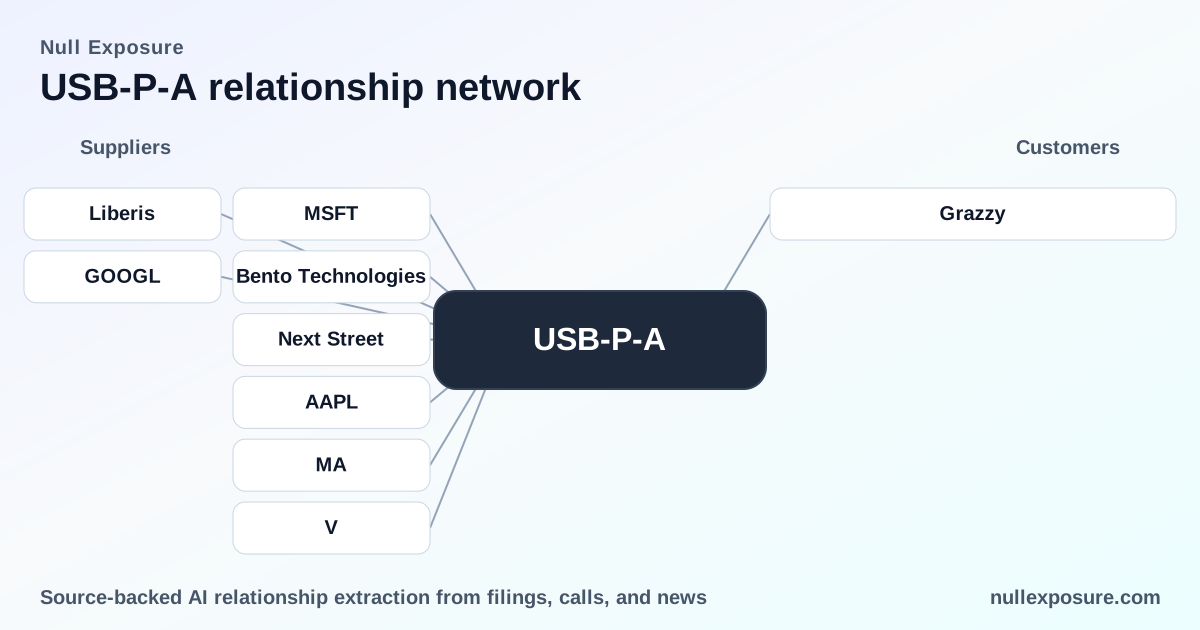
U.S. Bancorp (USB-P-A) — Customer Relationships That Drive Payments and Wealth Flows
U.S. Bancorp derives commercial value from traditional banking products layered with payment rails and branded partnerships: interest income and fee-based revenue across consumer banking, payments, and wealth management. The customer relationships captured here highlight the bank’s strategic position as a payments provider for large branded programs, a partner to fintech payroll/tipping services, and a corporate wealth manager—each relationship translating into recurring fee streams, deposit flow, or cross-sell opportunities for the bank’s franchise.
For a concise map of customer ties and how they influence credit and revenue risk, visit NullExposure.
Why these customer links matter for investors
U.S. Bancorp’s commercial value increases when it secures payment processing or deposit relationships with large brands and high-frequency payroll/payment flows. Payments partnerships scale interchange and fee income predictably; wealth-management mandates deepen long-term deposit and asset-management relationships. The three customer items recorded here—Amazon, Grazzy, and the NFL—illustrate three distinct monetization channels:
- Large merchant program participation (Amazon) bolsters payment volume and associated service revenue.
- Embedded fintech partnerships (Grazzy) deliver high-frequency transaction flows and potential deposit funding from hourly workers.
- Brand-level wealth and banking mandates (NFL) enhance fee-based wealth revenue and institutional visibility.
These relationship types are commercially complementary: payments drive transactional revenue and deposits; wealth management delivers higher-margin advisory and custody fees.
Relationship inventory: every customer link in the record
Amazon — small-business card program transition
U.S. Bank, together with Mastercard, replaced American Express as the issuer/partner on Amazon’s small-business card program, moving those payment flows to U.S. Bank’s platform and Mastercard rails. This transition captures merchant-facing issuance volume and interchange revenue tied to Amazon’s small-business ecosystem. Source: Finviz reporting citing American Banker (May 4, 2026) — https://finviz.com/news/319692/analysts-see-limited-upside-for-us-bancorp-usb-amid-neutral-outlook
Grazzy — prepaid debit program for tipped employees
A PR Newswire release announced that Grazzy, a digital tipping platform, partnered with U.S. Bank to offer a prepaid debit card program enabling hourly employees to access tips more quickly. This arrangement places U.S. Bank as the issuer and settlement partner for micro-payments, feeding steady transactional volume and potential deposit/float benefits. Source: PR Newswire (Mar 10, 2026) — https://www.prnewswire.com/news-releases/grazzy-us-bank-debit-card-program-simplifies-the-way-tipped-employees-earn-and-receive-digital-tips-302411967.html
NFL — bank and wealth-management partner
U.S. Bank signed on as the National Football League’s bank and wealth-management partner, positioning the bank to handle corporate banking needs and deliver wealth services to league stakeholders. This relationship signals institutional fee opportunities and elevated brand visibility for U.S. Bancorp’s wealth platform. Source: Finviz reporting (Apr 2, 2026) — https://finviz.com/news/319692/analysts-see-limited-upside-for-us-bancorp-usb-amid-neutral-outlook
Operating-model signals and company-level constraints
The constraints payload returned with this customer set is empty; there are no explicit contractual constraints listed in the record. As a company-level signal, that absence indicates the source data did not flag procurement restrictions, exclusive-deal caveats, or other legal encumbrances tied to these customer links.
Translating that into operational characteristics for risk assessment:
- Contracting posture: U.S. Bancorp operates as an active commercial partner across payments and wealth channels, structuring client agreements that emphasize scale and ongoing service delivery rather than one-off projects.
- Concentration: The documented relationships span retail (Amazon), fintech (Grazzy), and sports/institutional (NFL), indicating diversified customer exposure across revenue streams rather than single-counterparty concentration.
- Criticality: Payment rails and payroll/tipping access are high-criticality operational lines—disruption to these would materially affect transaction volumes; wealth mandates are medium-to-high criticality for fee revenue and client retention.
- Maturity: Partnerships recorded are formal public announcements and program launches, reflecting established, revenue-generating engagements rather than exploratory pilots.
These company-level signals should be read as an input to credit and investor analysis rather than definitive legal or contractual status; no constraint excerpts tied to specific customers were provided in the record.
What investors should extract from these ties
Key drivers
- Recurring fee growth: Payments and card issuance for Amazon channels and Grazzy’s debit program generate steady interchange and service income.
- Deposit and float potential: Wage and tipping flows routed through U.S. Bank-driven cards increase low-cost deposit balances and transactional stickiness.
- Brand and cross-sell lift: The NFL mandate enhances institutional credibility and opens advisory and custody revenue opportunities.
Principal risks
- Competitive intensity in issuer services—large merchant programs can shift vendors if economics diverge.
- Operational reliance on payments rails—processing disruptions or regulatory changes to interchange fee structures would compress margins.
- Disclosure and preferred-stock specifics—the USB-P-A preferred instrument’s public record in this payload lacks standard equity metrics; investors must evaluate issuer credit quality and call features separately.
A compact checklist for investors:
- Confirm the scope and duration of each customer agreement and any exclusivity or indemnity terms.
- Assess contribution to deposit balances versus pure fee revenue for each relationship.
- Validate operational controls and settlement risk on payment programs, given their criticality.
Bottom line and next steps
U.S. Bancorp’s customer links to Amazon, Grazzy, and the NFL reflect a deliberate strategy to capture payment flows, embed banking in fintech payroll rails, and broaden wealth-management mandates. For holders or prospective purchasers of USB-P-A preferred shares, these relationships imply diversified, recurring revenue streams that support the bank’s franchise economics, but they do not substitute for a full credit review of U.S. Bancorp’s balance sheet and preferred share terms.
For more granular customer mapping and consolidated relationship intelligence, visit NullExposure to review expanded linkage analysis and issuer-level signals.