USB-P-Q (U.S. Bancorp preferred) — Customer relationships, commercial signal, and investor implications
U.S. Bancorp operates as a full-service bank holding company: it generates fee income and net interest margin across retail deposits, commercial lending, payments processing, mortgage servicing, trust and wealth management services. Preferred holders of USB-P-Q have exposure to a diversified banking franchise whose commercial relationships drive deposit flows, payment volumes and cross-sell economics rather than direct cashflow to the security itself. For investors, the relevant question is how commercial partnerships and customer positioning translate into deposit stability, fee diversification, and franchise resilience — not one-off marketing arrangements. Learn more at https://nullexposure.com/.
Why a single sponsorship matters to a bank's economics
Large consumer-facing banks monetize brand and distribution in predictable ways: marketing partnerships convert into account openings, card issuance, and payments volume, which in turn compresses customer acquisition costs and sustains low-cost funding. A sponsorship like the one documented here is a strategic marketing contract intended to lift retail and affinity relationships rather than to produce discrete, material fee streams. That pattern is familiar across national banks and has measurable downstream benefits for deposits and transactional revenue.
What the records show about U.S. Bank’s customer ties
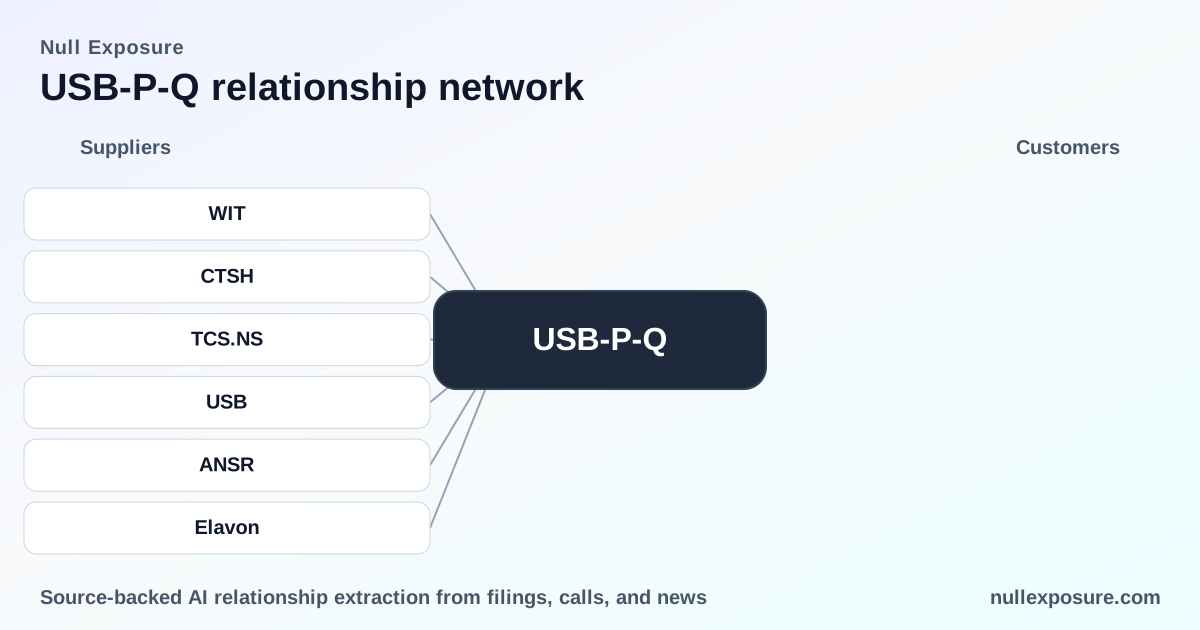
The relationship inventory for USB-P-Q is narrow in this dataset: a branded sports sponsorship is documented. Below is the complete listing and plain-English summaries of each recorded customer/partner relationship.
- U.S. Bank and the WNBA: U.S. Bank became a sponsor and the official bank of the WNBA, a consumer-facing partnership positioned to enhance national brand recognition and affinity among targeted retail segments. According to a Twin Cities Business Journal report dated March 10, 2022, the arrangement establishes U.S. Bank as the league’s official banking partner for the relationship period (FY2022 referenced in the record). (Twin Cities Business Journal, March 10, 2022)
This is the entirety of the customer-relationship entries returned for USB-P-Q in the supplied records.
How the relationship typology maps to banking operating characteristics
With no broader contract-level constraints flagged in the available information, treat the sponsorship as a marketing-driven, non-critical commercial contract rather than a strategic dependency. Company-level signals you should factor into underwriting USB-P-Q include:
- Contracting posture: Marketing and sponsorship contracts are typically fixed-term and renewable, with limited counterparty credit exposure, so the bank’s operational risk from this relationship is marketing and reputational, not credit risk to the balance sheet.
- Concentration: The recorded relationship set is not concentrated around single corporate customers; the data shows a consumer-facing sponsorship rather than material dependency on a single corporate counterparty.
- Criticality: This relationship is strategic for branding and customer acquisition but not critical to funding or core lending operations. Deposit and payment volumes derive from many relationships; a single sponsorship does not represent a funding hinge point.
- Maturity: The sponsorship is recorded in FY2022, making it a relatively recent marketing engagement in the dataset and consistent with banks’ cyclical sponsorship strategies.
These characteristics are company-level signals based on the relationship type recorded, not contract text. No explicit contract constraints were supplied in the record set.
What investors in preferred stock should watch
Preferred shareholders are one removal from common-equity operational sensitivity, so evaluate how customer relationships affect the deposit base, default risk on senior assets, and the bank’s ability to maintain coupon obligations:
- Brand lift converts into deposits and cards over time. Sponsorships that align with target demographics reduce customer acquisition cost and increase low-cost deposit growth, which supports net interest margin stability.
- Revenue impact is indirect and long-tail. Sponsorships support fee income via higher transaction volumes and new accounts; they do not deliver immediate, material top-line gains in most cases.
- Counterparty concentration risk is negligible here. The single recorded partnership is not a material corporate counterparty that could threaten balance sheet stability if it failed.
- Reputational risk should be monitored. High-profile partnerships increase visibility; any reputational missteps by either party can have second-order effects on customer behavior and regulatory scrutiny.
Key takeaway: for preferred-holders of USB-P-Q, monitor deposit trends, payment volumes, and fee revenue metrics rather than treating a brand sponsorship as a credit driver.
Operational implications for risk and portfolio construction
From a portfolio perspective, USB-P-Q’s customer relationship footprint as presented supports a defensive stance in preferred exposure:
- Low single-counterparty operating risk in the available records reduces near-term credit vulnerability from customer churn tied to one contract.
- Marketing-driven growth strategies are consistent with fee diversification objectives but require tracking through deposit and card metrics in earnings reports and regulatory filings.
- Absence of disclosed constraints in the record set is itself a signal: investors should rely on regulatory filings, quarterly results, and deposit/performance trends for hard metrics rather than sponsorship press releases alone.
If you track U.S. Bancorp at the security level, prioritize quarterly disclosures for deposit composition, net interest margin trends, and non-interest income lines linked to payments and wealth management.
Explore a broader view of relationship signals and how they influence preferred exposure at https://nullexposure.com/.
Bottom line: convert relationship signals into financial metrics
U.S. Bank’s documented WNBA sponsorship is a branding and customer-acquisition play that supports the underlying retail deposit and payments engine — the economic foundation that underpins preferred-credit stability. For USB-P-Q investors, the sponsorship is a positive signal for customer growth strategies but not a material credit determinant by itself. Focus on deposit trends, payment volumes, and fee-income durability in earnings and regulatory filings to assess the true credit trajectory.
For additional company relationship intelligence and curated signals for fixed-income investors, visit https://nullexposure.com/.