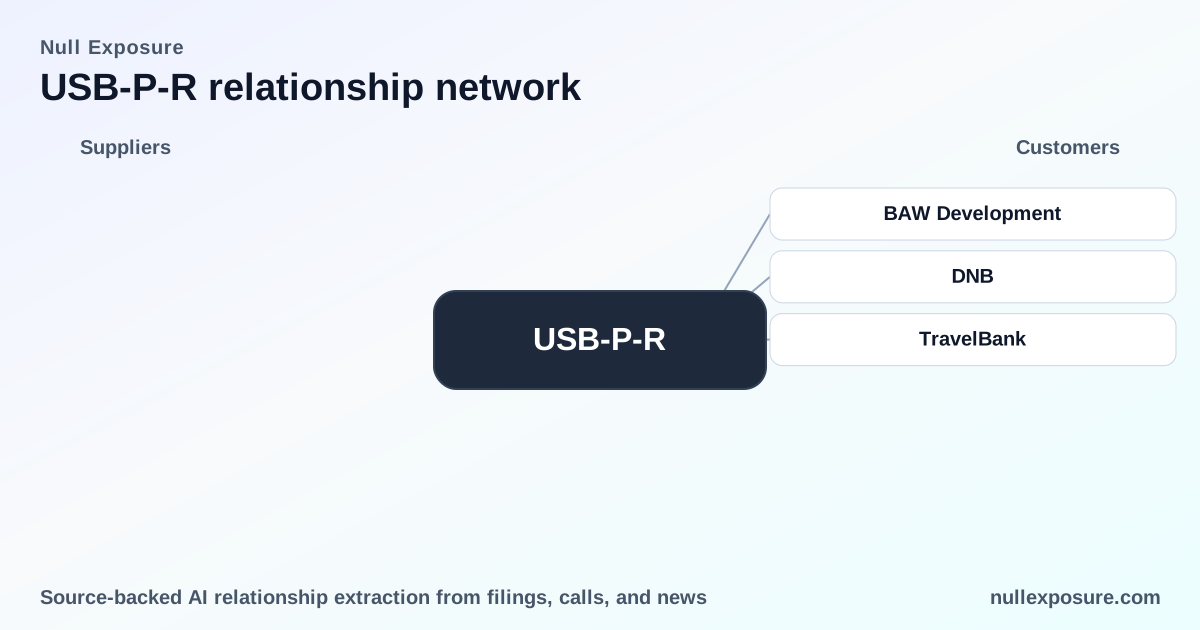
U.S. Bancorp (USB-P-R) — Customer Relationships That Drive Fee and Card Revenue
U.S. Bancorp operates as a diversified bank holding company that monetizes through interest-bearing lending, fee income, and scale in payments and card services. The company expands its commercial footprint by underwriting co-branded credit programs, originating and servicing loans, and deploying tax-equity and community development capital, all of which generate recurring fees, interchange revenue, and longer-duration funding streams for the balance sheet. For investors in USB-P-R, the credit and fee quality of these customer relationships is a central driver of preferred-stock coverage value. Explore additional coverage at https://nullexposure.com/.
Why these customer ties matter to investors
U.S. Bancorp’s customer portfolio is not passive marketing: co-brand credit arrangements and institutional partnerships are product-level revenue engines that scale card receivables, deliver interchange fees, and create cross-sell opportunities for deposit and treasury products. The bank’s community development investments and construction lending illustrate a parallel strategy: selective, high-profile transactions that generate fee income, tax-equity returns, and relationship depth in targeted markets.
Operationally, this model reflects a mature contracting posture with large corporate partners, moderate concentration risk where a few co-brand wins materially expand card volumes, and high criticality of payments capabilities to the firm’s franchise economics. Below I summarize every customer relationship that appears in the available results and cite the reporting.
Key customer relationships and what they mean
Amazon
U.S. Bancorp won Amazon’s small-business credit card program from American Express, a meaningful co-brand acquisition that materially grows the bank’s business card portfolio and associated fee income. Source: BizJournals reporting on the April–May 2026 transaction (BizJournals, FY2026, https://www.bizjournals.com/pacific/bizwomen/news/latest-news/2026/04/us-bank-lands-amazon-credit-card-deal.html?page=all).
Harley‑Davidson Co.
Harley‑Davidson is an existing co-brand partner whose credit-card relationship helps U.S. Bancorp access an affinity consumer base and capture loyalty-driven card spend and financing revenue. Source: BizJournals mention of co-branded cards (BizJournals, FY2026).
The Kroger Co.
Kroger’s co-branded credit card is another affinity channel that channels grocery and retail spend onto U.S. Bancorp’s card platform, creating durable interchange and installment finance opportunities. Source: BizJournals coverage of U.S. Bank’s co-brand partnerships (BizJournals, FY2026).
Korean Air
Korean Air is cited as a co-brand partner that broadens U.S. Bancorp’s international affinity footprint and rewards-based card capabilities, supporting travel-related spend and cross-border transaction volume. Source: BizJournals listing of current co-branded cards (BizJournals, FY2026).
Dun & Bradstreet (DNB)
U.S. Bancorp reports business credit information to Dun & Bradstreet, which supports the bank’s commercial lending and underwriting workflows by contributing standardized credit data. Source: A consumer-facing credit-cards overview noting the bank “reports to Dun & Bradstreet” (NerdWallet, March 2026, https://www.nerdwallet.com/credit-cards/best/us-bank-cards).
BAW Development (Hinchliffe Stadium redevelopment)
U.S. Bancorp Community Development Corporation provided $10 million in New Market and Federal Historic Tax Credit equity for the Hinchliffe Stadium Neighborhood Restoration Project, demonstrating the bank’s use of tax-equity and community development capital to participate in structured, fee-bearing redevelopment finance. Source: NJB Magazine report on the $94 million financing (NJB Magazine, June 2021).
TravelBank
TravelBank integrated U.S. Bancorp’s InstantCard service into its expense-management product suite via a partnership launched in 2020, which demonstrates U.S. Bancorp’s strategy to embed payment and virtual-card capabilities into corporate travel and expense flows. Source: PhocusWire reporting on TravelBank’s partnership with U.S. Bancorp (PhocusWire, 2020).
Operating-model implications and company-level constraints
Because the constraints dataset contains no explicit extraction, the following observations are company-level signals rather than relationship-specific findings:
- Contracting posture: U.S. Bancorp operates through formal co-brand and partnership contracts with large corporate counterparts, indicating a legal and operational emphasis on long-term, negotiated agreements rather than ad-hoc merchant relationships.
- Concentration: Winning a single large co-brand (for example, Amazon’s small-business card) can materially increase card volumes, so concentration risk across major co-brand partners is an active economic factor for revenue volatility.
- Criticality: Payments and card origination functions are core to the firm’s fee and interchange income; disruptions or loss of a large co-brand could compress revenues and raise funding pressure for preferred claims.
- Maturity: The relationships described reflect a mature, diversified franchise that balances retail and corporate co-brand programs with community development and structured tax-equity investments, spreading economic exposure across multiple revenue pools.
Investment implications — what to watch
- Revenue upside from co-brand wins: The Amazon small-business card program is a material growth vector for card balances and interchange fees and should be tracked as a near-term earnings driver.
- Counterparty concentration risk: The economics of a few large co-brand agreements escalate the impact of contract renewals or terminations; monitor announcements and contract durations.
- Fee diversity and credit quality: Community development deals and tax-equity investments generate fee income but have different risk-reward profiles than revolving consumer card receivables; distinguish earnings durability by product.
- Operational resilience in payments: As cards and virtual-card services embed into partners like TravelBank, operational execution and platform reliability are strategic assets that protect revenue.
Visit https://nullexposure.com/ for more structured profiles and cross-comparisons of bank customer relationships.
Bottom line
U.S. Bancorp’s customer relationships detailed here show a deliberate strategy to scale card and payments revenue through co-brand agreements while supplementing fee income with tax-equity and community development investments. For holders of USB-P-R, the health and contract stability of these relationships underpins preferred coverage prospects through steady fee streams and predictable card receivable behavior. Monitor co-brand contract rollouts, counterparty concentration, and operational delivery in payments as the near-term catalysts for valuation and credit-view shifts.