USB-P-S (U.S. Bancorp preferred): customer relationships that matter for credit and income investors
U.S. Bancorp operates as a full-service banking franchise, monetizing through net interest margin on loans and deposits, fee income from payments and treasury services, and lending products for consumers and businesses. Recent customer developments — from large commercial partnerships to small-business SBA work — reinforce the bank’s strategy of combining scale payments capability with targeted lending platforms to drive durable fee streams and deposit relationships. For income-focused investors in USB-P-S, these customer ties inform funding stability and the outlook for noninterest revenue.
Learn more about our coverage at https://nullexposure.com/.
What the recent customer news signals about U.S. Bank's go-to-market
U.S. Bank is executing a two-track commercial strategy: scale payments partnerships to capture transaction fees and embedded lending, and direct small-business lending through SBA and relationship banking to deepen deposit and cross-sell opportunities. The selection to take over Amazon’s small-business card and the expansion of the Avvance point-of-sale lending product signal a move to marry large-partner distribution with in-house lending infrastructure. At the same time, coverage of SBA loan recipients demonstrates continued penetration in community and small-business segments that underpin deposit stability.
Key takeaway: these relationships are complementary revenue engines — large-brand payment partnerships increase fee and interchange income, while SBA and other small-business lending sustain interest income and client stickiness.
Customer relationships: detail and source notes
Amazon — a strategic payments and small-business card partnership
U.S. Bank was selected to take over Amazon’s small-business credit card program from American Express, in partnership with Mastercard, while expanding its Avvance point-of-sale lending product with longer terms and broader partner integrations. This is a material commercial win that expands fee-bearing payments volume and embeds U.S. Bank in a major distribution channel. (Source: simplywall.st coverage of U.S. Bank developments, reporting on late-March FY2026 announcements.)
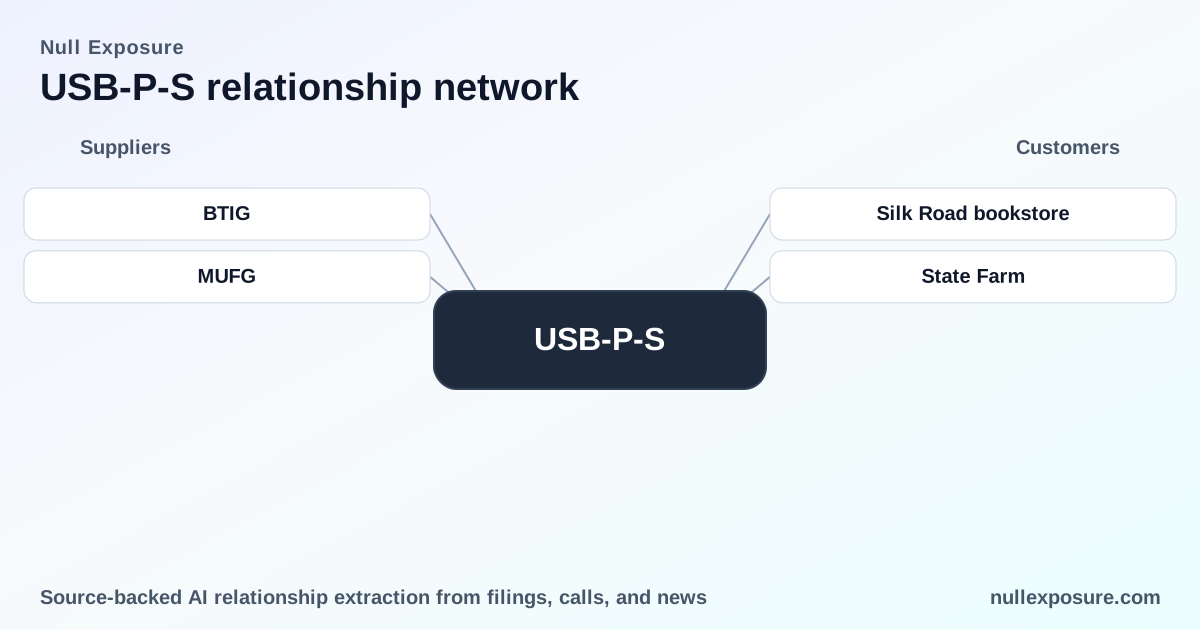
Silk Road bookstore — an example of SBA-enabled small-business banking
A small-business owner served by U.S. Bank used an SBA loan originated through the bank to finance inventory and operating needs, demonstrating the bank’s role as an on-the-ground SBA lender for local businesses. The profile illustrates the bank’s continued flow of community and small-business lending that complements its national payments franchise. (Source: CSRwire press release, March 2026.)
State Farm — long-tenured client relationships across loan and deposit products
A State Farm affiliate or related business has been a longtime U.S. Bank client, having received multiple SBA loans through the bank and maintaining business and personal accounts, highlighting cross-product, multi-decade relationships that drive deposit balances and repeat lending. (Source: CSRwire press release, March 2026.)
How these relationships influence the operating model and business risks
U.S. Bank’s customer mix demonstrates several company-level operational characteristics that matter for preferred-stock investors:
- Contracting posture: The bank executes long-term, high-touch commercial contracts with large partners (e.g., card programs and payment rails) while maintaining direct origination relationships with small-business borrowers. This combination creates both negotiated, contractually defined fee flows and relationship-driven lending activity.
- Concentration: Commercial wins with platform partners can create concentrated revenue pockets when large accounts or card programs are involved; however, U.S. Bank also maintains broad retail and SBA lending footprints that diversify revenue across thousands of smaller clients.
- Criticality: Payments programs and card servicing are critical infrastructure for partners; being chosen for Amazon’s program positions U.S. Bank as a key counterparty in e-commerce payments, raising both revenue opportunity and operational responsibility.
- Maturity and scalability: The Avvance platform expansion and the bank’s long record in SBA lending indicate a mature product set that scales across partner integrations and local branches, supporting steady fee and interest income growth without a material increase in marginal operating risk.
These signals together suggest a business model that balances scale-driven fee capture with diversified lending, improving predictability of cash flows supporting dividend coverage on preferred instruments.
Investment implications for USB-P-S holders
- Revenue quality improves as payments partnerships generate recurring fee income that is less rate-sensitive than net interest margin. The Amazon card program, in particular, boosts interchange and processing revenue.
- Deposit stability strengthens through long-term client relationships and retained business accounts, lowering rollover risk and underpinning funding for preferred dividends.
- Operational risk increases marginally with large partner contracts because failures or contract loss can move volumes; investors should monitor contractual terms and contingency plans disclosed in corporate filings.
- Credit profile uplift is conditional on execution — the combination of payments scale and SBA lending supports more predictable cash flows, which is favorable for preferred holders who prioritize stable distributions.
Actionable point: track public disclosures and partner announcements for changes in program volumes and any material contract terms; these will be leading indicators for fee trajectory and funding dynamics.
Learn more about how we analyze client relationships and capital implications at https://nullexposure.com/.
Bottom line
U.S. Bancorp’s recent customer developments — a major card program with Amazon, continued SBA client origination, and entrenched long-term commercial relationships — reinforce a hybrid business model that blends scalable payments revenue with relationship-driven lending. For investors in USB-P-S, that combination supports a stable cash-flow profile while introducing operational concentration that requires monitoring. The credit and income outlook is positive when execution and partner integrations proceed as announced; investor focus should remain on contract performance, program volumes, and periodic corporate disclosures.