USBC: Tokenized deposits at the center of a pivot from hardware to regulated fintech
USBC, Inc. operates as a technology company that has shifted from legacy sensor products to tokenized, on-chain representations of U.S. dollar bank deposits, monetizing through partnerships that attach USBC’s privacy-preserving blockchain to regulated deposit accounts and related platform services. The company’s balance sheet shows a small market capitalization ($157.2m) and substantial operating losses (EBITDA -$68.5m), underscoring that revenue will hinge on successful commercialization of its tokenized-deposit network and partner distribution. For a quick look at firm-level coverage and relationship analysis, visit https://nullexposure.com/.
What investors need to know upfront
USBC has redefined its go-to-market: financial infrastructure over consumer sensors. The business model now depends on three operational pillars: (1) technology licensing and network services for tokenized deposits; (2) contractual relationships with a regulated bank partner to provide FDIC-eligible deposit rails; and (3) commercial distribution through fintechs and platform partners. The company carries concentrated ownership (insiders ~95.9%) and negligible institutional ownership, which amplifies governance and liquidity considerations.
Strategic partner set: a concise walkthrough of each relationship
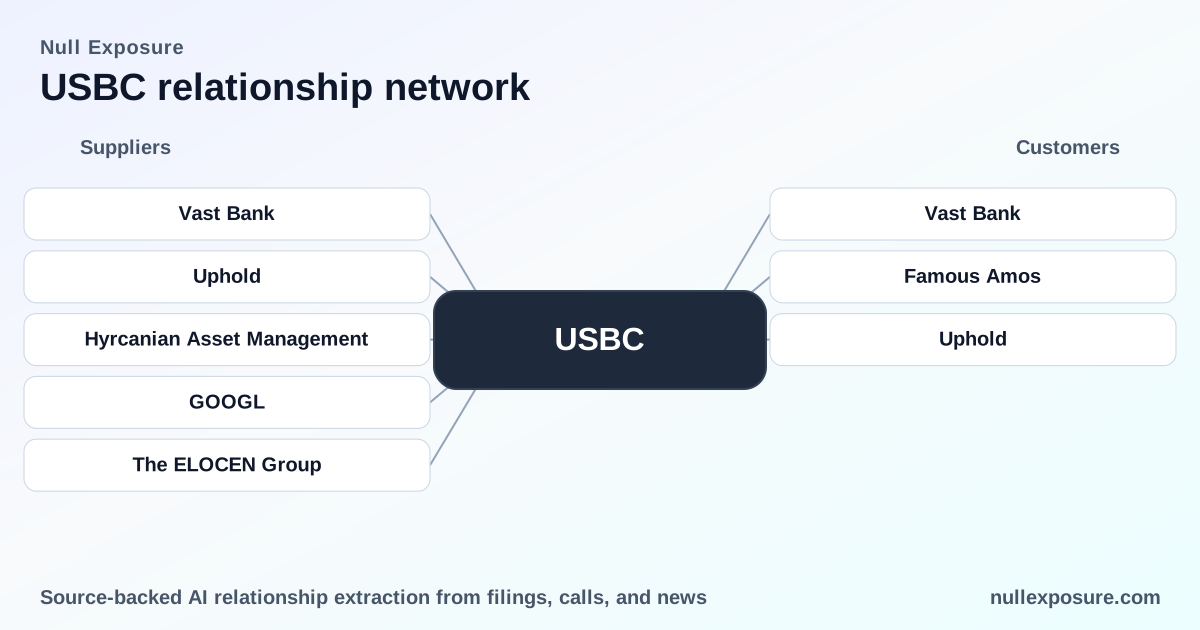
Vast Bank
USBC’s tokenized deposits are enabled by Vast Bank’s national charter and compliance framework, which makes underlying deposits eligible for FDIC insurance subject to limits and regulations; USBC will represent Vast Bank’s customer deposits on its privacy-preserving blockchain. This design positions Vast Bank as the regulated settlement and custody anchor for USBC’s product. Source: GlobeNewswire press release (Oct 23, 2025) and related reporting (Investing.com, Mar–May 2026).
Uphold
Uphold is the fintech distribution partner that will enable its customers to open U.S. dollar accounts with digital, on-chain access through USBC’s network starting in 2026; the agreement allows Uphold customers to hold and transfer digital representations of their deposits routed to Vast Bank via USBC’s blockchain. This gives USBC an established retail channel and a branded front-end for onboarding users onto tokenized deposit rails. Source: GlobeNewswire (Oct 23, 2025) and CoinCentral/TradingView coverage (Mar–May 2026).
Fintech reporting and market reaction pieces (TradingView, CoinCentral, Investing.com) also confirm a finalized strategic partnership involving USBC, Uphold and Vast Bank to commercialize regulated, tokenized deposits in FY2026.
Particle Acquisition
USBC divested its legacy non-invasive sensor technology business to Particle Acquisition for $1 plus assumption of the business’s obligations, completing the sale and extending a bridge note to the buyer. The transaction reflects a deliberate balance-sheet and focus move: shedding legacy hardware operations to concentrate resources on the tokenized-deposit platform. Source: TradingView report on the divestiture (May 4, 2026).
Famous Amos (and U.S. Black Chambers, Inc.)
Famous Amos provided grant funding for a business training initiative where USBC (identified in coverage as U.S. Black Chambers, Inc.) sponsors business training and growth opportunities; the relationship is programmatic and community-facing rather than revenue-generating. This positions USBC as an active sponsorship partner in small-business development and diversity-focused outreach. Source: LocalNewsPasadena report (2025).
Commercial and operational constraints that shape execution
-
Customer mix and go-to-market posture: USBC identifies both retail deposit customers (individuals) and institutional counterparties (businesses, exchanges, institutional investors) as intended users of its infrastructure. These counterparty classes indicate a two-sided strategy: mass retail distribution through partners like Uphold and selective institutional use for treasury and custody flows. This is a company-level signal drawn from USBC’s public disclosures (company statements describing retail and institutional target segments).
-
Stage of deployment: USBC is operating under a structured pilot program before a broad retail launch; management articulated a limited internal-user pilot to validate the offering and inform timing for public availability. This confirms that product-market fit, compliance testing, and operational controls remain active near-term priorities rather than full-scale monetization. This pilot description is presented at the company level in investor communications.
-
Contracting posture and concentration: The business depends on a few strategic partnerships for both regulatory cover (Vast Bank) and customer access (Uphold). That creates concentration risk: commercial outcomes hinge on the success and exclusivity terms of these relationships, and on regulatory acceptance of tokenized deposit structures.
-
Criticality and maturity: The tokenized-deposit product is a critical transformational asset for revenues but remains nascent in commercial maturity; divestiture of legacy hardware signals capital and management focus toward scaling the fintech platform.
Investment implications: growth drivers and principal risks
USBC’s path to value realization is clear: convert tokenized deposit pilots into recurring platform fees and network services sold to fintechs and institutions, while leveraging Vast Bank’s charter for regulatory legitimacy and Uphold’s distribution reach. Key growth drivers are partner activation, volume flow through tokenized deposits, and network monetization (transaction, custody, or licensing fees).
Principal risks are concentrated and operational:
- Partner dependency (platform access and regulatory delivery rest on a small number of counterparties).
- Commercial immaturity (pilot stage delays reduce near-term revenue prospects).
- Balance-sheet strain (large historical losses require capital efficiency as the company repositions).
Investors should monitor pilot milestones, any regulatory guidance on tokenized deposits, revenue recognition from initial partner integrations, and how proceeds or bridge financing from the Particle Acquisition sale are allocated.
Final read: how to track the story
Focus on three near-term catalysts: (1) pilot outcomes and concrete launch timelines announced by USBC; (2) operational rollouts with Uphold and deposit flows recorded with Vast Bank; and (3) any additional distribution or institutional partnerships to reduce concentration risk. For ongoing monitoring and more relational intelligence, see the company page at https://nullexposure.com/.
Bold takeaways: USBC shifted from hardware to regulated fintech; its value depends on partner performance and pilot commercialization; and concentrated counterparties create both leverage and material execution risk.