US Foods (USFD) — Customer Relationships and What They Signal for Investors
US Foods operates as a broadline food distributor that monetizes by selling fresh, frozen, dry and non-food products into foodservice channels across the United States, generating revenue when title transfers at delivery and capturing margin across logistics, procurement and national account agreements. The company's model blends recurring commercial volume, meaningful negotiated channel exposure via GPOs, tactical spot orders, and targeted tuck‑in acquisitions to expand local reach — while recent government contract awards add a discrete, definable revenue stream. For a consolidated view of US Foods’ customer stance and counterparties, visit https://nullexposure.com/.
How US Foods’ customer model looks in practice
US Foods is a nationwide distributor serving roughly 250,000 customer locations and operating under a broadline distribution segment. The company’s customer book mixes:
- Framework relationships (GPOs and national account arrangements) that drive consistent negotiated volume and price terms, accounting for a substantial share of net sales.
- Spot purchase orders from independent and multi‑unit operators that preserve pricing flexibility and inventory turnover.
Nullexposure’s signals show that GPOs represent a material channel, while no single end customer exceeds 2% of sales — an important structural balance between concentration and diversification. The firm also sells to federal, state and local governments and has begun to secure multi‑year government contracts, which introduce a stable, contractually defined revenue stream alongside commercial sales.
Corporate signals that matter to underwriters and allocators
Investors should treat these operating characteristics as company‑level realities rather than isolated anecdotes. Key takeaways:
- Contracting posture: A dual posture — negotiated frameworks through GPOs coexist with individual purchase orders — implies revenue stability from negotiated terms and margin variability from spot activity. (Signal derived from company filing language describing GPO relationships and purchase orders.)
- Concentration and criticality: No single customer contributed more than 2% of sales in FY2025, limiting single‑counterparty concentration, but GPOs accounted for approximately 27% of net sales, concentrating negotiation risk at the channel level and amplifying the importance of national contract retention.
- Geographic maturity: US Foods operates coast‑to‑coast within the U.S., supplying roughly a quarter‑million locations; that footprint supports scale economics in procurement and logistics.
- Customer mix includes government: Federal and military customers are explicit parts of the revenue base, shifting some volume from commercial to contractually governed government demand.
- Distribution role: The company is a broadline distributor — distribution volume and logistics execution are the critical operational levers for customer satisfaction and margin capture.
These signals affect working capital, margin cyclicality, and renewal economics. For further context on how we surface these relationships and signals, see https://nullexposure.com/.
Deal and counterparty readouts — one paragraph per documented relationship
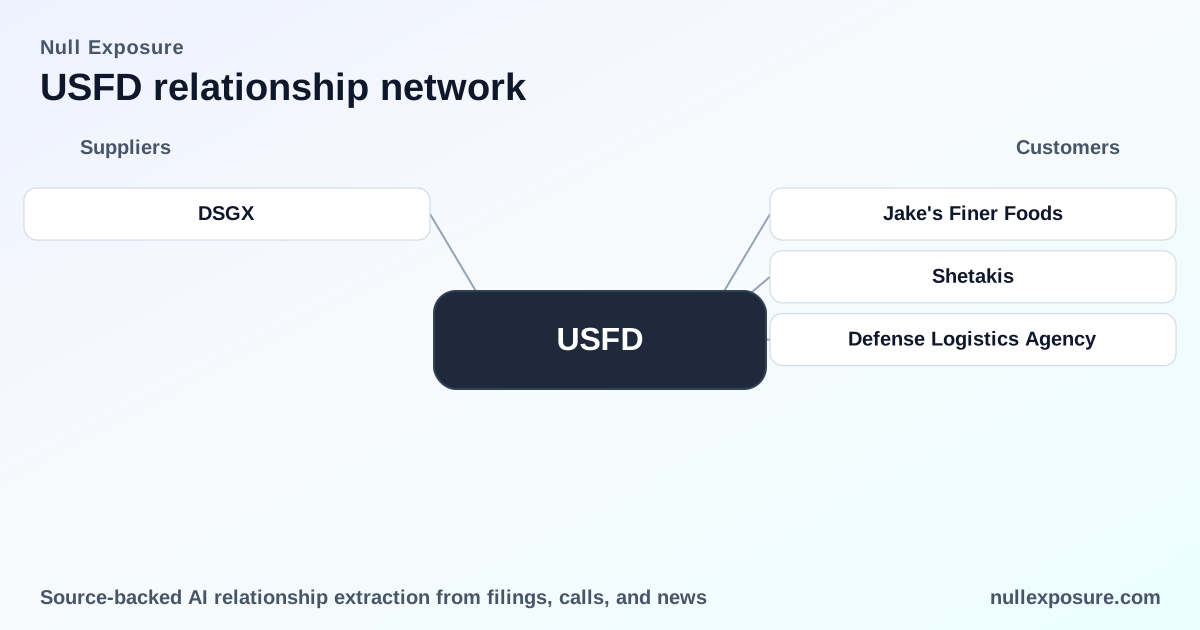
Jake's Finer Foods
US Foods completed the acquisition of Jake's Finer Foods and Gourmet Ranch in Houston on January 10, 2025, for $92 million, reinforcing regional presence and last‑mile distribution density in Texas. This was disclosed in US Foods’ FY2025 Form 10‑K filing (filed Dec 2025).
Shetakis
On November 14, 2025, US Foods completed the acquisition of Shetakis for $46 million, a tuck‑in that extends the company’s reach into additional regional markets and customer sets, according to the FY2025 10‑K filing.
Defense Logistics Agency — contract (coverage A)
US Foods secured a new US$198.26 million contract with the Defense Logistics Agency to supply food and beverages to multiple U.S. military branches, representing a meaningful government revenue award that complements core commercial distribution, as reported by SimplyWallSt in early 2026.
Defense Logistics Agency — contract (coverage B)
Independent trade reporting also documented the same US$198.26 million DLA award, highlighting the contract’s contribution to a defined, multi‑branch military revenue stream and the company’s expanded government sales channel (Sahm Capital coverage, January 2026).
Defense Logistics Agency Troop Support (322‑day bridge agreement)
A separate item references a 322‑day bridge agreement with Defense Logistics Agency Troop Support that adds government volume to the existing commercial base and provides investors with a defined government revenue cadence tied to Army, Navy, Air Force and Marine demand (SimplyWallSt coverage, May 2026).
ARMK (Aramark) — customer mention
Aramark’s FY2025 filing lists national distributors including US Foods among the channels through which it purchases product, indicating that major institutional operators use US Foods as a supplier, per Aramark’s 2025 Form 10‑K (filed Oct 2025).
What these relationships collectively imply for valuation and risk
- Revenue diversification with concentrated channels: The 27% GPO share creates durable volume but centralizes negotiation exposure at the GPO level; retention and margin pass‑through under those agreements are valuation levers. At the same time, the fact no single customer exceeds 2% of sales reduces idiosyncratic counterparty risk.
- Government revenue as stability and complexity: The recent DLA awards and bridge agreement introduce contractual revenue that reduces short‑term top‑line volatility, but government contracts typically entail strict compliance, invoicing cadence shifts, and potential working‑capital impacts that investors should model explicitly.
- M&A and regional strategy: The Jake’s and Shetakis acquisitions are consistent with a strategy of buying regional scale to densify routes and reduce last‑mile costs — a tactical growth lever that supports margin expansion over time.
- Operational grooming is critical: As a broadline distributor, US Foods’ margins hinge on procurement scale, routing efficiency and national account retention; any disruption to these distribution mechanics, or adverse renegotiation of GPO terms, would pressure operating margin.
Key takeaways for investors
- US Foods is a national broadline distributor that monetizes via distributed sales, logistics services and negotiated channel agreements.
- GPOs are materially important (≈27% of net sales) even while no single customer exceeds 2% of sales, creating a mix of concentration and diversification.
- Government contracts are now an explicit revenue vector, with multiple DLA awards and bridge agreements providing a defined, contractual stream alongside commercial customers.
- Tuck‑in M&A expands local density, improving unit economics across routes and serving as a lever for margin improvement.
For a deeper drill into counterparty exposures and how these customer relationships translate into credit and revenue scenarios, see our platform at https://nullexposure.com/.