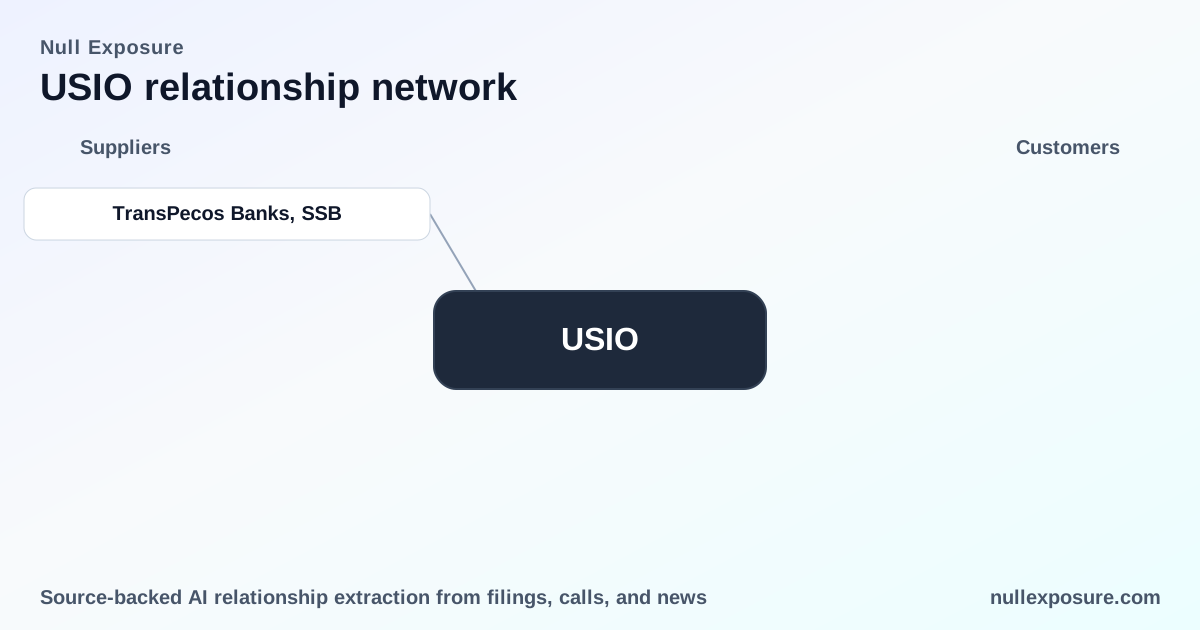
Usio Inc (USIO): Customer Map and What It Means for Revenue Durability
Usio operates as an integrated electronic payments processor that monetizes through transaction fees, prepaid card programs, and payment-facilitation services sold to merchants, governments and consumers across the United States. The business collects volume-based fees under predominantly multi-year merchant contracts and supplements core processing revenue with value-added products such as private-label gift cards and a PayFac-in-a-Box integration layer for software partners.
If you want a consolidated view of corporate customer relationships tied to Usio’s payment and prepaid solutions, visit https://nullexposure.com/ for more indexed relationship intelligence.
How Usio makes money and the shape of its commercial posture
Usio’s disclosed operating model combines merchant contracting, government sales, direct-to-consumer prepaid offerings, and technology partnerships. The company reported roughly $85.4 million in trailing twelve-month revenue and a negative EPS, reflecting a company still balancing growth investments and operating leverage. Several operating-model constraints surface from its disclosures:
- Contracting posture — long-term, volume-linked: Management states that most merchant customers execute multi-year contracts (generally three-year terms) that generate volume-based transaction fees, which creates recurring revenue tied to payment volumes rather than one-off software licenses.
- Counterparty mix — broad but U.S.-centric: Usio sells to government entities, corporations, small businesses and individual consumers via prepaid programs, and management emphasizes geographic dispersion across the United States. This supports revenue diversification but keeps the book highly correlated to U.S. payment volumes and regulatory environment.
- Role and criticality — service provider to transactional operations: Usio functions as a service provider for card, ACH and prepaid flows and as a buyer of processing rails where it bundles offerings for clients; payments are operationally critical to its customers and thus create stickiness once integrated.
- Product maturity and route-to-market — established PayFac layer: The PayFac-in-a-Box product launched after the Singular Payments acquisition and targets bill-centric verticals (legal, healthcare, property management, utilities, insurance), signaling a software-enabled services model built to monetize embedded payments through partners.
These constraints together describe a company with recurring, volume-driven revenue under multi-year contracts, U.S.-focused counterparty exposure, and product-led distribution through software partners—a useful lens for evaluating customer concentration risk and revenue resilience.
Customer relationships that matter — the public signals
Below I review every customer relationship surfaced in public results and what each indicates about Usio’s commercial footprint.
Antone’s Nightclub — private-label gift card launch
Usio launched a new private-label gift card platform in collaboration with iconic Austin venue Antone’s Nightclub, debuting the solution at the Austin Blues Festival. This client-level collaboration illustrates Usio’s strategy to commercialize prepaid and gift-card solutions through event and retail partners. (GlobeNewswire, April 28, 2026)
Mastercard — technology selected by a payments network leader
Management referenced Mastercard among leaders choosing Usio’s technology for mission-critical payment functions, implying Usio’s platform integrates with major card network capabilities or has been validated in contexts where network-grade performance matters. (Earnings call transcript, Q4 2025)
Apple — technology endorsement by a platform provider
Usio cited Apple alongside other leaders as choosing its technology, signaling integrations or reference use-cases involving high-profile consumer-platform environments and lending credibility to its architecture for consumer-facing payment products. (Earnings call transcript, Q4 2025)
City of New York — government client reference
Usio lists the City of New York as an entity that has selected its technology, supporting the company’s stated market for government prepaid and electronic payment programs and demonstrating ability to service large, complex public-sector accounts. (Earnings call transcript, Q4 2025)
State of California — state-level government engagement
The State of California is also named among public-sector organizations using Usio’s technology, reinforcing the company’s penetration into government payment initiatives and its capacity to meet public-sector procurement and compliance requirements. (Earnings call transcript, Q4 2025)
What the relationship map implies for investors
- Revenue stickiness is high where integration occurs. Multi-year contracts and government program wins create structural revenue durability—payment processing is operationally critical for merchants, events, and public entities.
- Concentration is muted by counterparty breadth, but the business remains U.S.-centric; an economic or regulatory shock to U.S. payment volumes would have outsized impact. Usio’s mix of small-business, government and consumer programs indicates diversified end markets but single-country exposure.
- Validation from large platform and network names (Mastercard, Apple) is a non-financial signal that the platform meets performance and integration standards needed for enterprise and high-profile consumer partners. That helps channel growth for PayFac and private-label solutions.
- Monetization lever is volume-based; margin sensitivity to transaction mix is real. PayFac and prepaid programs drive higher take-rates but also require operational and capital support; investors must watch transaction volumes and customer on-boarding economics.
Risks and monitoring checklist for operator and research teams
- Track quarterly trends in transaction volume and average take-rate to understand real revenue momentum. Usio’s FY2025 financials show moderate revenue growth but negative EPS and operating margin pressure; pricing or cost shifts will quickly affect profitability.
- Monitor new PayFac partnerships in bill-centric verticals—these are the primary route to scale embedded payments and lift revenue per client.
- Watch government contract pipeline and procurement outcomes, especially at the state and city level, which are higher-margin and sticky but can be lumpy.
- Observe concentration among merchant cohorts; while management describes geographic dispersion, a small number of large programs could still create earnings volatility.
For a broader set of customer mappings and cross-company relationship analytics, see the research hub at https://nullexposure.com/.
Bottom line
Usio is a U.S.-focused payments processor that monetizes via recurring, volume-based merchant contracts, government prepaid programs, and software-partner PayFac offerings. Public signals—partner launches with Antone’s Nightclub and references to Mastercard, Apple, the City of New York and the State of California—illustrate a mix of event/retail use-cases, enterprise validations, and public-sector traction that collectively support a durable, if nascent, revenue base. Investors and operators should value the company on transaction volume trajectory, the health of PayFac distribution, and the pace at which higher-margin prepaid and private-label products scale.