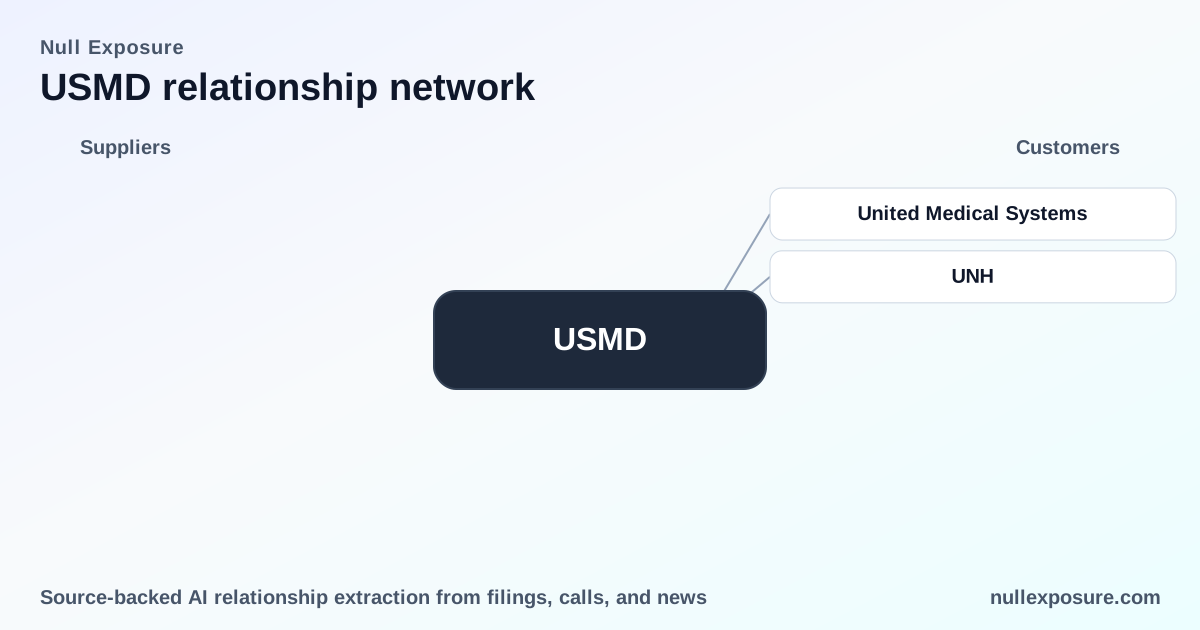
USMD Holdings: customer relationships and what they signal for investors
USMD Holdings operates as a physician-led integrated healthcare system that monetizes through clinical services delivered in hospital and outpatient settings, payer contracts that channel insured patient volume, and strategic asset management including selective divestitures. Investor thesis: USMD’s commercial value derives from its payer relationships that drive recurring patient flow, and from active management of non-core assets that improves capital efficiency. For a concise company snapshot and ongoing updates, visit https://nullexposure.com/.
Why customer relationships matter for a healthcare operator like USMD
For healthcare operators, payers and equipment/service vendors are the operational levers that determine utilization, margin and capital allocation. Where payers bring steady, attributable patient flow, carriers can convert capacity into predictable revenue; where vendors enable mobile or outsourced services, management can de-risk capital ownership. USMD’s public record shows both kinds of relationships: a large-scale payer access arrangement and a strategic sale to an equipment services provider. These linkages shape contracting posture, concentration risk, criticality to operations, and relationship maturity — all important for due diligence.
What the historical record shows about USMD’s counterparties
Below I cover every customer-related relationship returned in the recent record. Each entry is a plain-English, investor-focused summary with a source note.
United Medical Systems
USMD sold most of its lithotripsy division to United Medical Systems, a provider of mobile medical equipment and services, in a transaction announced in FY2015; that divestiture signals management’s willingness to monetize capital-intensive, non-core service lines and use third-party vendors for specialized clinical services. Source: PR Newswire release announcing the sale (FY2015): https://www.prnewswire.com/news-releases/usmd-health-system-announces-the-sale-of-its-lithotripsy-division-to-united-medical-systems-300197127.html.
UNH (inferred symbol)
More than 19,000 UnitedHealthcare employer-sponsored plan participants access USMD’s services each year, indicating a meaningful payer-sourced patient volume relationship that underpins outpatient and inpatient utilization tied to employer-sponsored insurance. Source: PR Newswire joint announcement regarding care coordination in Dallas–Fort Worth (FY2016): https://www.prnewswire.com/news-releases/usmd-and-unitedhealthcare-to-improve-patients-care-in-dallasfort-worth-300300978.html.
UnitedHealthcare
UnitedHealthcare is the named payer through which over 19,000 employer-sponsored members access USMD’s services annually, reinforcing that payer network participation — not only fee schedules — drives patient flow and utilization for USMD’s care sites. This is a commercial relationship that supports recurring volume-based revenue streams. Source: PR Newswire (FY2016): https://www.prnewswire.com/news-releases/usmd-and-unitedhealthcare-to-improve-patients-care-in-dallasfort-worth-300300978.html.
Operating-model implications and company-level constraints
The dataset returned no explicit contractual constraints or line-item limitations tied to specific counterparties. As a company-level signal, the absence of disclosed constraints in this record communicates two practical ideas for investors:
- Contracting posture: USMD demonstrates a mixed posture — it delegates capital-intensive modalities (lithotripsy) to third-party vendors via divestiture, while retaining payer relationships that generate patient flow. This suggests management prioritizes operational flexibility and capital redeployment.
- Concentration and criticality: The UnitedHealthcare channel supplying access to 19,000 employer-sponsored participants is material from a utilization perspective; while the public record does not quantify revenue share, the payer relationship is critical to patient volume and therefore to revenue stability. Investors should assess concentration risk in consolidated financials and payor-revenue disclosures.
- Maturity: The documented relationships date back to FY2015–FY2016, demonstrating multi-year commercial and vendor ties rather than one-off arrangements — a signal of relationship stability and integration into operational workflows.
These are company-level inferences drawn from the public relationship history; they are not contractual assertions about single counterparties because the dataset does not include contract text or constraint excerpts.
Key takeaways for investors and operators
- Payer access is a primary operational lever. UnitedHealthcare’s connection to 19,000 employer-sponsored participants supplies recurring patient volume that translates directly into utilization and revenue. Monitor payer mix disclosures and any shifts in employer-sponsored membership counts.
- Management actively manages capital-intensive assets. The sale of the lithotripsy division to United Medical Systems (FY2015) is evidence of an asset-lighting strategy for specialized technology and an openness to vendor partnerships that reduce balance-sheet capital needs.
- Relationships are longstanding and operationally integrated. The FY2015–FY2016 time stamps show these are not ephemeral arrangements; relationship tenure supports predictability in operations.
Risk signals investors should probe further
- Concentration risk in payers: The single headline payer relationship described in the public release is meaningful for volume; investors should request payer-revenue breakdowns to quantify dependency.
- Operational reliance on vendors for specialty services: Divesting a lithotripsy unit reduces capital burden but increases vendor dependence; diligence should evaluate service-level terms and continuity of care implications.
- Lack of disclosed contractual constraints: The absence of contract excerpts in the record prevents assessment of termination rights, rate resets, and exclusivity provisions that can materially affect cash flow.
Concluding view and next steps
USMD’s customer relationships reveal a strategy that blends payer-driven volume with selective outsourcing of capital-intensive services. For investors, the priority is twofold: (1) quantify how much of revenue and utilization flow through the named payer channels, and (2) assess vendor dependency for specialized clinical services post-divestiture. For immediate follow-up and deeper relationship mapping, see the company’s public filing archive and ongoing relationship signals at https://nullexposure.com/.
For a broader view of counterparty intelligence and historical relationship tracing, visit https://nullexposure.com/ — the home page hosts our aggregated signals and research tools.