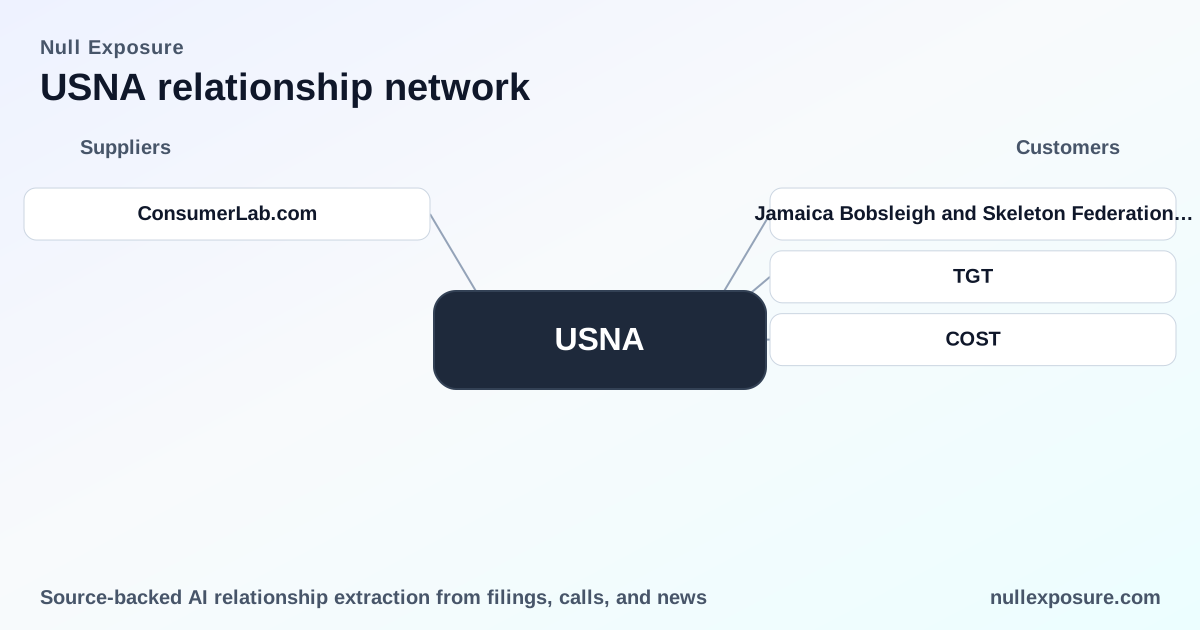
USANA’s customer relationships: retail rollouts, subscription backbone, and geographic concentration
USANA Health Sciences operates as a product-focused consumer health company that develops, manufactures, and sells nutritionals, personal care, and food products through a legacy direct‑selling network and an expanding direct‑to‑consumer/retail footprint. The firm monetizes through product sales, a meaningful recurring‑revenue subscription program (Auto Order), and growing wholesale placements via its Rise Wellness and Hiya brands at mass retailers. For investors, the immediate thesis is simple: durable core nutrition sales plus a transition toward omnichannel retail distribution create revenue upside, but APAC concentration and execution on retail launches determine downside. For further corporate signals and ongoing customer intelligence, visit https://nullexposure.com/.
How USANA earns revenue and the structural customer signals investors should track
USANA generated roughly $854.5 million in net sales in 2024 and remains a predominantly product‑selling business. The company's customer base and contract posture include several structural characteristics that drive both opportunity and risk:
- Subscription orientation: A high‑frequency Auto Order program delivers recurring revenue and represented a substantial share of product sales volume (the Auto Order program offered a 10% discount and represented 63% of product sales volume for the year ended December 28, 2024). This is a material operating characteristic that improves predictability of cash flows.
- Direct selling and individual customers: The firm's core channel is person‑to‑person distribution through independent Associates and Preferred Customers; active Customers totaled approximately 454,000 as of December 28, 2024, reflecting a mature, customer‑led selling model.
- Geographic concentration: Asia Pacific is the dominant source of revenue, with Greater China the largest single market (representing roughly 48.4% of net sales in recent disclosures). The company operates in 25 markets globally, so international risk and regulatory exposure are central to the investment case.
- Customer materiality: No single Associate or customer accounted for 10% or more of net sales—relationship-level concentration is not driven by any single wholesale counterparty, but regional concentration (APAC/China) is strategically critical.
- Product mix maturity: USANA’s business remains anchored in its core nutritionals, which contributed approximately 87% of product revenue for the company’s direct selling segment in 2024.
- Scale: Net sales are in the high‑hundreds of millions, indicating spend and scale consistent with the “100m_plus” spend band.
These characteristics form the basis for evaluating customer relationships and the company’s pivot to retail.
Retail expansion is a strategic pivot — what the company has said publicly
USANA’s management has communicated a deliberate shift from a legacy direct‑selling posture toward a broader omnichannel approach, using retail partners to accelerate brand reach for newer product lines (notably Rise Wellness’ Protein Pop and Hiya). This channel mix change creates inventory and working‑capital demands in the near term but should broaden the addressable market if execution aligns with retail cadence. Management discussed inventory increases tied to retail launches on the Q4 2025 earnings call, which underpins near‑term margin pressure but longer‑term distribution leverage.
Relationship roll call and what each means for investors
Jamaica Bobsleigh and Skeleton Federation (JBSF)
USANA entered a sponsorship/partnership with the Jamaica Bobsleigh and Skeleton Federation to support the team through the 2026 Winter Olympics, providing nutritional products to the athletes. A PR Newswire release on March 10, 2026, announced the agreement and framed it as a brand‑marketing and athlete‑support initiative that aligns with USANA’s positioning in sports nutrition.
Costco (COST)
Rise Wellness, a wholly owned subsidiary of USANA, launched Protein Pop Plus and executed a nationwide rollout at all U.S. Costco locations. Management and multiple media reports tied inventory increases at Rise Wellness specifically to supporting the Protein Pop launch at Costco. Sahm Capital reported the Costco launch on February 25, 2026, and USANA’s Q4 2025 earnings call (reported in March 2026) confirmed inventory buildup to support that retail expansion.
Target (TGT)
USANA’s Hiya brand increased distribution into Target stores in the U.S., and management highlighted Target as a key retail partner in the company’s omnichannel expansion. Finviz and the Q4 2025 earnings discussion referenced Target as a targeted channel for Hiya’s broader distribution, and the company confirmed being in Target stores in the U.S. during the March 2026 earnings commentary.
Why each relationship matters for revenue durability and valuation
- Costco (Protein Pop): A national Costco roll‑out materially accelerates customer trial and scale for the Rise Wellness brand; however, it also explains the near‑term inventory and working‑capital build cited by management. Investors should treat broad Costco placement as a growth inflection if sell‑through and reorder behavior follow standard CPG patterns.
- Target (Hiya): Target provides a mainstream retail foothold for Hiya’s children’s‑health products and signals management’s push to diversify channels beyond direct selling; success depends on margin structure and USANA’s ability to manage in‑house manufacturing scaling referenced in disclosures.
- JBSF sponsorship: This is primarily a brand‑marketing initiative that supports athlete credibility and consumer perception in sports nutrition categories; it is not material to sales but affects brand equity.
Operational and risk implications to monitor
- Execution on omnichannel logistics: Retail rollouts increase inventory needs and supply‑chain complexity; management has already flagged inventory increases to support these launches in Q4 2025 commentary.
- Geographic risk concentration: China and Asia Pacific exposure remains the dominant macro risk—currency, regulatory, or distributor dynamics in that region will materially affect consolidated performance.
- Subscription retention: Auto Order underpins recurring sales and is a major retention lever—monitor subscriber growth and attrition rates as primary drivers of topline stability.
- Customer diversification vs. concentration: While no customer accounts for >10% of sales, the company’s regional concentration creates a de facto counterparty risk at the market level rather than the single‑buyer level.
Bottom line and next actions for investors
USANA is executing a credible transition from a primarily direct‑selling manufacturer into a hybrid model that combines a large subscription base with fast‑scaling retail placements. The potential upside comes from retail scale and higher DTC margins for newer brands; the key risks are APAC concentration and execution on inventory and retail sell‑through. For ongoing monitoring and detailed relationship intelligence on USANA and its retail partners, see https://nullexposure.com/.
Key takeaways:
- Subscription (Auto Order) is a strategic revenue stabilizer.
- Costco and Target placements are growth catalysts but raise near‑term working‑capital needs.
- Asia Pacific concentration is the primary macro risk to valuation.
For investors and operators tracking partner rollouts or shelf performance, maintain focus on retail sell‑through, subscription KPIs, and regional sales mix on each quarterly call.