U.S. Physical Therapy (USPH): enterprise distribution, fee-for-service revenues, and the NYU Langone alliance
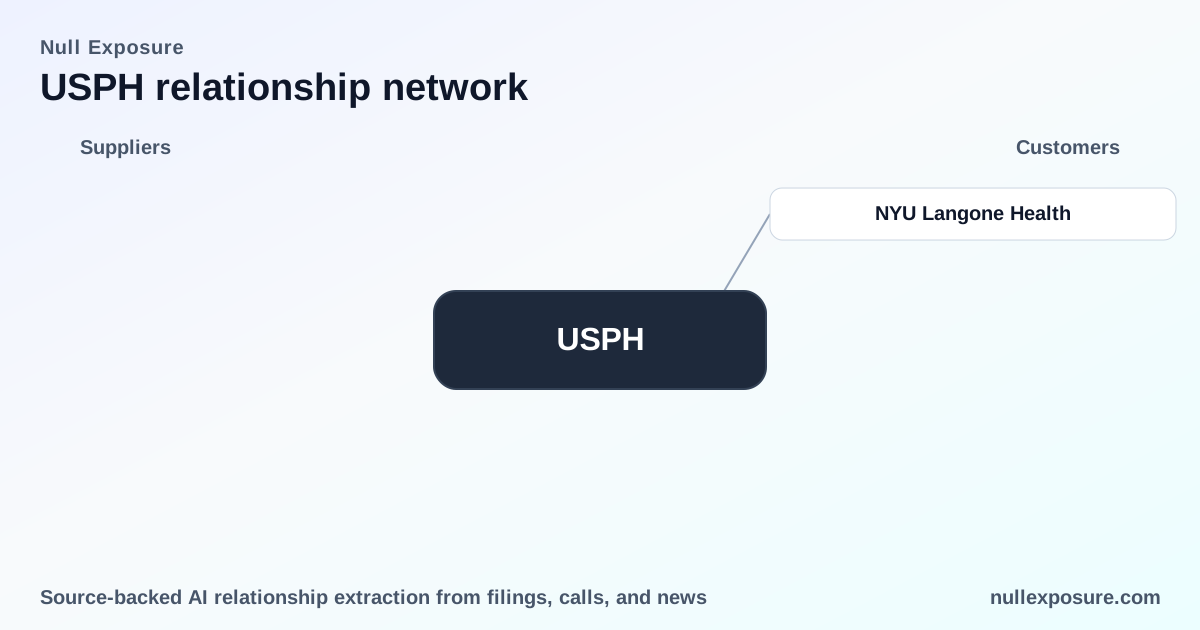
U.S. Physical Therapy operates and/or manages outpatient physical therapy clinics and industrial injury prevention services, monetizing through a mix of fee-for-service clinic revenue, payer-managed contracts (including Medicare and commercial insurers), long-term management agreements, and employer-contracted IIP programs. The business model captures per-visit and per-hour economics in clinical operations while selling contracted, usage-based injury-prevention services to large employers; these revenue mixes produce a hybrid of predictable recurring cash flows and utilization-linked sensitivity. For investors evaluating customer relationships, the most consequential data point this year is the company’s long-term clinical alliance with NYU Langone, which reframes USPH’s strategic positioning in major Northeast health systems.
Explore more company relationship intelligence at https://nullexposure.com/.
Why the NYU Langone alliance matters now
U.S. Physical Therapy’s Metro Physical & Aquatic Therapy subsidiary signed a 10-year alliance with NYU Langone Health to bring Metro’s 60 Long Island and New York–area outpatient clinics into NYU Langone’s clinical network. This creates immediate distribution scale inside a major academic health system and converts previously standalone clinics into an integrated source of referral volume and contracted service delivery. According to Simply Wall St reporting in March 2026, the alliance formally folds Metro clinics into NYU Langone’s network and establishes a long-dated collaboration framework. A follow-up note from Sahm Capital reiterated the same 10-year arrangement and emphasized the strategic lift for USPH’s local market share in the New York metro area (reported February–May 2026).
NYU Langone Health — Simply Wall St (March 10, 2026): Metro’s 60 Long Island and NYC-area clinics enter NYU Langone’s clinical network under a 10-year alliance.
NYU Langone Health — Sahm Capital (Feb 9, 2026; referenced May 4, 2026): Same 10-year alliance reported, highlighting potential changes to USPH’s growth profile in the region.
How USPH structures customer contracts and where revenue actually comes from
USPH operates two principal commercial segments: physical therapy operations and Industrial Injury Prevention (IIP) services. Company disclosures state that clinic revenues follow standard outpatient reimbursement mechanics—Medicare, commercial insurers, managed care programs, workers’ compensation—and management contract fees when clinics are run on behalf of third parties. Meanwhile, IIP revenues are usage-based, recognized on the number of hours and agreed rates for services provided to employers and self-insured plans.
- Contracting posture: a hybrid of payer-negotiated schedules (including Medicare Physician Fee Schedule reimbursement), employer-paid programs, and multi-year management/affiliate arrangements. Company filings describe Medicare reimbursement and explicit contractual arrangements with third-party payors and employers (FY filings).
- Payment counterparties: a diversified mix across government payors (Medicare/Medicaid), large and very large enterprise employers (including Fortune 500 clients), and commercial insurers.
- Service role: USPH functions as a service provider—operating clinics, delivering onsite IIP services, and managing clinics for third-party physicians or hospitals without ownership in many managed locations.
These characteristics create a blended revenue profile: stable base demand from payer-reimbursed clinic visits plus variable, usage-linked institutional contracts for industrial services.
Operational footprint, concentration and what it signals about risk
USPH’s operating scale is national and material: the company reported operating or managing 729 clinics in 43 states as of year-end 2024. That footprint produces geographic diversification across payor mixes but also concentrates exposure to U.S. reimbursement policy and employer procurement cycles.
- Concentration: the IIP segment explicitly contracts with large employers and insurers; the company notes a meaningful proportion of IIP work is paid directly by employers, including Fortune 500 firms, which concentrates contract value in a limited set of enterprise buyers.
- Criticality: physical therapy services and onsite injury-prevention are core inputs to employers’ worker-health programs and health systems’ outpatient networks—USPH’s role as an operator and manager is operationally critical to partners seeking standardized rehabilitation and return-to-work outcomes.
- Maturity: long-term arrangements—illustrated by the NYU Langone 10-year alliance—signal an ability to negotiate extended network agreements and embed clinics in sophisticated health systems, reducing short-term churn and raising switching costs for large partners.
These company-level constraints and signals recommend an investor view that USPH trades off some utilization sensitivity for contract durability with large payors and enterprise clients.
Relationship-by-relationship snapshot (complete coverage)
-
NYU Langone Health — Simply Wall St reported in March 2026 that Metro Physical & Aquatic Therapy, a USPH subsidiary, entered a 10-year alliance to integrate Metro’s 60 Long Island and New York–area outpatient clinics into NYU Langone’s clinical network. This is a material expansion of USPH’s network alignment with a major academic health system. (Simply Wall St, March 10, 2026)
-
NYU Langone Health — A Sahm Capital report (first published Feb 9, 2026 and referenced May 4, 2026) also covered the same 10-year Metro–NYU Langone alliance, highlighting that the arrangement could materially change USPH’s competitive dynamics and patient referral flows in the New York market. (Sahm Capital, Feb–May 2026)
What investors should weigh: valuation, margins, and partnership risk
USPH’s financial profile—approximately $773M revenue trailing twelve months against a market capitalization near $1.08B—positions the company as a mid-cap healthcare services operator where valuation reflects expected continued margin compression/expansion cycles tied to reimbursement trends and utilization. Management’s ability to lock multi-year network and employer contracts (as with NYU) increases revenue visibility and justifies premium multiple components, while the usage-based nature of IIP revenue introduces throughput sensitivity tied to employer injury rates and program utilization.
Key investor considerations:
- Reimbursement risk from Medicare and commercial payors is a structural factor; USPH’s payor mix includes government programs and managed care.
- Counterparty concentration in IIP (large and very large enterprises) amplifies contract renewal risk but also increases per-contract revenue scale.
- Strategic partnerships with health systems (exemplified by NYU Langone) are high-impact — they convert local clinic ownership into system-aligned volumes and referral pipelines.
For deeper relationship intelligence and ongoing monitoring of USPH customer alignments, visit https://nullexposure.com/.
Bottom line: service scale with enterprise distribution
U.S. Physical Therapy combines national clinic scale, payer-based reimbursement stability, and enterprise-level IIP contracts. The NYU Langone alliance is the clearest near-term inflection: a 10-year commitment that strengthens USPH’s position inside a major health system and elevates the strategic value of its Metro subsidiary. Investors should view this as a validation of USPH’s partnership model—one that balances fee-for-service clinic economics with larger, contracted enterprise relationships that can drive durable cash flow.