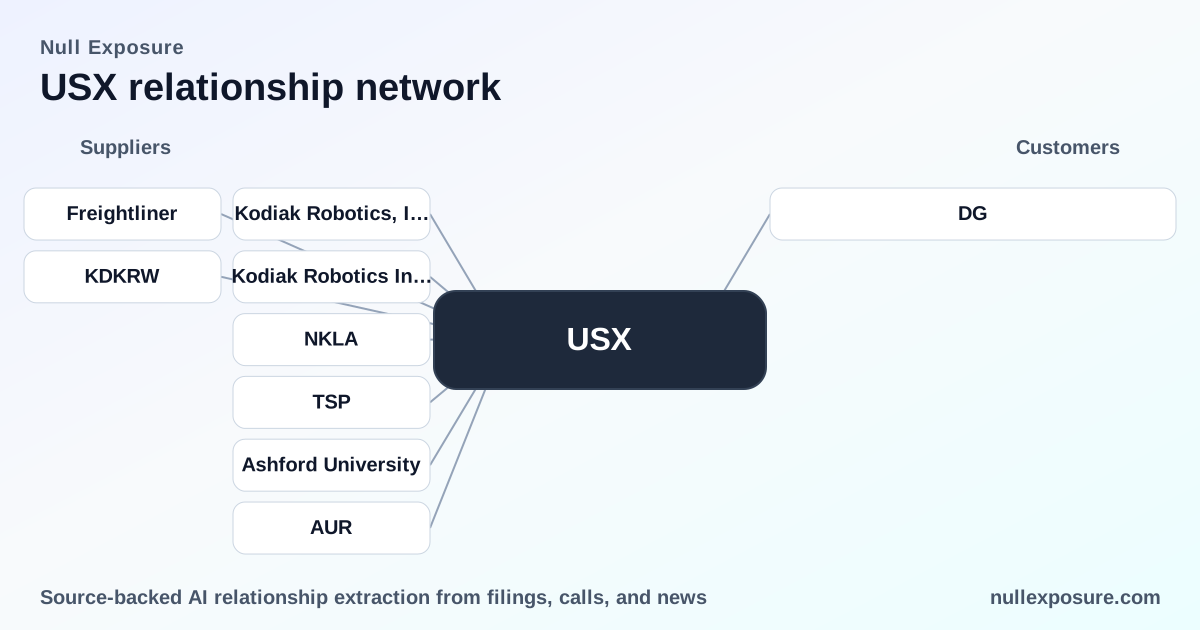
US Xpress (USX) — Customer Relationships That Drive Revenue and Risk
US Xpress is a national truckload and dedicated carrier that monetizes through contractual hauling services, dedicated-account operations, and time‑and‑mileage fees tied to major retail and distribution customers. Revenue depends on long-term dedicated contracts, spot market brokerage when capacity is available, and contract provisions (fuel surcharges, detention, accessorials) that convert operational leverage into cash flow. For investors, the critical questions are customer concentration, contract terms, and the litigation/reputational exposure that flows from service performance. For a convenient consolidated view of commercial relationships and source material, visit https://nullexposure.com/.
Why customers determine USX’s valuation more than capex
US Xpress runs a capital-intensive transport operation but the value proposition to clients is service continuity and contractual reliability. A few large customers can account for a disproportionate share of revenue, which compresses margin volatility when contracts are stable and amplifies downside if a major account restructures or exits. Contract type matters: dedicated accounts shift operational control and liability, reducing spot-market volatility but increasing dependency on single-client performance and settlement terms.
What the public record shows about named customers
Below are the relationships surfaced in recent coverage and filings. Each entry is accompanied by a concise, plain-English summary and the reporting source.
Walmart — largest customer; litigation and disclosure themes (FY2025)
Walmart is identified in litigation as US Xpress’s largest customer, and an amended investor complaint alleges that Walmart changed shipping patterns while company executives provided “highly misleading” information about shipping performance. The matter is tied to a settlement process reported in May 2026 and highlights the reputational and disclosure risk that accompanies major retail relationships. According to Trucking Dive (May 4, 2026), the amended complaint centers on changing shipping patterns and investor disclosures relevant to FY2025.
DG — court ruling emphasized contract control (FY2019)
A federal judge granted Dollar General’s motion for summary judgment in a negligence suit involving a US Xpress delivery driver, ruling that under the dedicated account contract Dollar General relinquished control of the trailer and its contents once the truck left the distribution center. The ruling underscores how dedicated-account contracts can allocate operational control and legal liability, affecting where risk sits in routine delivery incidents. This was reported by FreightWaves (March 10, 2026) with reference to the FY2019 contractual posture.
Dollar General — same matter, same legal signal (FY2019)
The FreightWaves coverage repeats that the Indiana U.S. District Court found that Dollar General’s dedicated-account contract transferred control to US Xpress and its driver upon dispatch, resulting in judgment for Dollar General. The coverage reinforces the legal precedent that dedicated contracts can insulate customers by design, and shows how litigation outcomes feed directly into contract interpretations and operational responsibilities. See FreightWaves (March 10, 2026).
Operating-model signals and business-model constraints
Investors should treat these observations as company-level operating signals rather than isolated anecdotes.
- Contracting posture: US Xpress operates significant dedicated-account contracts that shift day-to-day control to the carrier; this reduces spot-market exposure but increases counterparty concentration risk.
- Concentration: The record identifies at least one very large retail customer; customer concentration is a structural risk that links USX revenue to a handful of counterparties.
- Criticality: For large retailers, US Xpress provides mission‑critical outbound and last‑mile services — disruption translates quickly into commercial and reputational pressure.
- Legal maturity: Court decisions confirming the allocation of control and liability under dedicated contracts set a precedent for how future disputes will be judged; litigation is a predictable ongoing constraint for a carrier with large retail clients.
These constraints shape capital allocation, pricing leverage, and the company’s bargaining position when negotiating renewals or defending claims.
Investment implications — what matters next
The recent reporting yields clear investment implications for operators and allocators:
- Customer concentration is a lever and a risk. A stable, multi-year dedicated account can produce predictable cash flow, but a loss or renegotiation of a major retail account will exert immediate pressure on utilization metrics and margins.
- Contract terms determine where losses land. Dedicated-account language that assigns control to the carrier gives US Xpress pricing power but also operational responsibility; conversely, language that insulates clients reduces USX’s leverage.
- Litigation and disclosure events create headline risk. Allegations about misleading investor communications and court rulings on liability both increase the cost of capital and invite closer regulatory and investor scrutiny.
- Operational execution is the margin driver. Performance slippages with major customers drive contractual disputes and potential compensation or settlement obligations.
Consider a focused checklist when evaluating US Xpress exposure: customer revenue concentration by name, vintage and termination provisions of key contracts, recent litigation outcomes, and any public disclosures tied to service performance.
What investors should watch in the coming quarters
- Renewal outcomes with major retail accounts and any shift from dedicated to transactional models.
- Additional litigation or settlements that reference performance disclosures or contract allocation of control.
- Public filings and investor communications for revised revenue concentration disclosures and guidance adjustments.
For a consolidated, source-backed view of US Xpress’s customer relationships and related public documents, see https://nullexposure.com/.
Bottom line
US Xpress’s revenue profile is deeply shaped by large, dedicated retail relationships; those relationships deliver predictable revenue when contracts and service quality hold, but they concentrate operational and legal risk. Recent reporting on Walmart and court rulings involving Dollar General crystallize the twin themes investors must monitor: concentration-driven leverage and contract-defined liability. Investors should price USX with careful attention to contract maturity, renewal cadence, and any incremental litigation or disclosure events that alter perceived stability.