UTAA: How a Talent Agency Turns Client Deals into Market Value
United Talent Agency (UTAA) operates as a talent, content and multimedia dealmaker that monetizes by brokering creative partnerships, taking commissions on representation, and securing production and distribution arrangements that generate fees and backend participation. For investors, the essential thesis is straightforward: UTAA’s value hinges on its ability to convert client relationships into recurring content revenue and high-margin advisory and production fees, while using capital markets (including SPAC activity) to scale distribution and underwriting capabilities. For a quick company overview and monitoring signals, visit https://nullexposure.com/.
What the FaZe Clan deal tells investors
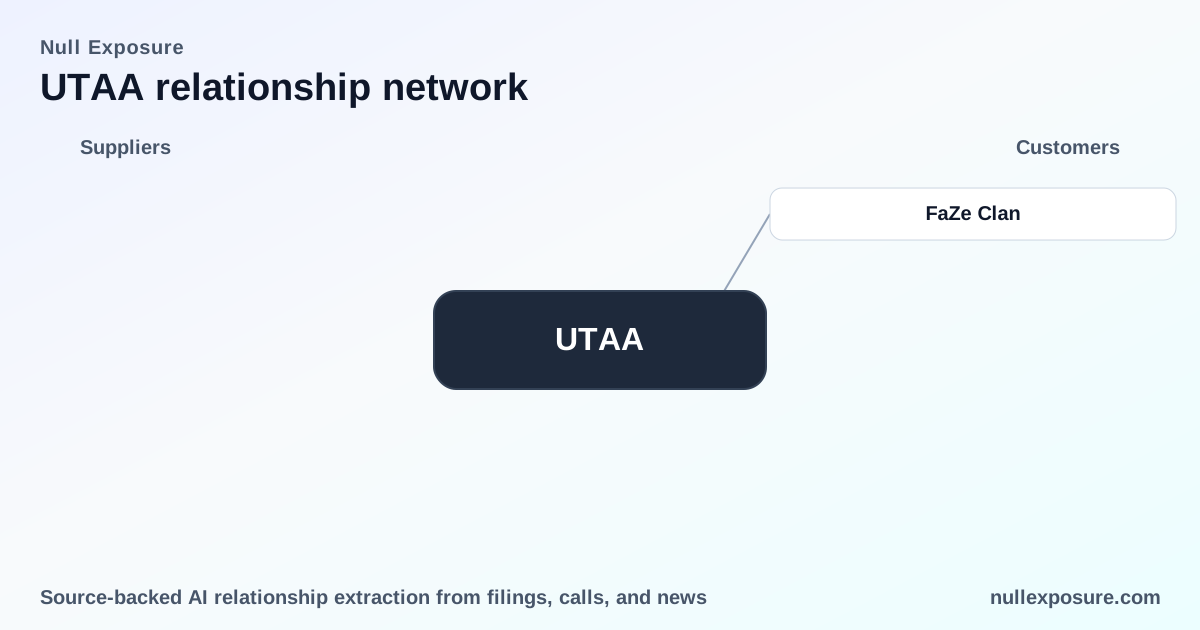
UTAA’s publicly visible customer activity in this review centers on a content partnership with FaZe Clan, a major esports and lifestyle entertainment brand. UTAA secured a February deal to help FaZe Clan expand into podcasting and unscripted content, a transaction that illustrates the agency’s core competency: packaging talent and intellectual property into new media formats that can be monetized across streaming and branded-content channels. According to Front Office Sports (March 10, 2026), the agency executed that arrangement as part of its broader content push that was active in FY2021 (https://frontofficesports.com/united-talent-agency-raises-200m-for-spac/).
Why this single relationship matters beyond the headline
This FaZe Clan engagement is not simply a one-off booking. It signals three strategic characteristics of UTAA’s operating model:
- Content-first monetization: UTAA converts client fame and IP into serialized media (podcasts, unscripted series) that produce fee and licensing revenue streams instead of one-time talent commissions.
- Cross-vertical distribution play: Working with an esports brand shows UTAA’s ability to bridge traditional entertainment and fast-growing digital-native audiences—a pathway to new advertising, sponsorship, and platform partnership fees.
- Capital-market facilitation: The same Front Office Sports coverage that details the FaZe Clan deal also notes UTAA’s SPAC financing activity in 2026, indicating the agency is using public-market capital to bolster production and distribution capacity, which amplifies the value of client relationships.
Operating posture, concentration and maturity — investor implications
Present signals indicate a project-based contracting posture: deals are often structured around specific content initiatives (podcasts, series, branded content) rather than long-term captive contracts. That posture creates episodic revenue but high margin upside when content scales.
Concentration should be treated as a watch item. While UTAA represents wide talent pools, the evidence here documents a high-profile engagement with FaZe Clan; investors should therefore monitor whether a small set of marquee clients drive disproportionate value. In practice, that means UTAA’s economics will show volatility tied to the success of a limited number of content franchises unless distribution and licensing deals convert discrete projects into recurring revenue.
On maturity, UTAA is an established agency expanding into production and distribution, with capital-market activity (the $200M SPAC raise reported in March 2026) reflecting a push from representation toward owning parts of the content supply chain. That transition increases operating leverage but also requires higher upfront capex and execution discipline.
Risk checklist for investors and operators
- Revenue variability: Project-based content deals create quarter-to-quarter swings in fee recognition.
- Client concentration risk: Dependence on marquee clients to seed content franchises elevates downside if those relationships underperform.
- Execution and distribution risk: Owning production/distribution requires different capabilities than talent representation; failed launches can impair returns and reputation.
- Reputation and talent retention: Agency value is a function of access to talent; sustaining that access requires competitive compensation and relationships management.
Relationship summary — what the record shows
FaZe Clan — United Talent Agency secured a deal in February (FY2021 activity) to expand FaZe Clan into podcasting and unscripted content, reflecting UTAA’s role in translating esports IP into new media formats; this was reported by Front Office Sports on March 10, 2026 (https://frontofficesports.com/united-talent-agency-raises-200m-for-spac/).
Investment takeaways and next steps
- Positive: UTAA leverages client IP into scalable content products. The FaZe Clan engagement is a concrete example of converting fandom into monetizable formats—valuable in an attention-driven media market.
- Watch: execution on production and distribution. The firm’s SPAC-related capital raise increases upside but also raises expectations for converting content deals into recurring revenue.
- Tactical: Monitor announcements of broader content partnerships and distribution deals that convert episodic wins into platform-level recurring income.
For investors doing diligence, the top immediate actions are to track subsequent announcements tied to the FaZe Clan partnership (distribution deals, sponsorships, or series launches) and to review UTAA’s disclosures around the use of SPAC proceeds and operating metrics for production revenue. For a centralized source of situational summaries and relationship tracking, see https://nullexposure.com/.
Bold, high-impact client wins like FaZe Clan are evidence of UTAA’s strategic direction—moving from talent representation toward owning the content lifecycle—but converting those wins into predictable, repeatable cash flows is the critical next phase investors should demand proof of.