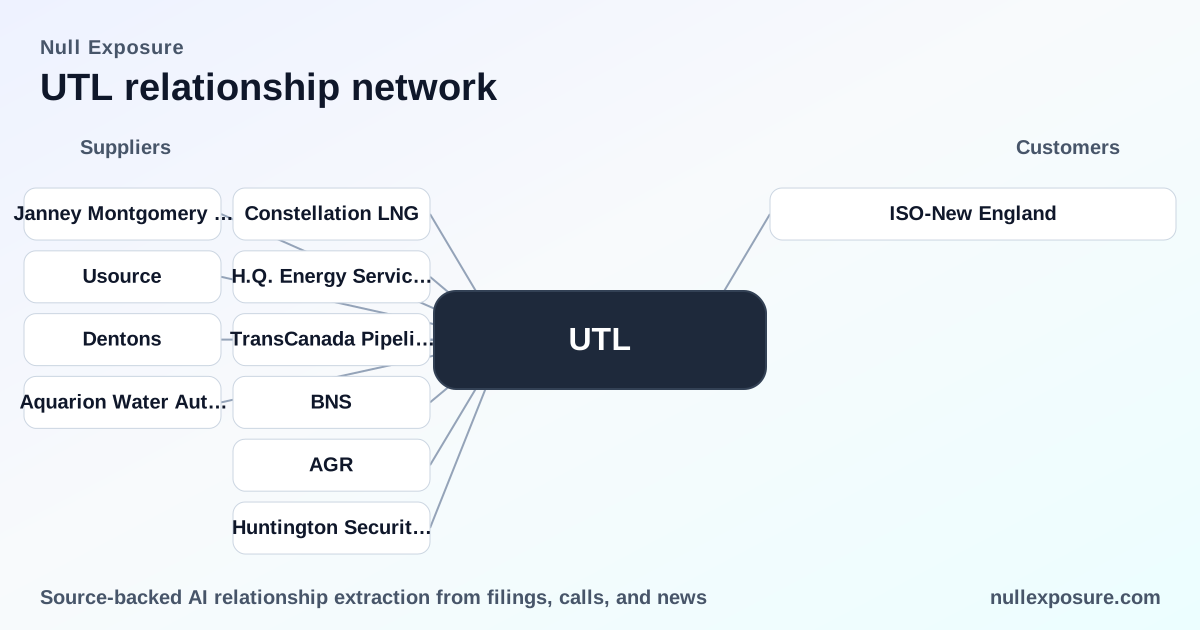
Unitil (UTL) — Customer Relationships That Drive Regulated Cash Flow and Wholesale Market Exposure
Unitil operates as a regional utility holding company that monetizes a regulated distribution franchise: it delivers electricity and natural gas to roughly 215,100 customers across New Hampshire, Massachusetts and Maine and recovers costs principally through tariffed, usage‑based charges under traditional cost‑of‑service regulation. Revenue is largely monthly and tied to customer consumption, while select large accounts are supplied through wholesale market procurement channels. Read on for a focused inventory of the company’s customer-facing relationships, the operating constraints that shape revenue durability, and the investor implications.
For a broader view of datasets and tools that can accelerate your diligence, visit https://nullexposure.com/.
The basic investor thesis — stable distribution economics with targeted wholesale exposure
Unitil’s core value proposition is stable, regulated cash flow from distribution margins and fees recovered under state tariffs, complemented by operational flexibility when serving large commercial customers through wholesale market purchases. The company’s monetization levers are straightforward: volume-driven monthly billings, cost recovery in regulated rates, and occasional wholesale market participation for specific customer segments. This combination produces predictable margins while leaving selective earnings volatility tied to weather, wholesale power prices and large-account procurement dynamics.
How Unitil’s customer model actually works
Unitil’s operating footprint is a collection of distribution utilities—Unitil Energy, Fitchburg, Northern Utilities, Bangor and Maine Natural—each delivering electricity and/or gas under regulated frameworks. According to Unitil’s FY2025 Form 10‑K, the distribution utilities “primarily deliver electricity and/or natural gas to customers in the Company's service territories at rates established under traditional cost of service regulation,” which underscores a regulated, rate‑base business model with long-lived assets and predictable capital recovery.
Key company-level operating signals:
- Contracting posture: A majority of revenue is recognized monthly based on tariffs and customer consumption, signaling a usage‑based, recurring revenue profile.
- Customer composition: The counterparty base is dominated by individual/residential customers and small commercial accounts, increasing the sensitivity of revenue to weather and consumption trends (Unitil reported residential sales rising 34.0% in 2025 vs. 2024, driven by a colder winter and customer growth).
- Geographic concentration: All revenues and long‑lived assets are U.S.‑based, concentrated across parts of New England, which implies regional exposure to regulatory and weather cycles.
- Role dynamics: Unitil functions both as a seller (distribution service provider) and as a buyer for supply in specific situations, particularly for large accounts that are served via wholesale markets.
- Operational maturity: The business operates in a mature, regulated segment with cost‑of‑service ratemaking, producing stable but rate‑regulated returns.
Collectively, these signals point to a low-beta, predictable utility franchise with pockets of wholesale price exposure and weather sensitivity that can move near‑term earnings.
Relationship inventory: the counterparties and market links that matter
This section documents every customer-related relationship identified in the company material. Each relationship summary is concise, with source attribution.
ISO‑New England — wholesale market procurement for large accounts
Fitchburg, one of Unitil’s distribution companies, procures electric power supply for large account customers directly through ISO‑New England’s markets, meaning Unitil uses regional wholesale market access to serve certain high‑demand customers rather than sourcing exclusively through bilateral contracts. According to Unitil’s FY2025 Form 10‑K, this is an active procurement pathway for those large accounts. (Source: Unitil 2025 Form 10‑K, FY2025)
Investor takeaway: Wholesale market exposure through ISO‑NE is limited and targeted to large accounts, so overall regulated distribution cash flows remain the primary earnings driver, but spikes in wholesale prices can affect margins on those served via ISO‑NE.
Why these relationships matter for valuation and risk
Unitil’s customer relationships and market links drive three core investment considerations:
-
Revenue predictability and monetization structure. Because a majority of revenues are recognized monthly under tariffed, usage‑based billing, Unitil benefits from high predictability in cash flows with regular receipts tied to consumption. This supports dividend coverage and stable free cash flow generation. (Evidence: company revenue recognition language in FY2025 filings.)
-
Concentration and regional regulatory exposure. The business is geographically concentrated in New England, so state ratemaking outcomes, regional fuel costs and shifting policy (e.g., renewables integration) are high‑leverage items for valuation. Unitil’s regulated rate framework reduces merchant risk but makes returns sensitive to allowed ROE and rate case frequency.
-
Targeted wholesale risk and operational flexibility. The fact that Unitil’s Fitchburg unit procures for large customers through ISO‑New England introduces a discrete channel of exposure to wholesale prices, while also providing the utility with flexibility to accommodate large loads without relying on fixed long‑term bilateral purchases. This is a double‑edged characteristic: flexibility with episodic price risk.
Material risk factors for underwriters and investors
- Weather and volume sensitivity. A 34% increase in residential sales in 2025 tied to colder winter weather illustrates how short‑term earnings can swing with weather variability even within an otherwise stable tariff structure.
- Regulatory outcomes. Returns depend on cost recovery in rate cases and regulatory treatment of procurement costs, which can compress earnings if regulators disallow pass‑throughs or alter ratemaking mechanics.
- Wholesale market pass‑throughs. For customers served via ISO‑NE markets, spikes in wholesale prices directly affect procurement costs and could transiently impact working capital and gross margins if not immediately passed through.
Practical implications for portfolio managers and operators
For investors seeking stable utility exposure with modest growth, Unitil’s profile is compelling: regulated distribution fundamentals, high institutional ownership (83.6%), and a low beta favor defensive allocations. For operations or commercial counterparties, the mix of tariffed retail billing and selective wholesale procurement suggests negotiating levers are limited at the retail level but meaningful in large‑account supply arrangements.
If you want a concise, comparable view of Unitil’s customer relationships versus peers or a tailored counterparty risk memo for underwriting, see more at https://nullexposure.com/.
Bottom line — where Unitil’s customer relationships leave you
Unitil’s customer relationships form a stable, tariff‑anchored revenue base with focused wholesale market links for large accounts. The operating model is mature and regulated, producing predictable cash flow while retaining targeted exposure to regional wholesale price dynamics and weather risk. For investors, Unitil reads as a defensive utility holding with selective earnings volatility tied to wholesale procurement and customer consumption swings.