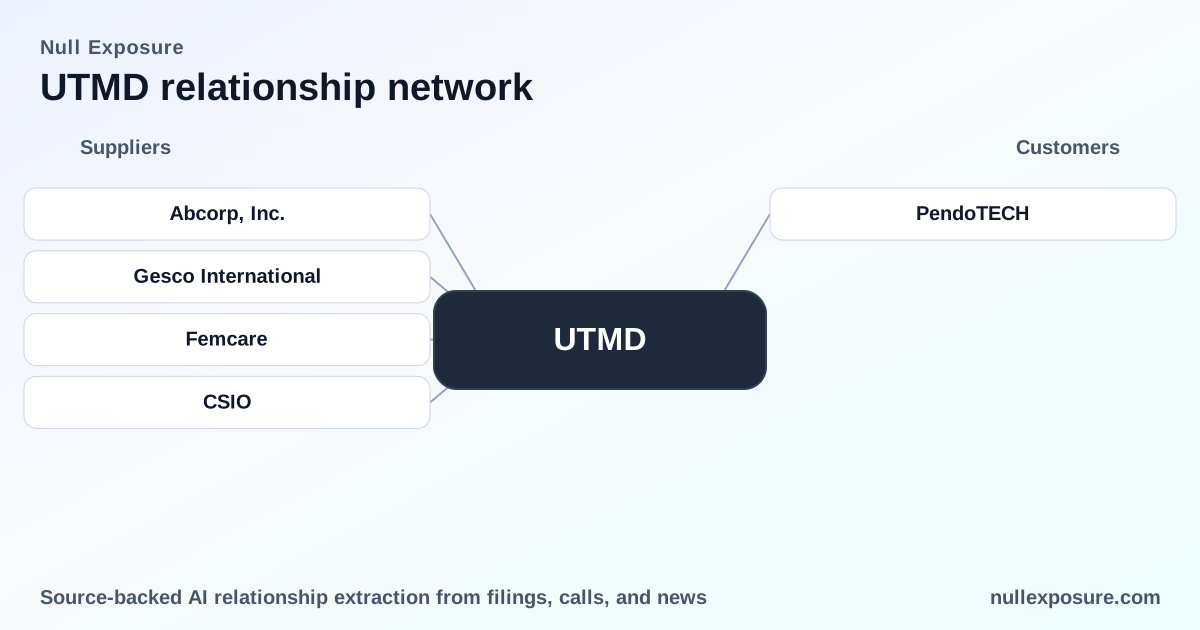
Utah Medical Products (UTMD): Customer Map and the PendoTECH Dislocation Investors Should Price In
Utah Medical Products develops, manufactures and distributes specialized medical devices and monetizes through direct sales to clinician end-users, a global network of roughly 200 distributors, and subcontract manufacturing and OEM supply arrangements. Revenue derives from a mix of recurring product lines (notably Filshie clips) and contract manufacturing/OEM customers, creating stable cashflow characteristics but concentrated product exposures and periodic counterparty swing risk. For a consolidated view of customer relationships and signals, visit https://nullexposure.com/.
The short read for investors
UTMD’s business is fundamentally a mixed model: direct-to-clinic sales plus a large distributor footprint and selective OEM manufacturing. That structure dampens single-customer volatility but does not eliminate material line-level concentration; the recent collapse of orders from a formerly large OEM customer, PendoTECH, has meaningfully depressed volumes and margins through FY2025–FY2026.
The PendoTECH relationship — plain language facts
PendoTECH was a significant OEM buyer whose orders fell sharply beginning in 2024 and were effectively zero through late 2025 into 2026; management has guided that sales to PendoTECH will remain at zero for 2026. According to UTMD’s FY2024 10‑K, domestic sales to PendoTECH declined by $4,157 (64.7%), and multiple market reports in early 2026 (Zacks/TradingView, Yahoo Finance, The Globe and Mail, GuruFocus) confirm management’s guidance that PendoTECH purchases were nil in Q4 2025 and are expected to remain nil in 2026.
- Utah Medical’s FY2024 10‑K records the decline in domestic sales to PendoTECH and quantifies the drop in the company filing for FY2024.
- Press reporting (Zacks/TradingView and syndications in March 2026; Yahoo Finance; The Globe and Mail; GuruFocus in May 2026) documents management’s public guidance that sales to PendoTECH and the China distributor remained at zero in 2026.
- Quarterly coverage from Q3 2025 also noted the reduction, with PendoTECH sales falling to approximately $0.01M in the quarter versus $0.3M a year earlier, reflecting the multi-quarter nature of the pullback.
Sources include Utah Medical Products’ FY2024 10‑K and multiple March–May 2026 press reports distributed by Zacks/TradingView, Yahoo Finance, The Globe and Mail and GuruFocus.
What the company-level constraints tell us about risk and resilience
The relationship signals in public filings and commentary frame UTMD’s operating model in practical, investor-relevant terms:
- Global distribution plus direct-sales emphasis. UTMD sells directly in several developed markets (U.S., Canada, UK, France, Ireland, Australia, New Zealand) and uses third‑party distributors elsewhere, giving the company broad geographic diversification that reduces single-country concentration risk.
- Material product concentration. Four recent acquisitions accounted for 56% of consolidated 2024 sales, and Filshie clips alone represented 26% of total 2024 U.S. dollar sales, indicating product-line concentration that creates earnings sensitivity to procedure volumes and reimbursement trends.
- Moderate customer concentration on the OEM side. The company’s largest OEM customer represented 7% ($2.7M) of consolidated sales in 2024, down from higher levels in previous years—this shows the ability to reduce dependency but also highlights the impact when a large OEM pauses purchases.
- Mixed contractual posture. UTMD acts as manufacturer, OEM supplier and seller through distributors; it also subcontracts components and finished goods for over 120 companies. This multi-role positioning improves revenue diversity but links margins to volume and product mix.
- Relationship maturity and stability on core products. The Filshie clip is a mature franchise (40+ year history, millions implanted) and functions as a steady cash generator rather than a high-growth engine.
- Spend mix includes many small partners. Roughly 104 distributors purchased at least $5,000 in 2024, indicating a long tail of small accounts that smooths overall counterparty risk but limits pricing leverage.
These constraints together portray a company with structural resilience from global reach and product franchises, balanced against meaningful materiality at the product level and episodic OEM volatility.
How the PendoTECH pullback translated to margins
The loss of PendoTECH volume had an immediate P&L effect: gross profit contracted and margins compressed as volumes fell and product mix shifted toward lower-margin items in some markets. Stocktagged reporting of UTMD’s Q4 and Q1 2026 commentary cites management explaining that reduced orders from the former large OEM customer were a principal driver of the gross-profit decline and unfavourable mix in Ireland. Those operational earnings effects underscore the sensitivity of UTMD’s margins to OEM and distributor demand cycles.
Source examples: the FY2026 press coverage and analyst write-ups (TradingView/Zacks, StockTitan summaries, Yahoo Finance) documenting gross profit movements tied to volume and product-mix shifts.
Investor implications and what to watch next
- Concentration is structural but manageable. Filshie and the acquisition portfolio supply a stable base; the OEM channel is less reliable and requires monitoring for recovery or replacement orders. Watch organic procedure volumes and distributor order cadence.
- Margin recovery will depend on volume mix and new OEM wins. Management commentary points to margin damage from the PendoTECH decline; a return of OEM orders or higher-margin distributor demand will drive operating leverage.
- Geographic footprint reduces single-market risk but increases execution demands. Global distributor management and channel retention are critical to preserving sales where direct presence is limited.
- Balance-sheet strength and cash generation are central. Given the product maturity and dividend policy, the stock trades with stable cash-return expectations; earnings upside will be linked to re-establishing OEM flows or expanding higher-margin direct sales.
Compact relationship register (all entries covered)
- PendoTECH — Former OEM customer whose purchases declined substantially in FY2024 (10‑K), dropped to near-zero by Q3 2025 and were guided by management to remain zero through 2026; press coverage corroborates the zero-sales guidance and links the decline to margin pressure (UTMD FY2024 10‑K; Zacks/TradingView, Yahoo Finance, The Globe and Mail, GuruFocus, StockTitan, March–May 2026).
Bottom line
UTMD combines defensible product franchises and global distribution with episodic OEM dependence that can amplify short-term earnings volatility. Investors should value the company as a cash-generative, dividend-paying medical-instruments operator while pricing in the operational imperative to replace lost OEM volume or materially expand higher-margin direct sales. For a deeper, structured customer map and signal tracking for UTMD, see https://nullexposure.com/.
Bold takeaways: UTMD’s global distributor footprint cushions but does not erase product and OEM concentration risk; PendoTECH’s pause is earnings-relevant today and recovery or replacement of that OEM business is the most direct path to margin improvement.