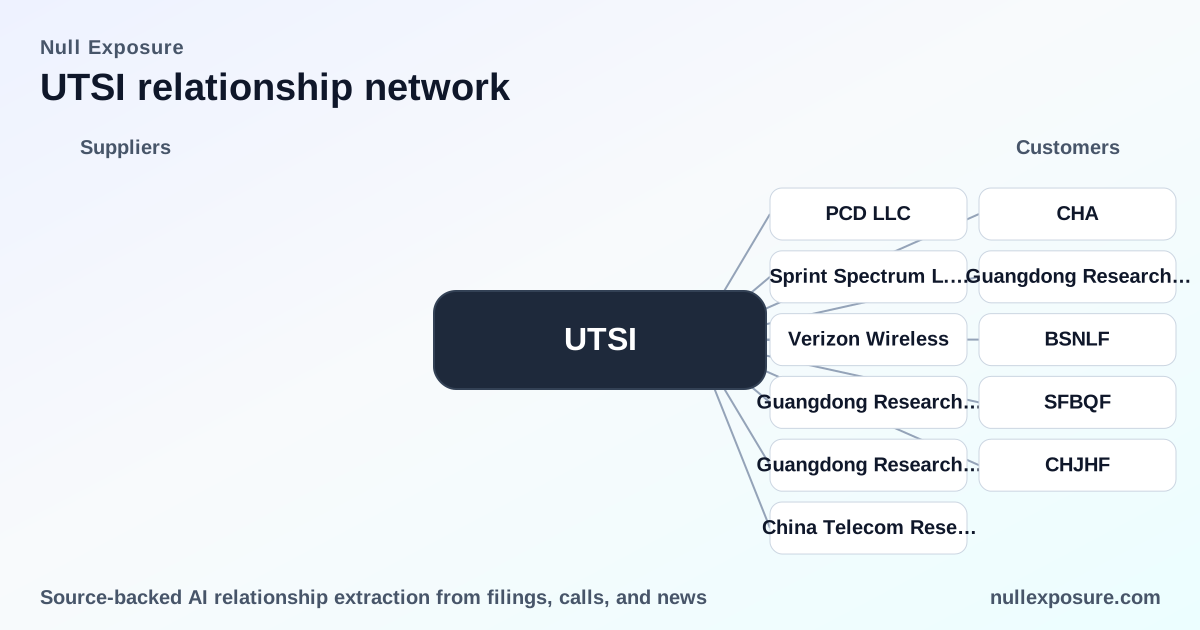
What UTStarcom’s customer footprint tells investors about revenue durability and concentration
UTStarcom is a vertically integrated telecommunications equipment and services supplier that monetizes through hardware manufacturing, long‑term support contracts and professional services sold primarily to telecom carriers and government‑affiliated operators. The company combines volume OEM work (manufacturing router platforms) with recurring, ratable revenue from multi‑year support arrangements and project‑level services that drive margins and cash flow timing. For investors, the combination of large governmental customers, APAC concentration and long‑duration contracts is the dominant framework for evaluating revenue durability and downside risk.
For background research and regular updates visit https://nullexposure.com/.
Why the China Telecom win changes the near‑term revenue profile
UTStarcom won a major RFP from the Guangdong Research Institute of China Telecom to manufacture disaggregated router platforms for China Telecom’s STN metropolitan transport network — a program explicitly targeted to support 5G transport, enterprise and cloud services. A GlobeNewswire release on January 22, 2025 announced the RFP win and UTStarcom’s shift from design services into volume manufacturing of STN routers, and company filings and subsequent news confirm an initial purchase order was executed and deliveries completed in 2H 2025. This contract is both strategic and revenue‑bearing, moving UTStarcom deeper into carrier transport manufacturing and frame‑agreement execution (GlobeNewswire Jan 22, 2025; UTStarcom unaudited results reporting, 2025–2026).
Legacy carrier relationships still matter to the operating story
UTStarcom’s historical disclosures show long‑term supply and post‑contract support obligations tied to legacy handset and carrier segments. The 2010 Form 10‑K documents a three‑year supply agreement with PCD LLC entered at the time of a divestiture and notes revenue recognition stretched over seven‑year post‑support periods for significant contracts; SoftBank agreements carried multi‑year service periods and penalty clauses linked to product failure rates. Those contractual terms explain why revenue can be lumpy while service margin accrues ratably over many years (UTStarcom 2010 Form 10‑K).
Relationship-by-relationship brief (plain English, sourced)
PCD LLC
UTStarcom agreed to a three‑year supply arrangement with PCD LLC concurrent with a 2008 divestiture, positioning UTStarcom as the handset supplier for that segment during the contract term (UTStarcom 2010 Form 10‑K).
Verizon Wireless
Verizon Wireless accounted for a material portion of handset sales in the PCD segment historically, with Verizon cited as representing roughly 20% of related sales in the 2010 disclosure (UTStarcom 2010 Form 10‑K).
Sprint Spectrum L.P.
Sprint Spectrum is listed among significant purchasers in the archived Form 10‑K references (Sprint Spectrum L.P. indicated in FY2010 disclosures), reflecting legacy carrier exposure in UTStarcom’s handset history (UTStarcom 2010 Form 10‑K).
SoftBank (SFBQF)
Sales to SoftBank included three‑year service obligations and a seven‑year penalty exposure tied to product failure rates, illustrating UTStarcom’s willingness to accept long service tails and warranty risk as part of carrier deals (UTStarcom 2010 Form 10‑K).
Guangdong Research Institute of China Telecom Co., Ltd (China Telecom Research Institute)
UTStarcom won a major RFP to manufacture disaggregated router hardware for China Telecom’s STN network; the award was announced in January 2025 and described by the company as a move into volume manufacturing for China Telecom’s 5G transport infrastructure (GlobeNewswire Jan 22, 2025; company unaudited results, 2025).
China Telecom
Following the RFP award, UTStarcom executed frame agreements and received an initial purchase order under that framework, delivering products to China Telecom in the second half of 2025 — signaling contract execution beyond the bid stage into delivered revenue (company results and market releases, 2025–2026).
BSNL / BSNLF
Market reports indicate UTStarcom collected $3.39 million from BSNL while leaving approximately $4.57 million outstanding, a reminder that receivables from government operators in APAC can be significant and require active collection management (StockTitan/Intellectia reporting referencing FY2020/FY2026 news items).
Note: multiple press items and aggregators reference the China Telecom relationship under slightly different names or tickers (CHA, CHJHF) in 2025–2026 reporting; these are referring to the same Guangdong Research Institute / China Telecom program documented above (GlobeNewswire, QuiverQuant, Yahoo Finance, Marketscreener, 2025–2026).
What the disclosed constraints imply about UTStarcom’s operating model
- Contracting posture — long‑term and ratable: UTStarcom has structured meaningful deals with extended post‑contract support terms (seven‑year recognition windows noted in historic filings), which produces predictable service revenue but delays margin realization into future periods. This is a core driver of revenue cadence and working capital dynamics (2010 Form 10‑K excerpts).
- Concentration — government and APAC focus: Historically more than half of net sales were to entities affiliated with the Chinese government (approximately 53% in 2010) and the majority of sales occur in China and India, creating client concentration and geopolitical exposure that investors must price (company disclosures, 2010).
- Criticality — carrier transport infrastructure: The China Telecom STN contract is functionally critical to a major national carrier’s 5G transport network, elevating both revenue importance and operational requirements for quality, delivery and after‑sales support (GlobeNewswire and company results, 2025–2026).
- Maturity and segment mix: UTStarcom has wound down handset operations and reorganized toward broadband and transport infrastructure plus services; its segment mix now centers on core IP‑based infrastructure, hardware manufacturing and professional services rather than legacy handsets (2010 filings and subsequent corporate commentary).
- Materiality variation: UTStarcom described revenue of $16.2 million on certain contract phases as immaterial as of 2010, so individual contract dollar amounts can be small relative to total company revenue even when operationally significant for a product line (2010 Form 10‑K).
Risks and upside distilled for investors
- Upside: the China Telecom manufacturing frame and initial deliveries materially re‑orient UTStarcom toward higher‑volume carrier router manufacture, which supports revenue growth and factory utilization if follow‑on orders are secured (company releases, 2025).
- Risk: customer concentration and APAC government exposure remain the dominant downside risks — a high share of sales to government‑affiliated carriers and the legacy practice of long warranty/support tails creates cash‑flow timing and collection risks (2010 Form 10‑K; StockTitan receivables reporting).
- Operational risk: long service periods and penalty clauses (e.g., SoftBank) create contingent liabilities if product reliability issues arise; conversely, ratable revenue recognition smooths reported income but hides near‑term margin pressure.
Bottom line and next research steps
UTStarcom’s customer book combines strategic, high‑criticality carrier contracts in China with legacy carrier and service arrangements that extend revenue recognition into future years. For investors, that means emphasizing order pipeline validation, receivable trends (notably in India), and follow‑on purchase orders under the China Telecom frame as the keys to confirming durable revenue improvement. For continuing due diligence and monitoring of client activity and contract execution, see our research hub at https://nullexposure.com/.
Key takeaway: the China Telecom RFP and delivery cycle is the single most consequential customer development for UTStarcom in 2025–2026; balance that upside against persistent concentration and long support tails when constructing investment scenarios.