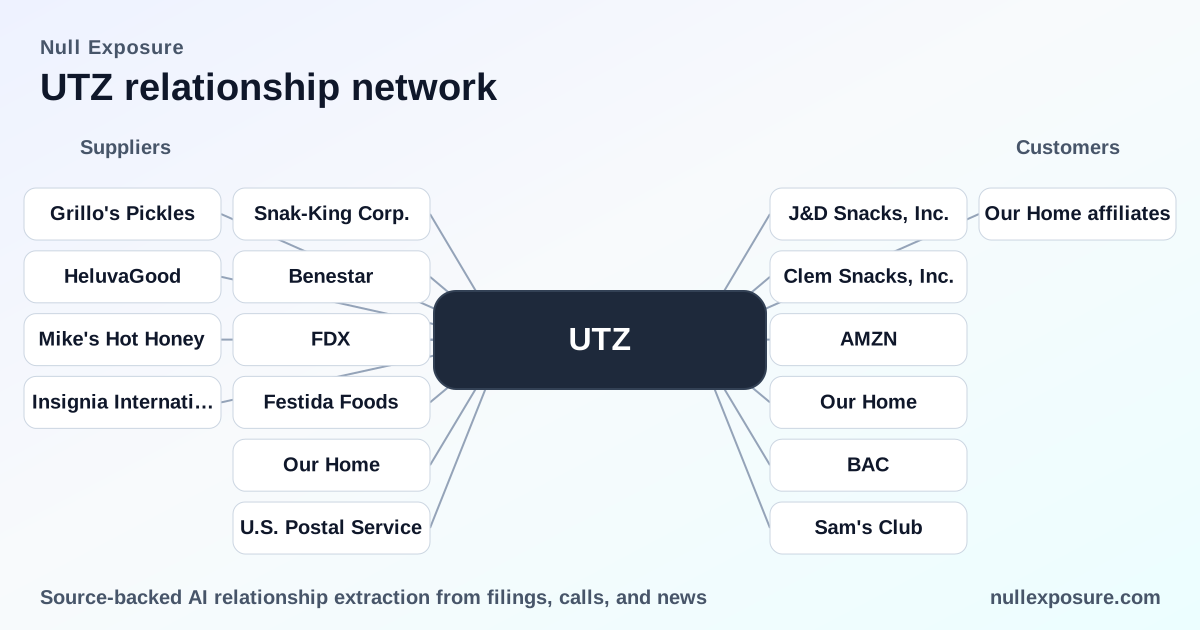
Utz Brands (UTZ) — Customer Relationships and Strategic Distribution Signals
Utz Brands manufactures and sells branded salty snacks and related products, monetizing through wholesale sales to retailers and distributors, direct-store-delivery (DSD) routes, and direct-to-consumer channels; the company captures margin primarily on Branded Salty Snacks (≈88% of net sales) while expanding reach through targeted acquisitions and selective third‑party retail partnerships. Revenue is driven by national retail distribution and a large DSD footprint, with supplemental reach via online marketplaces like Amazon and warehouse clubs such as Sam’s Club. For a concise market‑facing view of Utz’s customer relationships and distribution posture, see https://nullexposure.com/.
Executive takeaways for investors
Utz’s customer map is a classic consumer‑defensive distribution story: a U.S.‑focused snack manufacturer that combines owned manufacturing with a 2,500‑route DSD network, direct shipments, and third‑party retail channels to drive scale. The company shows evidence of active consolidation of its DSD footprint (acquisitions of local distributors), continued use of large retail partners and digital platforms to broaden reach, and a willingness to monetize non‑core assets while preserving distribution arrangements.
Key structural signals:
- Collections and cash flow are short‑term — receivables are billed and due on a short-term basis, implying limited customer financing risk to Utz.
- Customers are large retail enterprises — the business sells to supermarkets, mass merchandisers, club warehouses and other large retailers, indicating concentration toward institutional buyers rather than small independent accounts.
- Geographic concentration is domestic — substantially all invoiced sales occurred in the U.S., and national distribution is core to the operating model.
- Distribution is critical and mature — Utz combines manufacturing, distribution and DSD operations; the company reports long‑standing sales relationships with its top retail customers (averaging over 20 years).
- Product concentration — Branded Salty Snacks account for the bulk of sales, so retail distribution health directly affects core revenue (net sales ≈ $1.439 billion in the latest year).
For a detailed, sourced walk‑through of each identified relationship, read on — or explore further at https://nullexposure.com/.
How Utz is consolidating last‑mile distribution
Utz has executed targeted acquisitions to strengthen its DSD coverage in dense retail markets. The company’s strategy is to control last‑mile shelf presence while leveraging direct shipments and wholesalers to maintain national distribution. This approach reduces reliance on third‑party cold chains or long trade credit terms and reinforces the company’s manufacturing‑to‑shelf economics.
Clem Snacks, Inc.
Utz acquired Clem Snacks, a direct‑store delivery (DSD) distributor operating in the New York City region, to deepen last‑mile presence and shelf execution in a major metropolitan market. According to BakingBusiness (March 2026), Utz announced the acquisition to enhance its distribution network and DSD coverage in NYC.
J&D Snacks, Inc.
Utz acquired J&D Snacks, another DSD distributor serving the New York City area, as part of the same distribution consolidation effort — securing local routes and in‑store merchandising control. The acquisition was reported by BakingBusiness (March 2026) alongside the Clem Snacks transaction.
Amazon (AMZN)
Utz explicitly lists Amazon as a select third‑party retailer that extends direct‑to‑consumer reach; Utz fulfills DTC shipments through orders from its website and via Amazon, enabling national household penetration beyond DSD and warehouse channels. This disclosure comes from Utz’s FY2026 10‑K filing (reported via StockTitan, March 2026).
Sam’s Club
Sam’s Club is identified by Utz as a third‑party retailer partner that helps extend distribution reach; the relationship is referenced in the company’s description of direct‑to‑consumer and select retailer fulfillment channels. The FY2026 10‑K filing (StockTitan, March 2026) lists Sam’s Club among the retailer sites that support Utz’s online and wholesale presence.
Our Home (distribution agreement)
Utz continues to distribute certain Good Health products on its DSD network for Our Home under a distribution agreement, demonstrating that Utz will provide logistics and route capability even after divesting brand ownership. This arrangement is specified in Utz’s FY2026 10‑K (StockTitan, March 2026) describing ongoing DSD distribution for Our Home.
Our Home affiliates (asset sale)
On February 5, 2024, Utz sold the Good Health and R.W. Garcia brands, two plants, and related assets to affiliates of Our Home for $167.5 million, a transaction that monetized non‑core branded assets while enabling a continuing distribution role. The FY2026 10‑K recounts the sale and the related distribution arrangement (StockTitan, March 2026).
Bank of America (BAC)
Utz disclosed the sale of certain notes to Bank of America and two other banks as part of its financing activities, reflecting engagement with large financial counterparties for capital and funding solutions. The FY2026 10‑K filing (StockTitan, March 2026) notes the sale of notes to Bank of America and other lenders.
What these relationships mean for credit and commercial exposure
- Contracting posture: Receivables are short‑term and Utz does not carry significant customer financing, limiting receivable duration risk and the associated working capital strain.
- Counterparty profile: The customer base skews to large enterprises (supermarkets, club warehouses, mass merchandisers), which concentrates commercial exposure to a limited set of large buyers but provides scale and predictable replenishment cycles.
- Operational criticality of DSD: The DSD network is a competitive asset — acquisitions of Clem and J&D reinforce Utz’s priority on owning route economics and shelf placement, a critical driver of sold volumes for Branded Salty Snacks.
- Maturity and stability: Long‑standing retail relationships (top customers averaging >20 years) are a structural benefit that supports predictable shelf access and promotional planning.
- Product concentration risk: With Branded Salty Snacks representing the majority of net sales, any retail channel disruption or inventory re‑prioritization among big customers would have outsized impact.
Investment implications and risk checklist
- Positive: Owning DSD routes and acquiring local distributors supports margin protection and execution control; online and club partnerships broaden reach with limited capital outlay.
- Watch: High concentration in branded salty snacks and U.S. geography makes top‑customer behavior and domestic retail trends the primary risk vectors; the FY2026 revenue base (~$1.439B) underscores material scale but also exposure to U.S. consumer spend cycles.
- Financing note: The sale of notes to Bank of America signals active balance sheet management and engagement with institutional lenders.
For a deeper commercial‑risk analysis and relationship mapping tailored to investment diligence, visit https://nullexposure.com/.
Bold conclusion: Utz’s model monetizes shelf access through a hybrid of owned DSD routes, strategic distributor acquisitions, and selective retail partnerships — a configuration that preserves margin control but concentrates exposure in U.S. retail channels.