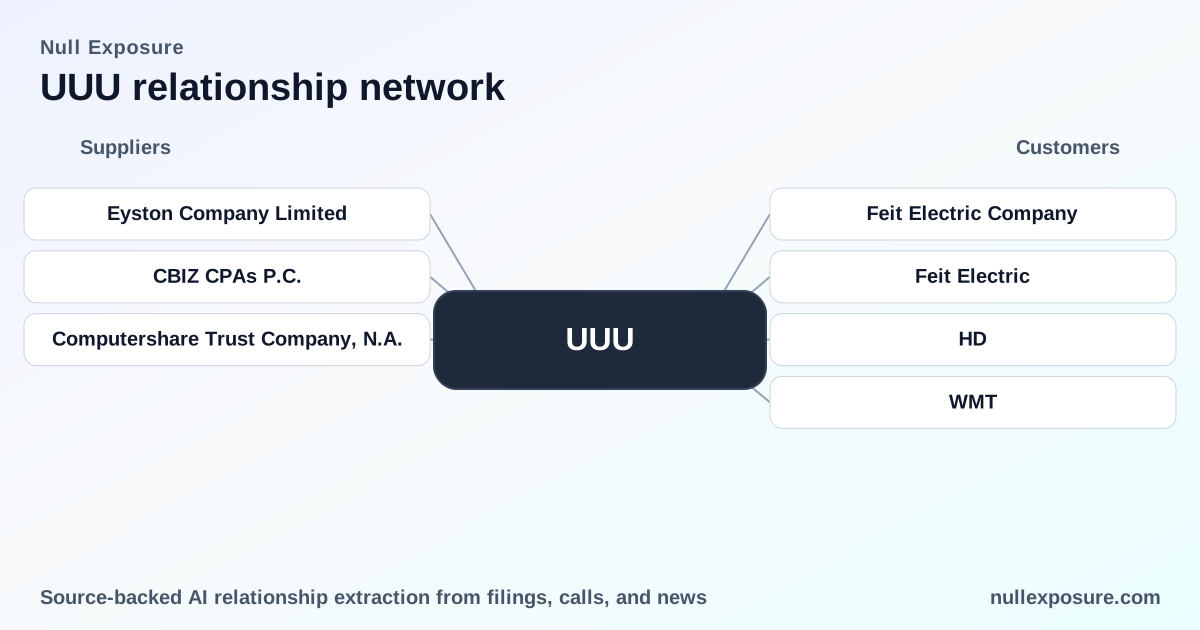
Universal Security Instruments (UUU): How a small safety-products seller narrowed to a few critical customers
Universal Security Instruments designs, markets and distributes smoke alarms, carbon monoxide alarms and related safety hardware and monetizes through wholesale and retail product sales to distributors and national retailers. Recent corporate activity — most prominently an asset sale to Feit Electric and a related special dividend — fundamentally changes the company’s revenue base and counterparty profile, shifting UUU from a broad retail supplier to a much smaller, concentrated operator focused on recovering value for shareholders. For the full collection of signals and source links used for this note visit https://nullexposure.com/.
What investors need to know in one line
UUU historically sold hardware into home centers, electrical distributors and online retailers; in FY2025 it executed an asset sale that removed its core smoke/CO alarm business from the company and produced a special cash distribution to shareholders, leaving residual operations with materially lower sales and a concentrated customer footprint.
The Feit Electric transaction rewrote the customer map
Feit Electric acquired core assets of UUU in a transaction public sources place in FY2025, with purchase proceeds driving a one‑time cash dividend to Universal Security Instruments shareholders. According to Inside.Lighting (March 10, 2026), Feit Electric paid $6 million in cash for the core assets of UUU, a corporate event that explains the outsized swing in UUU’s reported quarterly sales following the deal (see the SEC and market reports cited below).
- The company reported closing the sale of its smoke and carbon monoxide alarm business to Feit Electric in 2025; subsequent public statements tie large changes in UUU’s sales and earnings to that transaction (StockTitan overview, 2026).
- UUU’s quarter ended September 30, 2025, shows net sales collapsing to $759,999 from $7.2 million year earlier, and management attributed this to the sale of the smoke/CO alarm business to Feit Electric (StockTitan SEC filings summary, 2026).
- Following the asset sale, UUU declared a special cash dividend that market summaries connect explicitly to the Feit Electric proceeds (TipRanks and FinancialContent reporting, 2025–2026).
- Prior corporate filings show an asset purchase agreement dated October 29, 2024 that set the transaction in motion and created potential change‑of‑control considerations that management addressed publicly (Investing.com coverage of SEC filings, FY2024).
Collectively, these items establish Feit Electric as the counterparty that transformed UUU’s business in FY2025, converting operating cash flow exposure into a portfolio monetization event and a shareholder payout.
Customer relationships and historical retail placements (each result summarized)
Feit Electric (Inside.Lighting — FY2025)
Inside.Lighting reported that Feit Electric acquired the core assets of Universal Security Instruments for $6 million in cash, a transaction that removed the primary smoke/CO product line from UUU’s operating portfolio (https://inside.lighting/news/25-05/feit-electric-acquires-usi-6m-distressed-deal).
Feit Electric Company (StockTitan overview — FY2025)
StockTitan’s company overview states that UUU closed the sale of its smoke and carbon monoxide alarm business to Feit Electric Company in 2025, and that the transaction materially altered reported sales and earnings (https://www.stocktitan.net/overview/UUU/).
Feit Electric (StockTitan SEC filings summary — FY2025)
A StockTitan SEC summary notes that net sales plunged in the quarter ended Sept 30, 2025 primarily because the smoke/CO alarm business was sold to Feit Electric, linking the transaction directly to the revenue decline (https://www.stocktitan.net/sec-filings/UUU/page-4.html).
Feit Electric Company (TipRanks announcement — FY2025)
TipRanks covered UUU’s special cash dividend and explicitly ties the payout to proceeds from the sale of assets to Feit Electric Company, characterizing the dividend as a return of transaction proceeds to shareholders (https://www.tipranks.com/news/company-announcements/universal-security-instruments-announces-special-cash-dividend).
Feit Electric Company (FinancialContent market report — FY2025)
A market recap on FinancialContent similarly described the special dividend as a strategic move following the successful sale of assets to Feit Electric, and noted the market adjustment when the ex‑dividend date hit (Markets.FinancialContent, Sept 26, 2025) (https://markets.financialcontent.com/wral/article/marketminute-2025-9-26-universal-safety-products-uuu-plunges-over-33-as-special-dividend-ex-date-triggers-major-stock-adjustment).
Feit Electric Company (StockTitan news — FY2025)
StockTitan’s news feed repeated the narrative that the special dividend followed the asset sale to Feit Electric, reinforcing the linkage between the transaction and cash return to holders (https://www.stocktitan.net/news/UUU/universal-safety-products-inc-declares-one-time-special-cash-k43xww3y7yom.html).
Walmart.com (CPSC recall notice — FY2025 referencing 2017–2019)
A U.S. Consumer Product Safety Commission recall notice documents that certain Universal Security Instruments combination photoelectric smoke/CO alarms were sold through electrical distributors and online retailers, including Walmart.com, between June 2017 and December 2019 (CPSC recall posting, 2022) (https://www.cpsc.gov/Recalls/2022/Universal-Security-Instruments-Recalls-Combination-Photoelectric-Smoke-Carbon-Monoxide-Alarms-Due-to-Risk-of-Failure-to-Alert-Consumers-to-Hazardous-Levels-of-Carbon-Monoxide).
WMT (WTOP coverage of recall — FY2022)
WTOP reported on the 2022 recall and specified that the recalled alarms were sold between 2017 and 2019 at electrical distributors and multiple websites, including Walmart.com, reinforcing Walmart’s role as a distribution channel for UUU products in that period (WTOP, April 2022) (https://wtop.com/recalls/2022/04/2-universal-security-instrument-smoke-alarms-recalled/).
Homedepot.com (CNBC archival coverage — FY2012)
CNBC coverage from 2012 noted that IoPhic‑branded smoke and fire alarms (a product available through UUU channels historically) were available at Homedepot.com, showing UUU’s historical presence in national home center e‑commerce in earlier product cycles (CNBC, Oct 3, 2012) (https://www.cnbc.com/2012/10/03/new-smart-smoke-alarm-technology-answers-today-show-concerns.html).
HD (CNBC archival coverage — FY2012)
The same CNBC article documents product availability on HD/Homedepot.com in both battery and hard‑wired configurations, confirming Home Depot as a distribution partner for IoPhic/UUU products during that era (CNBC, 2012) (https://www.cnbc.com/2012/10/03/new-smart-smoke-alarm-technology-answers-today-show-concerns.html).
Walmart (WTOP recall context — FY2022)
WTOP’s recall story reiterates that major retailers including Walmart carried UUU’s affected alarms between 2017 and 2019, underlining the historical retail scale and the reputational risk associated with product recalls for national accounts (WTOP, April 2022) (https://wtop.com/recalls/2022/04/2-universal-security-instrument-smoke-alarms-recalled/).
Feit Electric Company, Inc. (Investing.com SEC filing report — FY2024)
Investing.com covered a filing showing that UUU entered an asset purchase agreement with Feit Electric on October 29, 2024, and that CEO compensation mechanics and change‑of‑control provisions were managed in connection with that deal (Investing.com coverage of SEC filings, FY2024) (https://www.investing.com/news/sec-filings/universal-security-instruments-ceo-waives-change-of-control-payments-93CH-3730810).
What the company-level constraints tell investors
The filings and company statements produce several clear operating model signals:
- Contracts are predominantly short‑term. UUU discloses that its contractual relationships generally have terms of one year or less, making revenue visibility limited and renewals critical to maintain sales levels.
- U.S. market concentration. Management states overall sales are primarily dependent on the strength of the U.S. housing market, indicating a geography concentration risk in North America.
- Customer concentration is material. For the fiscal year ended March 31, 2025, two customers accounted for roughly 21.7% and 14.9% of net sales, a high concentration that elevates counterparty and execution risk.
- UUU’s role is that of a seller to retail and distribution channels. The company historically sells directly to retailers and electrical distributors, consistent with its product portfolio in consumer and trade hardware.
- Product segment is hardware‑centric. The core business has been safety hardware — smoke alarms and carbon monoxide alarms — which exposes UUU to commodity pricing, recall risk, and channel margin pressure.
These constraints frame the post‑transaction company as highly sensitive to a few counterparties and to U.S. housing/retail demand, with limited long‑term contract protection.
Investor implications and closing view
The Feit Electric transaction converted operating exposure into a near‑term cash realization and shareholder return, but it also left UUU materially smaller and more concentrated, increasing idiosyncratic risk for investors who expect recurring hardware revenue. Key takeaways: Feit Electric is the single transformative counterparty in FY2025; Walmart and Home Depot have been important historical retail channels; and company statements confirm short contract terms and material customer concentration. For focused diligence on counterparties and corporate filings, see the underlying reporting and the UUU profile at https://nullexposure.com/.
If you want a compiled desk pack of these signals and primary links for inclusion in investment memos, visit https://nullexposure.com/ for direct access to the sourcing and relationship snapshots.