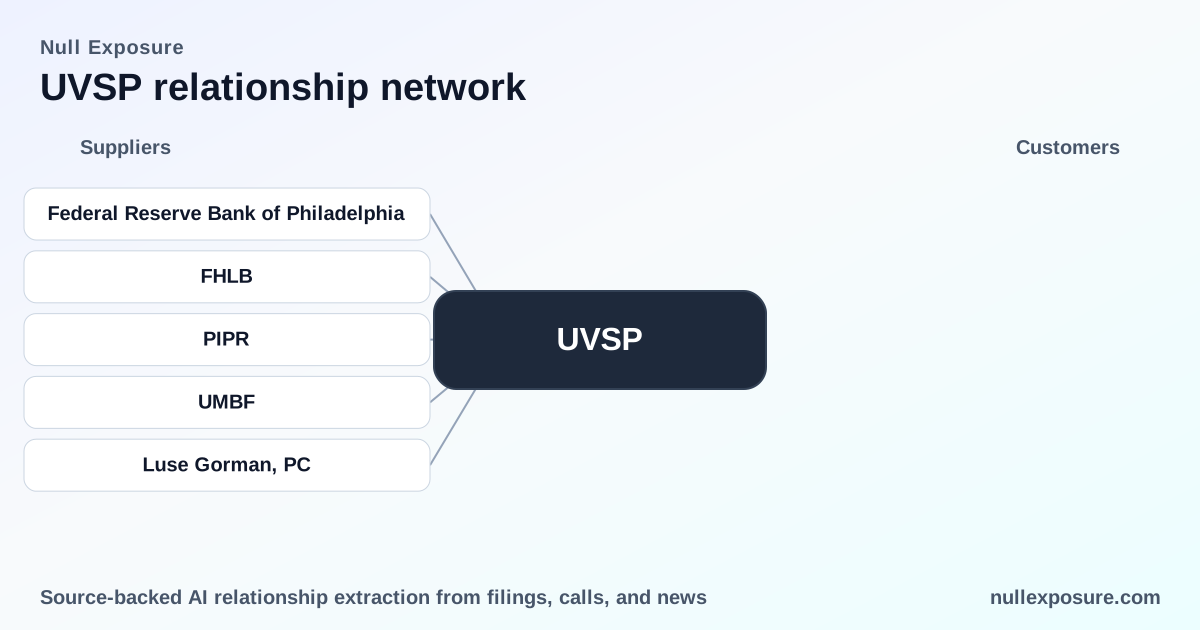
Univest (UVSP) — Customer Relationships and Commercial Signals for Investors
Univest Financial Corporation operates as a regional banking organization through Univest Bank and Trust Co., monetizing through net interest margin on lending, deposit services and diversified fee income from trust, insurance, mortgage banking, treasury management and investment services. With roughly $323.6 million in trailing revenue and a market capitalization near $1.06 billion, Univest generates stable margin and fee streams from a broad customer base while acting as a counterparty for capital market placement activity for smaller issuers. For a concise view of the company’s market-facing posture, visit https://nullexposure.com/.
Recent third‑party deals that put Univest in the customer role
The external coverage captured two discrete customer-facing relationships where Univest functioned as a financial intermediary or placement counterparty.
Fitness Champs Holdings (FCHL) — placement support on a public action
Fitness Champs worked with Univest on a public offering, indicating Univest participated in underwriting or placement activity for the issuer. According to Investing.com coverage dated May 2, 2026, Univest provided capital markets support to FCHL in FY2026.
RIME (Algorhythm/related placement) — placement fees tied to financing releases
TradingView reported on March 10, 2026 that a financing structure included a subsidiary guaranty and security agreements, and placement fees to Univest are payable as funds are released, signaling a fee-for-service arrangement tied to staged capital releases in a three‑year pre‑paid equity financing. The article documents the counterparty role Univest played in executing or administering the transaction.
What these relationships reveal about Univest’s customer-facing capabilities
Both items are consistent with Univest operating as an integrated financial services provider that combines commercial banking with intermediary services for smaller issuers and sponsors. The firm earns transactional fees when it arranges or places capital for customers, and it simultaneously runs traditional lending and deposit businesses that produce recurring margin. That dual pathway — recurring interest/fee income plus episodic placement fees — supports a diversified revenue base and explains why placement opportunities for smaller public issuers turn up in news coverage.
Company‑level commercial constraints and operating posture
Externally sourced constraints from company filings and segment descriptions provide a coherent picture of Univest’s operating model:
-
Long‑term contracting posture: The bank reports significant balances in gross loans and leases held for investment, which indicates a business built on long‑dated credit relationships rather than short transactional engagements. Company filings (balance sheet snapshots through Dec 31, 2024) document these investment loan balances.
-
Broad counterparty mix and criticality: Univest explicitly serves individuals, businesses, municipalities and non‑profit organizations, reflecting a client base that includes mission‑critical public and not‑for‑profit customers. That diversity increases both revenue stability and regulatory sensitivity because municipalities and nonprofits depend on reliable banking services.
-
Nationwide reach via digital channels: While regionally headquartered, the bank provides services nationwide through internet banking, enabling a geographically dispersed deposit and customer footprint beyond its Pennsylvania branch network.
-
Service provider role, not just a credit shop: Filings and segment disclosures emphasize fee‑based services — trust, insurance, mortgage banking, treasury management — showing Univest operates as a commercial service provider in addition to being a lender.
-
Scale and funding concentration signal: At December 31, 2024 and 2023, the company reported approximately $3.2 billion and $3.0 billion in uninsured deposits above the FDIC limit, respectively; this large uninsured deposit pool signals both high funding scale and potential concentration risk in a stress environment.
-
Active relationships and maturity: Revenue characterization in filings describes ongoing fee generation from services and lending, signaling active, mature customer engagements rather than nascent pipelines.
These constraints together describe a bank that is mature, service‑oriented, and capital markets‑capable, but also exposed to deposit concentration and the operational demands of serving critical municipal and nonprofit clients.
What investors and vendors should take from the relationship map
Univest’s observed customer engagements and the company‑level constraints imply the following commercial realities:
-
Stable core economics plus episodic fee upside: Core lending and deposit margins supply steady earnings, while deal‑by‑deal placement activity (e.g., FCHL, RIME) delivers supplemental fee income.
-
Counterparty diversity reduces single‑sector cyclical exposure yet increases operational complexity because servicing municipalities and nonprofits requires specific compliance and liquidity arrangements.
-
Vendor contracting posture will prioritize continuity and compliance: Given the long‑term credit book and critical municipal relationships, vendor contracts will focus on long‑dated SLAs, regulatory controls, and operational resilience.
-
Funding and concentration are principal risk vectors: The material uninsured deposit base is a balance sheet characteristic investors must monitor; it underpins the bank’s working capital but elevates liquidity and reputational risk in stress scenarios.
-
Placement work is revenue‑generating and structured: The two public reports show Univest collects placement fees under documented release schedules and security arrangements, underlining the firm’s role as an executing counterparty for smaller capital raises.
Due diligence checklist for premium finance operators evaluating Univest
- Confirm service continuity requirements tied to municipal/nonprofit clients and structure SLAs to meet regulatory and liquidity reporting needs.
- Price arrangements to reflect long‑term contract orientation and potential deposit concentration exposure.
- Validate indemnities, collateral and fee release triggers where Univest acts as placement agent (as in the RIME structure reported by TradingView).
For more detailed relationship intelligence and historical deal coverage, explore Univest’s public filings and third‑party transaction reporting on our platform at https://nullexposure.com/.
Bottom line for investors
Univest (UVSP) is a regional bank with diversified revenue streams combining a stable interest‑earning loan book and deposit base with recurring fee income and opportunistic capital markets placement fees. The two documented customer engagements show the bank executing placement and financing services for smaller issuers; company filings show a mature operating model with long‑term credit exposure and substantial uninsured deposits that heighten liquidity sensitivity. Investors should weigh the bank’s dependable margin generation and institutional ownership against funding concentration and the operational demands of serving critical municipal and nonprofit counterparties.