Universal Corporation (UVV): Customer Concentration and Strategic Dependencies
Universal Corporation processes and supplies leaf tobacco and plant-based ingredients to major consumer product manufacturers, monetizing through the sale of transformed agriproducts and a spectrum of supply-chain services from field procurement to delivered packed product. Revenue is driven by large, repeat commercial contracts with multinational tobacco manufacturers and expanding Ingredients Operations sales to food and CPG clients, creating high concentration but predictable gross margins; for a deeper dataset-driven view, see https://nullexposure.com/.
Quick investor thesis — why customers matter for UVV
Universal operates as a B2B supplier to very large manufacturers, selling processed tobacco and specialty plant ingredients rather than consumer goods. The company’s earnings profile is characterized by high customer concentration, short contract durations, and mature long-standing relationships, which together produce pronounced revenue sensitivity to the purchasing and negotiating behavior of a small number of global counterparties. Investors should treat UVV as a cash-generative, dividend-oriented play with concentrated counterparty risk and operational scale benefits in global sourcing and processing.
Who pays the bills: names and immediate takeaways
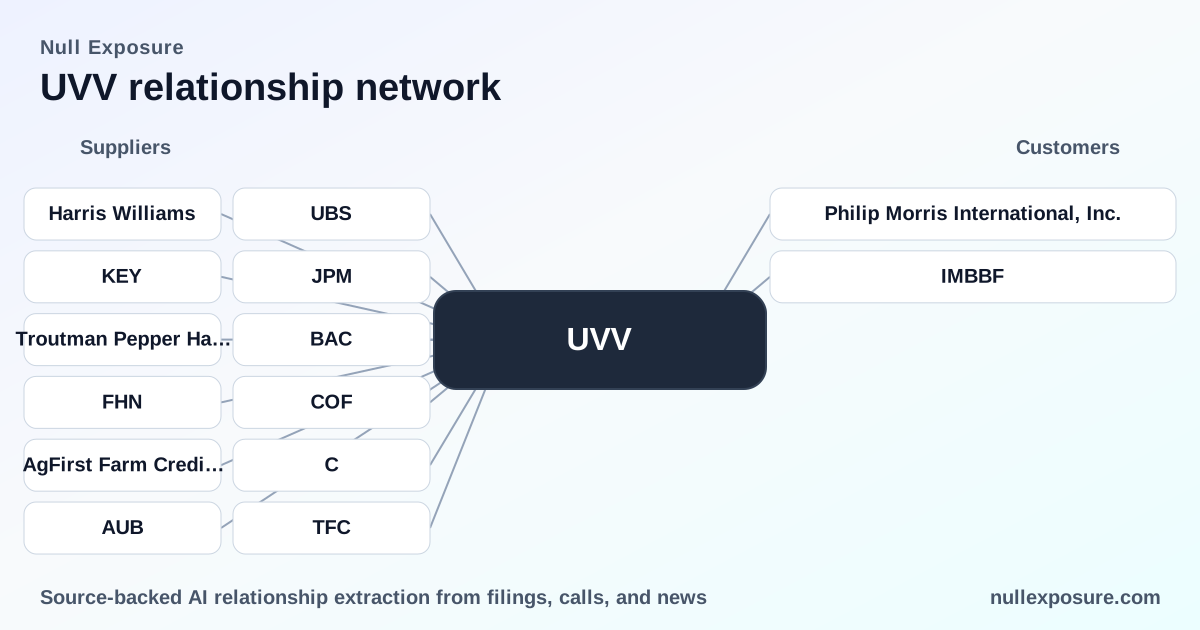
Below are every customer relationship cited in Universal’s FY2025 disclosures, summarized in plain English with source references.
-
Philip Morris International, Inc. — For the fiscal year ended March 31, 2025, Philip Morris International and its affiliates accounted for 10% or more of Universal’s revenues, positioning the company as a material purchaser of Universal’s processed leaf and related services. According to Universal’s Form 10‑K for FY2025, Philip Morris is explicitly listed among customers representing ≥10% of revenue.
-
IMBBF (inferred symbol) — The FY2025 filing lists "IMBBF" as an inferred identifier tied to one of Universal’s top customers; the same disclosure states that this customer contributed 10% or more of revenues in the period. Universal’s FY2025 Form 10‑K links the inferred symbol IMBBF to the group of customers accounting for material revenue share.
-
Imperial Brands plc — Imperial Brands and its affiliates also accounted for 10% or more of Universal’s revenues for the fiscal year ended March 31, 2025, making it an equally material commercial counterparty. This is described in Universal’s FY2025 10‑K, which names Imperial Brands among the customers responsible for significant revenue concentration.
Each of these entries is drawn from Universal’s annual 10‑K covering the year ended March 31, 2025, which identifies major multinational manufacturers as the primary commercial counterparties for sales.
Operating model and business-model constraints — what the disclosure implies
Universal’s public disclosures establish a set of company-level operating characteristics that determine how customer exposure converts into investor risk and opportunity:
-
Contracting posture: short-term — Contract durations and payment terms across revenue categories generally do not exceed one year, which increases revenue rate sensitivity to buyer procurement decisions and pricing cycles.
-
Counterparty profile: very large enterprises — A large share of sales is concentrated among major multinational tobacco manufacturers, implying that Universal’s negotiating counterparties possess scale and procurement sophistication.
-
Geographic reach: global supply chain — Operations in over 30 countries across five continents give Universal a broad sourcing footprint and the ability to arbitrage regional crop cycles, enhancing resilience in raw-material access.
-
Materiality: concentrated revenue — Sales to the top five customers exceeded 50% of consolidated revenues for the past three fiscal years, a structural concentration that translates into high customer dependence and elevated tail risk if a major buyer reduces purchases.
-
Relationship roles: both buyer and seller dynamics — Universal acts as a seller of processed tobacco and plant ingredients while also functioning as an intermediary buyer of raw agricultural output, embedding the company in both upstream sourcing and downstream manufacturing value chains.
-
Relationship maturity: long-standing but transactional — Top customers are described as long-standing, indicating durable commercial links, yet the short contract terms indicate the economic relationship is reset frequently.
-
Business segments: manufacturing and services — Revenue streams arise from manufacturing value-added products (reconstituted tobacco, specialty ingredients) and from services spanning field-to-delivery logistics and processing.
These constraints together define Universal as a global, manufacturing-centric supplier with concentrated customer exposure and operational flexibility in sourcing and processing.
Risk profile: concentrated customers plus short durations
The primary investor risk is concentration: two customers (Imperial Brands and Philip Morris) are explicitly called out as each representing at least 10% of revenue in FY2025, and the top five customers collectively account for more than half of revenue. Short contract durations intensify that risk, because revenue and pricing reset annually rather than being secured by long-term fixed contracts. At the same time, Universal’s global footprint and vertically integrated processing capability provide bargaining leverage on supply and the ability to reallocate output across customers and product lines.
What this means for valuation and active monitoring
Universal’s financial profile (mid-teens trailing P/E, forward P/E near 12.3, dividend yield north of 6%) reflects a stable cash return policy shaped by concentrated but durable customer relationships and steady margins from processing operations. Investors and operators should monitor:
- Annual revenue exposure by counterparty and any shifts in the composition of the top five customers.
- Renewal outcomes and pricing trends at contract re-bid windows, given the typical sub‑one‑year contract terms.
- Growth in Ingredients Operations as a diversification lever away from tobacco-centric counterparties.
- Macro crop and logistics developments across Universal’s 30+ country footprint that affect raw-material cost and availability.
For a concise scoring of these customer relationships and how they map to risk appetite, view additional analytical profiles at https://nullexposure.com/.
Bottom line
Universal’s business is straightforward: sell processed leaf tobacco and specialty plant ingredients to a small number of very large manufacturers, under predominantly short-term commercial arrangements. That structure underpins a high-yield, stable cash-flow profile but concentrates execution risk in the hands of a few buyers. For active investors, the trade-off is clear: attractive income and operating scale versus customer-concentration vulnerability that demands ongoing monitoring of contract renewals and buyer demand cycles.