UWM Holdings (UWMC) — who UWM sells to, and why it matters for investors
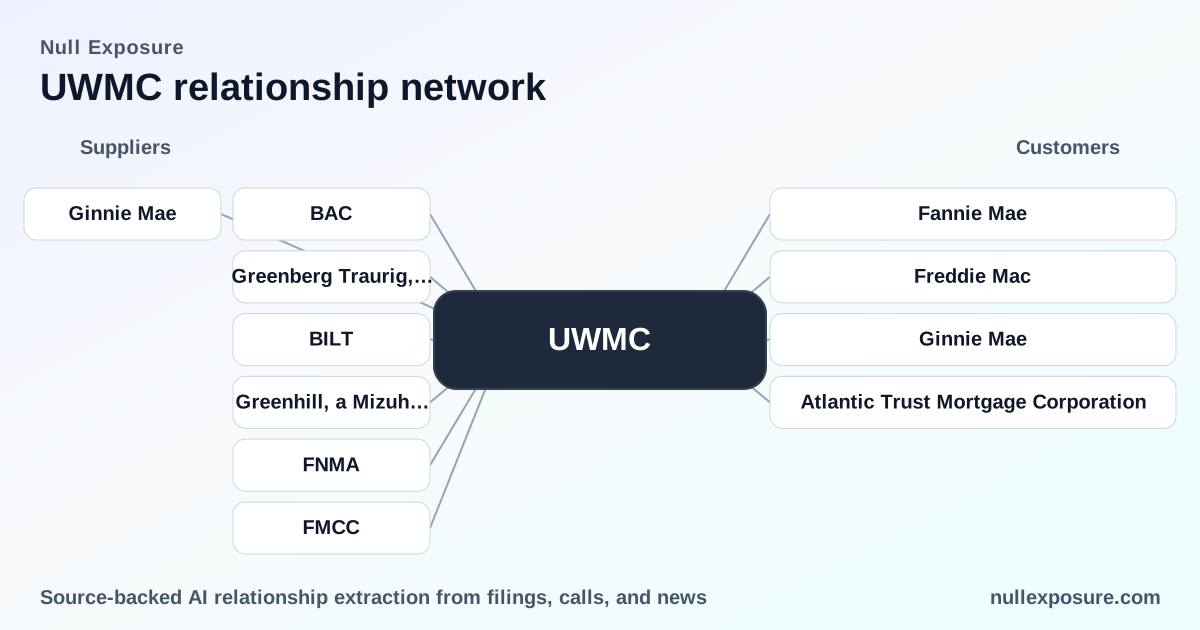
UWM Holdings originates, underwrites and processes residential mortgage loans and monetizes primarily by pooling and selling those loans into the secondary market, capturing origination and execution economics rather than long-duration mortgage credit risk. The company funnels the vast majority of production into agency channels (Fannie Mae, Freddie Mac and Ginnie Mae), with a smaller remainder in non‑agency jumbo and correspondent flows; those channel decisions are the dominant driver of revenue volatility, counterparty exposure and regulatory sensitivity for equity holders. For a concise view of UWM’s commercial relationships and what they imply for investors, read on or visit https://nullexposure.com/ for model-level context.
The business model in plain English: origination, sale and service economics
UWM runs a high-volume mortgage origination engine. It originates conforming and government loans nationwide, underwrites and packages them, then sells the loans into the secondary market—primarily to government-sponsored enterprises and government-backed pools—realizing fee income and servicing-related revenue rather than holding long-term credit. According to company filings for the year ended December 31, 2024, 89% of loans originated were sold to Fannie Mae or Freddie Mac or transferred to Ginnie Mae pools, with the remainder concentrated in non‑agency jumbo loans and other channels. That concentration shapes UWM’s contracting posture: counterparty dependence on government-sponsored buyers is a structural feature rather than a transitory one.
What the constraints tell you about operational characteristics
The company-level signals embedded in public disclosures reveal several operating constraints that investors should treat as core facts, not hypotheses:
- High counterparty concentration toward government channels. The 89% share sold into GSE/Ginnie channels reflects a deliberate, concentrated routing strategy that reduces loan inventory risk but increases policy and execution dependence on agency frameworks.
- National footprint. UWM originates conforming and government loans across all 50 states and DC, giving the platform broad geographic diversification of borrower exposure but consistent dependence on national mortgage policy and macro rate cycles.
- Services focus and maturity. UWM is organized around origination, processing and underwriting activities that feed the secondary market; this is a services-oriented, high-throughput business with mature agency relationships that determine settlement cadence, pricing and operational SLAs.
Together these constraints imply a contracting posture that is transactional and partner-dependent: UWM competes on execution speed, pricing and broker distribution while relying on external buyers for loan placement and liquidity.
The four customer relationships that matter, one by one
Fannie Mae — agency execution and pipeline sales
UWM originates conventional, agency‑eligible loans that it sells to Fannie Mae as part of its routine secondary-market distribution, making Fannie Mae a cornerstone buyer for the company’s conforming volume. This relationship is captured in company filings and public reporting covering FY2026 activity. (Source: Intellectia news report on Mat Ishbia share sale, March 10, 2026.)
Freddie Mac — a sister GSE and core purchaser
Freddie Mac functions alongside Fannie Mae as a primary destination for UWM’s conforming loans; UWM routes a large share of conventional originations to Freddie Mac under standard agency delivery conventions. The same FY2026 disclosures and market commentary describe UWM’s focus on agency-eligible pipelines destined for Freddie Mac. (Source: Intellectia news report, March 10, 2026.)
Ginnie Mae — government-guaranteed pool transfers
For government-backed loans (FHA, VA, USDA), UWM transfers production into Ginnie Mae pools for sale in the secondary market, relying on the government guarantee to enable efficient securitization and distribution. UWM’s public statements for FY2026 list transfers to Ginnie Mae pools as a key route for non‑conforming government product. (Source: Intellectia news report, March 10, 2026.)
Atlantic Trust Mortgage Corporation — broker channel interactions and litigation history
Atlantic Trust is a correspondent/broker counterparty that, in a contested period, submitted a material but limited volume of loans to UWM—10 loans during a trial period and a total of 87 submissions thereafter—illustrating the granular, relationship-level flows that feed UWM’s broker network. This interaction was documented in coverage of a broker exclusivity case during FY2025. (Source: MPA Magazine coverage of the Atlantic Trust case, FY2025.)
How these relationships translate into investor-relevant risks and advantages
- Concentration risk is real and visible. With 89% of production directed to GSEs and Ginnie Mae, UWM’s revenue stability depends on the health of agency sell-through mechanics and the company’s ability to meet agency delivery standards and pricing. That concentration is a risk if agency eligibility rules tighten or if pricing spreads compress.
- Counterparty criticality constrains pricing power. Dependence on large, institutional buyers means UWM competes on operational execution and scale rather than by assuming long-term credit exposure; operational performance and settlement reliability are as material as credit underwriting to margin outcomes.
- Geographic diversification moderates localized credit cycles. Nationwide origination reduces single-state risk but does not immunize the company from broad macro shocks—rate volatility and national housing corrections still move pipeline volumes and margins.
- Service-oriented maturity supports throughput economics but increases policy sensitivity. Investors should treat agency policy, regulatory changes, and investor sentiment toward GSEs as leading indicators for UWMC’s revenue trajectory.
Portfolio and stakeholder signals worth noting
- Institutional ownership is high (≈67%), reflecting active analyst and institutional interest in UWMC’s origination economics and rate-sensitivity exposures. Insider ownership is meaningful (~13%), which signals alignment of management with equityholders at the margin.
- Financial metrics show a large revenue base with modest net margins and significant operating leverage—characteristics consistent with high-volume origination businesses that scale fixed operations around pipeline flow.
If you are modeling scenario outcomes for UWMC, treat agency delivery rates, allowable product mix and national rate paths as primary drivers; operational execution metrics (turn times, buybacks, repurchase exposure) are the second-order drivers that determine realized margins.
For an investor-focused breakdown of counterparties and operational constraints, or to compare UWMC customer concentration against peers, visit https://nullexposure.com/ for in‑depth relationship analytics.
Bottom line for investors
UWM is fundamentally a high-throughput mortgage originator that earns fees by packaging and selling loans into agency and government-backed channels. The company’s commercial profile is defined by high counterparty concentration toward Fannie Mae, Freddie Mac and Ginnie Mae, a national origination footprint, and a services-centric operating model—all of which create distinct advantages in scale and distribution and distinct risks in terms of policy exposure and agency dependency. Investors should underwrite UWMC’s future performance primarily against agency delivery dynamics, secondary-market pricing and the company’s ongoing ability to manage broker and correspondent relationships.