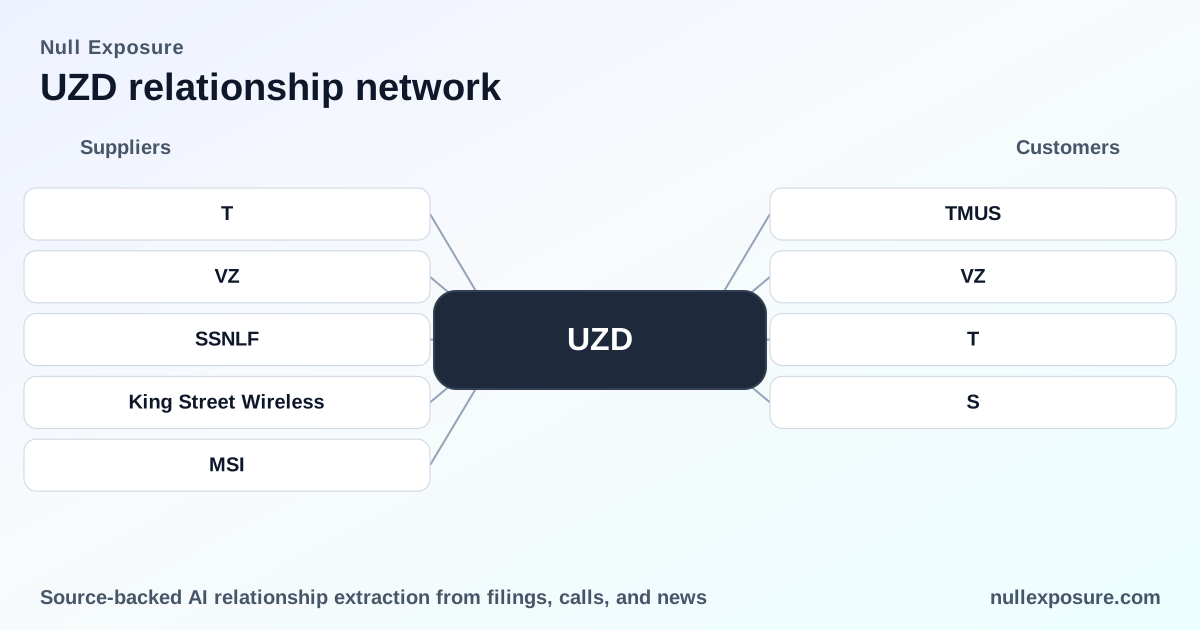
UZD (Array Digital Infrastructure, I): Spectrum sales and tower monetization drive near-term cash; asset-light services remain the core recurring hook
Array Digital Infrastructure (ticker: UZD) monetizes through two complementary channels: one-time or multi-stage asset monetizations (spectrum and network sales) to national carriers, and recurring tower and lease revenues from colocations and service contracts. Recent transactions with T-Mobile, AT&T and Verizon have accelerated cash realization from legacy wireless operations while the remaining infrastructure generates steady rental income and subscription service cash flows. For investors, the thesis rests on converting infrastructure ownership into durable cash yield while cycling large one-off proceeds into balance sheet optionality and dividend distributions.
Explore a concise map of counterparties and operational constraints below — and see how each relationship shifts UZD’s cash profile. For more, visit https://nullexposure.com/.
Quick read: how the counterparty list changes the story
UZD’s disclosed customer relationships show a clear strategic pattern: national carriers purchase spectrum and customer operations in large-ticket transactions, while UZD retains and monetizes tower assets through long-term leasing. The headline transactions with T‑Mobile, AT&T and Verizon are the primary drivers of recent cash inflows, while historical deals with Sprint illustrate precedent for market exits and localized divestitures.
- Big-ticket spectrum sales are the dominant near-term revenue drivers (multiple nine-figure transactions).
- Tower leasing and colocations underpin recurring service revenue and provide a predictable base.
- Contract mix combines long-term leases with short-term spectrum manager arrangements to ensure continuity for transferred customers.
Contracting posture and business-model constraints
UZD operates as a seller of spectrum and network operations and as a service-provider landlord for towers. The evidence supports several company-level signals: long-term leasing dominates tower revenues, with a weighted-average remaining lease term cited at 13 years, pointing to predictable cash flows from colocations. Simultaneously, UZD uses short-term spectrum manager leases to smooth customer transitions after divestitures — an operational concession designed to protect service continuity during ownership transfers; that arrangement explicitly provides T‑Mobile an exclusive license for up to one year at no cost. UZD’s customer base is concentrated in the United States, and the company serves consumer, business and government customers through both retail and digital channels. These features make the business a hybrid of asset-monetization events and recurring service receipts, with an elevated sensitivity to counterparty credit and the timing of spectrum closings. For more detail on counterparties and implications, see https://nullexposure.com/.
Line-by-line: every disclosed relationship and what it means for investors
T-Mobile — earnings call (2025Q4)
UZD disclosed that, in connection with the August 1 sale of wireless operations, it conveyed 30% of its spectrum to T‑Mobile and subsequently sold additional spectrum in August and October 2025 for total gross proceeds of $178 million. This is an explicit monetization of spectrum assets to a strategic consolidator. (Source: 2025Q4 earnings call, uzd-2025q4-earnings-call.)
TMUS — earnings call (2025Q4)
The company repeated the T‑Mobile disclosure under the TMUS ticker: 30% of spectrum conveyed and $178 million in proceeds from later agreements in 2025, confirming the same counterparty economics in multiple disclosures. (Source: 2025Q4 earnings call, uzd-2025q4-earnings-call.)
AT&T — earnings call (2025Q4)
UZD confirmed that it closed on a spectrum sale to AT&T in January 2026 valued at $1,018,000,000, representing a material liquidity event and transfer of network assets to a national carrier. (Source: 2025Q4 earnings call, uzd-2025q4-earnings-call.)
T — earnings call (2025Q4)
The AT&T disclosure is repeated under the T ticker, again noting the $1.018 billion spectrum closing in January 2026, underscoring that AT&T is a principal buyer in UZD’s divestment program. (Source: 2025Q4 earnings call, uzd-2025q4-earnings-call.)
Verizon — earnings call (2025Q4)
In the same earnings commentary, UZD stated it signed agreements to sell spectrum to Verizon in a transaction roughly valued at $1,000,000,000, positioning Verizon as another strategic acquirer of UZD spectrum. (Source: 2025Q4 earnings call, uzd-2025q4-earnings-call.)
VZ — earnings call (2025Q4)
The Verizon disclosure also appears under the VZ ticker, reiterating the near‑$1 billion spectrum sale and confirming the counterparty and magnitude. (Source: 2025Q4 earnings call, uzd-2025q4-earnings-call.)
Sprint — news report (FY2012)
Historical precedent: a 2012 news account reports that U.S. Cellular transferred spectrum rights in certain Midwest markets to Sprint for $480 million and exited those areas, showing UZD’s (formerly UScellular) willingness to divest regional assets to national carriers. (Source: ExtremeTech, FY2012 — reporting on the Sprint transaction.)
S — news report (FY2012)
The Sprint item is duplicated under the S ticker and confirms the $480 million Midwest-market transfer in 2012, a useful historical comparandum for how UZD handles market exits. (Source: ExtremeTech, FY2012.)
Verizon — news report (FY2024)
A FY2024 report from RCR Wireless notes that UScellular struck a deal to sell some remaining spectrum to Verizon for about $1 billion, aligning with later-formalized earnings disclosures and demonstrating persistent buyer interest. (Source: RCR Wireless, FY2024.)
TMUS — news report (FY2024)
RCR Wireless also reported that T‑Mobile planned to buy about 30% of UScellular’s spectrum plus subscribers and network assets for roughly $4.4 billion, framing the largest strategic transfer in the set of transactions. (Source: RCR Wireless, FY2024.)
Verizon — news report (FY2024) (duplicate)
The RCR Wireless item is also listed under the Verizon inferred symbol again, restating the ~$1 billion sale to Verizon reported during FY2024. (Source: RCR Wireless, FY2024.)
T-Mobile US — news report (FY2024)
RCR Wireless’ FY2024 coverage framed T‑Mobile as acquiring spectrum, subscribers and network operations (excluding company-owned towers) for around $4.4 billion, highlighting that UZD retained tower ownership in those deals — a structural outcome that supports ongoing tower rental revenue. (Source: RCR Wireless, FY2024.)
TMUS — industry news (FY2024)
WirelessEstimator’s FY2024 coverage reiterated that T‑Mobile agreed to acquire a significant portion of UScellular’s spectrum assets and customer base, reinforcing the strategic consolidation narrative. (Source: WirelessEstimator, FY2024.)
T-Mobile — industry news (FY2024) (duplicate)
The same WirelessEstimator piece appears under the T‑Mobile label and confirms the T‑Mobile acquisition of spectrum and customers, consistent across industry reporting. (Source: WirelessEstimator, FY2024.)
Key takeaways for investors
- One-off monetizations are material and front-loaded. The AT&T and Verizon closings (~$1.0B each) and the multi-stage T‑Mobile transactions (including the $178M tranche and the larger $4.4B framework reported in industry press) fundamentally reshape UZD’s near-term cash profile.
- Towers are the recurring backbone. UZD retains tower ownership and collects long-term lease and colocation revenues — supported by a 13-year weighted average remaining lease term in principal tower lessor arrangements — providing a predictable income base even as spectrum assets are sold.
- Contract mix is deliberate. UZD uses both long-term leases and short-term spectrum-manager arrangements (explicitly granting T‑Mobile temporary, exclusive use for up to a year) to protect continuity for transferred customers while realizing value from asset sales.
Bottom line
UZD has executed a deliberate conversion of wireless operating assets into cash via strategic sales to national carriers while preserving recurring tower and service cash flows. Investors should value UZD as a cash-yielding infrastructure holder with episodic large proceeds that change the balance-sheet and distributable cash profile. For a consolidated view of counterparties and ongoing disclosures, visit https://nullexposure.com/.
Bold takeaway: the combination of material spectrum exits and long-dated tower leases creates a hybrid profile — transient top-line monetizations with durable, predictable rental income underneath.