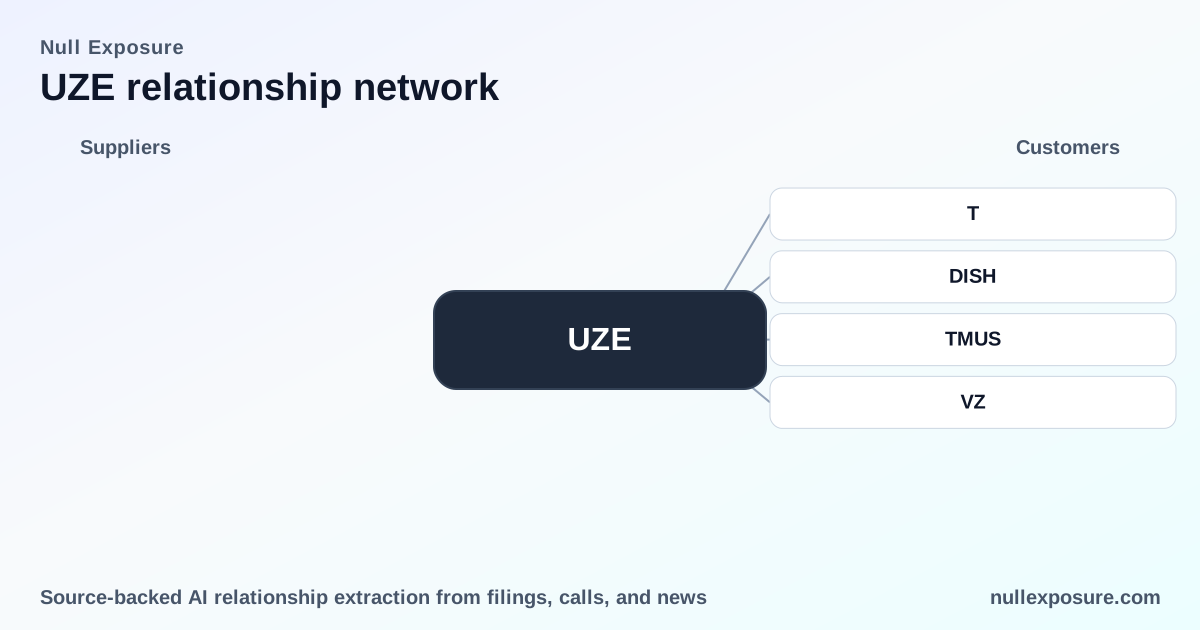
UZE: Counterparty Map and Commercial Dynamics that Drive the Preferred
United States Cellular Preferred 5.500% (UZE) provides a fixed-income exposure to an operator that historically monetizes through monthly subscription wireless revenue, tower leasing, device sales, and strategic spectrum monetization and licensing — with the preferred secured by the issuer’s balance-sheet capacity and dividend commitment. The company’s recent asset dispositions and spectrum license agreements reposition counterparty risk from retail subscribers toward large national carriers that are buying or licensing spectrum and tower access; investors should treat UZE as a play on steady coupon cashflow backed by an operator that is de-emphasizing retail operations in favor of asset monetization. For a quick reference on coverage and related research, visit https://nullexposure.com/.
One-line thesis: asset monetization converts operating exposure into large-counterparty credit
U.S. Cellular’s commercial posture is shifting: instead of deriving most value from customer ARPU growth, management is accelerating monetization of spectrum and infrastructure to large incumbents and resellers, which changes concentration and counterparty profiles in ways that benefit fixed-dividend holders if proceeds are used to defend the preferred. Key commercial drivers are recurring subscription billing, tower leasing, device resale, and spectrum licensing/sales to national carriers.
Who U.S. Cellular is transacting with — the short list investors need
Below I summarize each counterparty reflected in the UZE customer/relationship signals and cite the underlying source for the claim.
-
AT&T (T) — U.S. Cellular sold spectrum in a large, billion-dollar transaction that closed in January 2026, representing a direct monetization of spectrum assets to a major national carrier. According to the 2025 Q4 earnings call transcript, Array Digital Infrastructure closed the announced spectrum sale to AT&T for $1,018,000,000 (UZE 2025 Q4 earnings call, March 2026).
-
Verizon (VZ) — Verizon is a buyer of leftover spectrum holdings after U.S. Cellular’s strategic asset sales; management disclosed agreements that included Verizon in separate transactions priced at roughly $1 billion. The company’s 2025 Q4 earnings call confirms signed agreements to sell spectrum to Verizon for approximately $1,000,000,000 (UZE 2025 Q4 earnings call, March 2026). A LightReading recap of the FY2025 activity also references Verizon acquiring leftover spectrum (LightReading, 2025).
-
T-Mobile (TMUS) — In connection with the sale of U.S. Cellular’s wireless operations, 30% of the company’s spectrum was conveyed to T‑Mobile; the closing also involved short-term exclusive licenses that allow T‑Mobile to operate on certain U.S. Cellular spectrum for continuity of service. Management disclosed the 30% conveyance on the 2025 Q4 earnings call, and the Securities Purchase Agreement details a Short‑Term Spectrum Manager Lease providing T‑Mobile an exclusive license to use certain spectrum assets at no cost for up to one year (UZE 2025 Q4 earnings call, March 2026; Securities Purchase Agreement language cited in company filings).
-
DISH / Dish Network / DISH Wireless — U.S. Cellular has an operating relationship with DISH in the form of a Master Lease Agreement (MLA) that provides DISH access to thousands of owned towers, and U.S. Cellular’s public comments indicate a dispute over DISH’s contractual obligations under the MLA. The 2025 Q4 earnings call quoted management asserting that DISH’s assertions are “without merit” and that DISH’s obligations under the MLA remain intact (UZE 2025 Q4 earnings call, March 2026). Earlier reporting described the MLA granting DISH access to U.S. Cellular’s ~4,270 towers (WirelessEstimator article, 2021).
Each of the four counterparties above is present in the record set and is supported either by the UZE 2025 Q4 earnings call or by contemporary press coverage (see referenced call and articles).
What the relationship map implies for contracting posture and concentration
-
Contracting posture: mixed licensing plus subscription. U.S. Cellular continues to collect monthly billed subscription revenue from retail, business, and government customers, while simultaneously executing large spectrum sales and short-term exclusive licensing arrangements with national carriers. The company’s filings expressly describe monthly billing for wireless services alongside short-term spectrum manager leases that grant exclusive use to T‑Mobile for up to a year (company disclosures cited above).
-
Concentration and counterparty shift. Historically the business was diversified across millions of retail connections; recent transactions transfer material economic exposure to a small number of large carriers (AT&T, Verizon, T‑Mobile, DISH). That reduces retail revenue concentration risk for the parent but increases counterparty concentration risk tied to how these national carriers perform and meet contractual obligations.
-
Criticality and asset-backed resilience. U.S. Cellular’s core assets — licensed spectrum and tower portfolios — are strategically valuable to national carriers seeking incremental capacity, which makes these assets highly critical and liquid in the M&A/spectrum markets. This criticality supports valuation for asset sales that can be used to cover fixed dividends on preferred securities.
-
Maturity and business model evolution. The company operates in a mature U.S. telecom market and is shifting from operating a retail-centric wireless operator toward an asset-focused model (infrastructure and spectrum monetization). For preferred holders, maturity plus asset sales creates a clearer path for dividend support assuming proceeds are deployed to preserve capital structure stability.
Service mix and customer segmentation — how U.S. Cellular actually makes money
Company-level signals indicate revenue is generated across several segments: subscription services (monthly wireless billing), hardware (handsets and mobile devices sold directly and through resellers), and infrastructure (tower leasing to third-party carriers). Management statements and filing excerpts specifically describe resale channels for devices, direct and indirect sales to medium and large enterprises and government entities, and leasing tower space to third parties (company filings and earnings commentary).
Risk considerations that change with counterparty composition
-
Counterparty performance risk is now concentrated in a handful of national carriers; any dispute (for example the public disagreement with DISH over MLA obligations) could impair cash collection or future licensing revenue. The 2025 Q4 call shows management publicly contesting DISH’s position while citing the MLA as a material arrangement (UZE 2025 Q4 earnings call; WirelessEstimator 2021).
-
Execution risk on asset divestitures. The $1B‑scale spectrum transactions with AT&T and Verizon and the conveyance to T‑Mobile crystallize near‑term cash but also reduce long‑term operating scale; investors in UZE should evaluate how proceeds are allocated between debt reduction, dividend coverage, and restructuring cost absorption (earnings call disclosures, March 2026).
-
Operational continuity risk during transition. The short-term exclusive licensing to T‑Mobile for continued service continuity transfers operational dependency for customers to a third party during the handover period — a transition that is contractual in nature and spelled out in the purchase and spectrum manager lease language.
For a concise commercial mapping and ongoing monitoring of these relationships, the UZE coverage page at NullExposure provides curated signals and summaries: https://nullexposure.com/.
Bottom line: preferred security backed by monetizable, strategic assets
-
UZE pays a fixed 5.50% coupon tied to an issuer that is actively selling or licensing valuable spectrum and tower assets to large national carriers. Those transactions lower retail operating exposure but increase counterparty concentration risk tied to a few national buyers (AT&T, Verizon, T‑Mobile, DISH).
-
For income-focused investors, the security’s resilience depends on prudent use of sale proceeds (deleveraging and dividend coverage) and the enforceability of licensing/lease agreements during the transition.
-
Monitor three things: progress on spectrum sale proceeds and capital allocation; outcomes of the MLA dispute with DISH; and the short‑term licensing execution with T‑Mobile as documented in transaction agreements and the 2025 Q4 disclosures.
If you want deeper counterparty analytics, scenario modeling, and alerts tied to these specific counterparties and contractual events, check our research hub at https://nullexposure.com/.