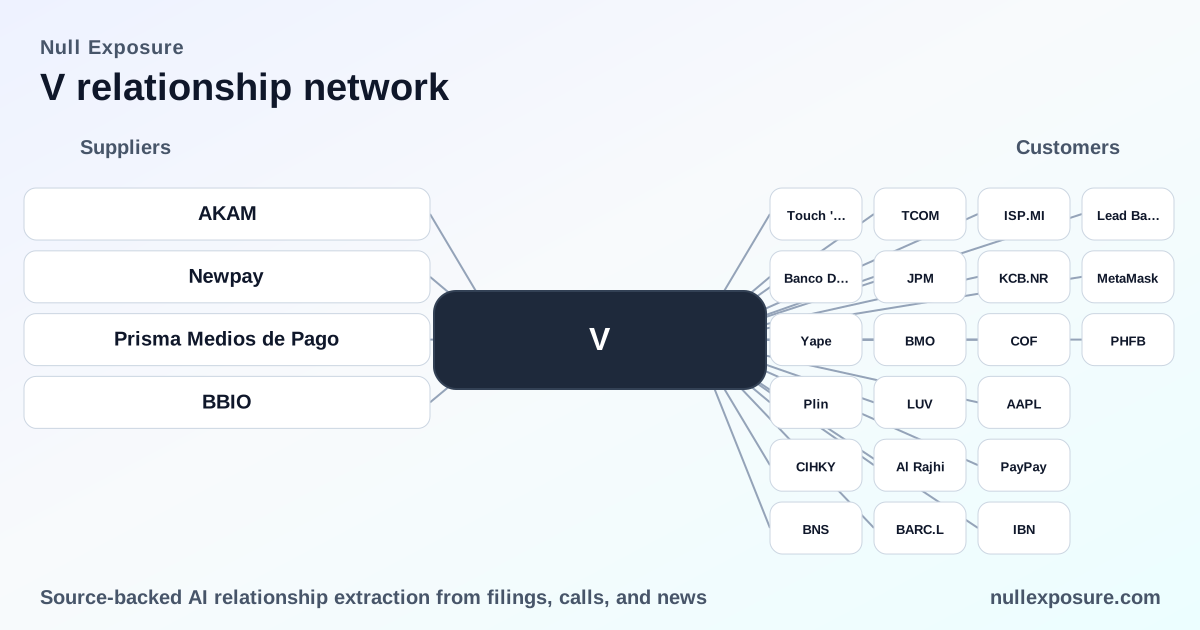
Visa (V) — customer relationships and why they matter to investors
Visa operates the global payments network VisaNet and monetizes primarily through transaction processing fees, value‑added services (fraud and risk tools, tokenization), and long‑run client incentive and licensing arrangements with banks, fintechs and large merchants. Its revenue lever is scale: greater transaction volume and deeper service adoption drive high-margin, recurring cashflows. Learn more at https://nullexposure.com/.
How Visa’s operating model shapes its commercial footprint
Visa is a network provider in a four‑party system: it sits between issuers, acquirers, merchants and consumers as a transaction router and product licensor. That posture creates two structural dynamics for investors: (1) high criticality but limited direct credit risk—clients depend on Visa’s rails for acceptance and settlement; (2) contract and incentive concentration—Visa carries material client incentives (roughly $10.6 billion in related liabilities as of September 30, 2025), which is evidence of deep, multiyear commercial commitments and a need to manage renewals and margin dilution. Corporate disclosures also flag regional legal exposure (EMEA litigation and a U.S. merchant class settlement), reinforcing that regulatory and merchant disputes are persistent operating risks.
- Geography and scale: Visa’s footprint is explicitly global (200+ countries) with meaningful North American and EMEA exposures, which influences pricing power and litigation posture.
- Relationship posture: Visa acts both as a buyer of technology partners and a service provider to issuers and platforms; most relationships are active and mature.
- Commercial economics: the company’s core product is transaction processing; services (risk, tokenization, Visa Direct) are growing margin drivers. The balance of steady transaction economics plus expanding services is the primary valuation argument for investors.
If you track issuer and fintech partner renewals as leading indicators for Visa’s nets, you can find a concise feed of customer developments at https://nullexposure.com/.
What Visa’s recent customer announcements tell investors
Below is a compact, plain‑English roundup of every customer relationship cited in the source material, with one‑ to two‑sentence descriptions and source context.
- Plin — Visa renewed relationships with Peru’s Plin after YellowPepper drove interoperability, reinforcing Visa’s position in Peruvian instant payments (Visa 2025 Q4 earnings call, Mar 2026).
- Yape — Visa renewed interoperability with Yape in Peru via YellowPepper acquisition benefits, supporting local transaction leadership (Visa 2025 Q4 earnings call, Mar 2026).
- Banco Diners — Banco Diners in Ecuador deployed Visa’s network‑agnostic scoring to process both Visa and non‑Visa transactions, a first in the region (Visa 2025 Q4 earnings call, Mar 2026).
- Touch 'n Go eWallet — Malaysia’s largest wallet will use Visa Direct to let tourists fund wallets across eight corridors, expanding Visa Direct reach in Southeast Asia (Visa 2025 Q4 earnings call, Mar 2026).
- BurgerFi / Anthony’s (BFIIW) — A co‑branded Visa loyalty card offering 3% cashback was launched for the restaurant chain (Restaurant Dive press release, FY2022).
- Capital One prefs (COF‑P‑I / COF‑P‑J / COF‑P‑K / COF‑P‑L) — Various Capital One disclosures note benefits and historical reliance on Visa services for product features; Capital One’s broader strategic moves (Discover deal) could reallocate volume over time (industry coverage, FY2024–FY2026).
- China Merchants Bank (CIHKY) — One of Visa’s largest clients in Mainland China renewed and is upgrading dual‑branded magstripe cards to contactless EMV chips under Visa’s program (Visa 2025 Q4 earnings call, Mar 2026).
- Deluxe (DLX) — Deluxe partnered with Visa to launch dlxFastFunds, leveraging Visa Direct to provide near‑real‑time settlements for businesses (company announcements and news coverage, FY2026).
- Freightos (CRGO) — Visa selected Freightos as a partner to address cross‑border freight payments, signaling Visa’s interest in embedding payments into B2B logistics (Trip.com/InsiderMonkey reports, FY2025).
- OBOOK / OwlTing (OWLS) — OwlPay Cash, developed with Visa and Cross River integration, targets remittances across high‑volume corridors using Visa Direct (press releases and filings, FY2025–FY2026).
- Auburn National Bancorp (AUBN) — The bank issues Visa Checkcards and reports that those cards can be used internationally, showing continued issuer reliance on Visa acceptance (company filings, FY2026).
- Fold Holdings (FLD) — Fold formalized partnerships with Visa and Stripe for a Bitcoin rewards card, using Visa rails to deliver crypto rewards through conventional card rails (company announcements, FY2025–FY2026).
- Paysign (PAYS) — Paysign distributes Visa‑branded reloadable cards and digital solutions by partnering with major payment networks (market commentary, FY2026).
- Wells Fargo prefs (WFC‑P‑A) — Product descriptions note acceptance “anywhere Visa Credit is accepted,” reflecting Visa’s ubiquity referenced in issuer materials (industry reporting, FY2021).
- China Merchants Bank duplicate (CIHKY) — Renewal and EMV upgrade noted again (Visa 2025 Q4 earnings call, Mar 2026).
- BMO — Visa expanded its enhanced spend management capabilities with BMO, extending commercial spend products to the issuer (Visa 2025 Q4 earnings call, Mar 2026).
- Scotiabank / BNS — Visa won Scotiabank’s wealth management credit card issuance across seven Latin American countries with Visa Infinite (Visa 2025 Q4 earnings call, Mar 2026).
- Southwest Airlines (LUV) — Visa is the exclusive payment network for Southwest’s co‑brand program and is expanding the relationship into a co‑brand debit offering (Visa 2025 Q4 earnings call, Mar 2026).
- Trip.com (TCOM) — Visa won Trip.com’s global virtual travel card issuing business, to be issued through TripLink fintech (Visa 2025 Q4 earnings call, Mar 2026).
- Copa Holdings (CPA) — Copa acknowledged a Visa agreement renewal in recent quarters, reflecting continued airline co‑brand activity (earnings transcripts, FY2025).
- Cullen/Frost (CFR) — Company filings disclosed an annual Visa volume bonus (approx. $5.4M), illustrating issuer incentive programs (earnings call transcript, FY2026).
- Western Union (WU) — Western Union is rolling a Western Union Visa Stable Card and working with Visa on a U.S. stable card pilot, expanding remittance product choices (earnings call coverage, FY2026).
- ZK International / xSigma (ZKIN) — xSigma Wallet will include an xSigma‑branded Visa credit card enabling crypto fiat on‑ramps via Visa rails (news reports, FY2025–FY2026).
- Al Rajhi — Al Rajhi expanded Visa Direct usage from card payouts to account deposits, deepening remittance capabilities in Saudi Arabia (Visa 2025 Q4 earnings call, Mar 2026).
- Barclays (BARC.L) — Visa renewed an almost 60‑year relationship with Barclays across large issuer and acquirer footprints in the U.K. and U.S. (Visa 2025 Q4 earnings call, Mar 2026).
- Intesa Sanpaolo (ISP.MI) — Visa supported large‑scale marketing and contactless product campaigns, including Olympic/Paralympic promotions (Visa commentary, FY2025–FY2026).
- KCB (KCB.NR) — KCB will use Visa Direct to account across eight corridors for its >30 million customers, showing Visa Direct scale in East Africa (Visa 2025 Q4 earnings call, Mar 2026).
- Intercorp Financial Services / Izipay (IFS) — Izipay accepts Visa alongside other platforms after corporate restructuring; Visa is embedded in Peruvian merchant acceptance (regional press, FY2022).
- Intermex (IMXI) — Intermex expanded integration with Visa Direct to enable customers to send funds to eligible Visa debit cardholders in multiple countries (company release, FY2023).
- ICICI Bank (IBN / India) — Visa won a de novo issuing relationship with ICICI for India’s first corporate FX prepaid card, leveraging Visa’s FX capabilities (Visa 2025 Q4 earnings call, Mar 2026).
- Bank of Hawaii (BOH / BOH‑P‑A) — Bank disclosures reference charges and adjustments related to Visa B conversion ratio changes, underscoring accounting interplay with network programs (earnings transcripts, FY2025–FY2026).
- AmeriServ (ASRV) — AmeriServ recognized a $250k signing bonus from a Visa contract renewal in 2024, illustrating small‑bank incentive flows (company release and filings, FY2024–FY2025).
- Camden National (CAC) — Annual Visa incentive bonuses are material to noninterest income for regional banks such as Camden (press release and filings, Q4 2025).
- First United (FUNC) — Debit card income increases were attributed to receipt of an annual Visa cash incentive (company filings, FY2025–FY2026).
- The Bancorp Bank (TBBK) — The Bancorp is a top issuer of Visa‑branded prepaid cards in the U.S., demonstrating Visa’s embed in the prepaid market (bank reporting, FY2023).
- Toronto‑Dominion (TD) — TD launched Virtual Card Numbers for TD Visa holders, leveraging Visa product features (bank product news, FY2026).
- Apple / Apple Pay (AAPL) — Visa supported the launch of Apple Pay in India and related contactless enablement (industry coverage, FY2026).
- PayPay — Visa participation is noted in Asian wallet and investor moves tied to SoftBank’s PayPay expansion (industry reporting, FY2026).
- ServiceNow (NOW) — News coverage highlights collaborations with Visa that deepen ServiceNow’s footprint in financial services (industry commentary, FY2026).
- Plutus (PLUT) — Plutus offers a Visa debit card that awards crypto rewards, showing fintechs using Visa rails for hybrid crypto‑fiat products (company interviews, FY2021).
- Dave (DAVE) — Dave’s banking service and debit transactions leverage Visa rails as a primary revenue channel for interchange and related services (profile pieces, FY2021).
- AMC — Commentary references an AMC Visa credit card program as a source of revenue uncertainty, reflecting retailer co‑brand volatility (investor forums, FY2026).
- Chime (CHYM) — Chime’s secured Visa credit card is issued by partner banks under Visa license, an example of fintech issuers using Visa license arrangements (industry reporting, FY2026).
- Urban One (UONE) — Urban One’s One VIP Visa Prepaid Card is issued under license by an FDIC bank, illustrating media brands entering payments through Visa licensing (industry press, FY2020).
- Despegar (DESP) — Despegar launched a co‑branded credit card in Brazil with Santander and Visa to deepen loyalty monetization (press coverage, FY2020).
- BBVA Argentina (BBAR) — BBVA marketed Visa virtual credit card functionality and installment offers for consumers, reflecting issuer product features (regional travel coverage, FY2025).
- Priceline (PCLN) — Priceline promoted a VIP Rewards Visa card with travel discounts and offers, showing merchant/partner card programs built on Visa rails (press release, FY2022 & FY2025).
- Sportsman’s Warehouse (SPWH) — A successful Visa co‑branded credit card program has materially supported the retailer’s loyalty economics (industry reporting, FY2022).
- Alaska Air (ALK) — Alaska’s Atmos Rewards credit card is issued and administered by Bank of America on the Visa platform (press release, FY2026).
- Other issuer and fintech mentions (ALTS, AMC, BMA, BOH duplicates, BRCB, CAC duplicates, multiple small banks and prefs) — Numerous regional banks, fintechs and specialty issuers reference Visa for debit/prepaid/credit issuance, incentive bonuses or technical integrations across the FY2020–FY2026 period (company filings and news coverage compiled across FY2020–FY2026).
Investment implications — what to watch next
- Retention and renewals: several large renewals (China Merchants Bank, Barclays, Scotiabank, Southwest) validate Visa’s durable issuer relationships; investors should track renewal cadence and incentive intensity.
- Visa Direct adoption: wins with KCB, Al Rajhi, Touch 'n Go and OwlPay demonstrate commercial traction for push‑payments and remittances — an incremental revenue and stickiness vector.
- Regulatory and litigation exposure: EMEA merchant litigation and U.S. class actions are ongoing constraints; legal outcomes can alter pricing dynamics or business rules.
- Incentive liabilities: the $10.6B+ in client incentive obligations is a structural economics factor; rising incentives can cap near‑term margin upside even as services grow.
Bottom line
Visa’s customer roster spans global banks, regional issuers, fintechs, remittance firms and branded co‑brands. That breadth is Visa’s moat: universal acceptance and deep issuer integration create a durable, high‑margin cash flow profile — but investors must monitor incentive commitments and regulatory pressures as the principal levers of margin and risk.
For a searchable, exportable view of these relationships and source links, visit https://nullexposure.com/.